Showing posts with label recollections. Show all posts

24 May 2014

Last of the Jims

I can think of three dates that determined the outcome of these 43 years I have spent so far on this wonderful green globe:
  • 22 May 1997 I became a father.
  • The weekend of 3-7 May 1991 Destiny thrust me into the great love of my life
  • In January of 1984, just a few weeks shy of my 13th birthday, I moved from Amesville, Ohio, to Portland, Tennessee. 
Uprooted in the middle of 7th grade, I was planted in a new school, a new community. The experience marked me for life--my best friends and my boyhood were boxed up back at home--a place I tell my kids was "the Magical Land." My awkward teenage years and the longest chapters in the unwritten book, JD's Book of Blunders, would take place in a strange land of Tennessee.

A story from those first days in Tennessee came back to mind this week, when I learned that my classmate at Highland Elementary, James "Bobo" Ayers, had passed away due to cancer. Like me, he was 43.

I have always had a problem with my name. Growing up, my family called me "JD," which always seemed like a baby name to me. To make things worse, my mom tells the story that the name had been given to me while I was still in utero, given by a man who assumed I would be "Junior Dittes."

When I was ready for 1st grade, I came up with a plan. I was going to leave "JD" behind and become "Jimmy." I remember writing "Jimmy" over and over on my wide-lined, elementary writing book, curling the y's this way and that. It didn't phase my parents--nor did it seem to matter to the other seven kids in the one-room Adventist school I attended.


28 January 2011

On Turning Faustus

Birthdays are wonderful times for reflection--and none more so than the decades. I've been trying to prepare myself for "40" for weeks now. But as the days have ticked down to my 40th January 28th on planet Earth--to be followed, hopefully, by my 40th January 29 and 30--I've been thinking more about Faustus than 40.

Here's why. (Pardon my self-indulgence. I promise to keep it under wraps for another ten years.)

Faust is a German legend about a man with an unquenchable thirst for knowledge. It is original tellings, Faust was a brilliant but doomed wizard, the draw of the story was the magic and demon, Mephistophiles, Satan's right-hand man.

The Faustus story benefited from two retellings in particular. At the height of the English Renaissance, Christopher Marlowe wrote the play, "The Tragical History of Dr. Faustus." His main character was a Renaissance Man who had mastered law, medicine and logic--a man who found magic to be the only study that still interested his teeming mind.

At the dawn of European Romanticism, Johann Wolfgang von Goethe penned Germany's greatest play, "Faust." Again, knowledge was the goal, magic was the means: only this time the growth of The Enlightenment was the writer's canvas.

I find myself, therefore, entering a new age (pardon the pun), thinking more of Faustus than 40.

I can trace it back to a dream I had in 1990, just one month before I turned twenty. I was traveling Europe at the time on a Eurail pass, sleeping on trains, in youth hostels, at the homes of long-lost relatives.

I dreamed I was hitchhiking--a skill I had been taught by none other than Jenny George, a.k.a. "future bride." The person who picked me up wasn't Jenny, it was another girl--a girl I had loved in academy. As we drove, we talked, and as we talked I flirted, knowing somewhat disconsolately how badly our relationship had ended.

I realized that she had grown quiet, staring ahead at the road. I gave up flirting, and asked her the question I had asked her three or four times a day over the last month of our relationship: "What's wrong?"

"You're different," she said. "I mean, you were different before...when you were at home...but now you have been around the world. I really don't know what to think of you anymore--no one does."

I turned away and looked away out the window. I groaned. As I remember, I was groaning as I awoke a few seconds later. While I do not remember whether I awoke on a train or in a bed, I have never forgotten that dream. It informed the next twenty years of my life (so far).

When she had rejected me the first time, I was very much a creature of my culture: I was white, religious, Southern. In other words, I was a Republican--a George W. Bush voter in waiting. Fortunately my curiosity was stronger than my chauvinism, and I flew to England after one year in college.

When she rejected me the second time--in the dream--I couldn't have understood the changes that had begun in England. They wouldn't be apparent until I had returned to the bastion of small-mindedness that was my American college. The seed was there; I think that's why I had the dream.

I think of the way that seed grew throughout my twenties. I returned to the United States to find a much smaller group of friends willing to accept my socialism, my antipathy toward borders, my boundless desire for adventure, but there were enough--and there was Jenny George, the woman--the mate--who shared every dream, every adventure, every spiritual longing. Thank God that Jenny knew what to think of me.

As I neared 30, the dreams petered out. We were stranded in Albania and shut out of Pakistan, returning to Tennessee in January of 2000 to follow Jenny's call into rural medical practice in Westmoreland. When I turned 30 in 2001, I was jobless, staying home with Ellie and newborn Owen. I was hungry for knowledge, for power. I think that's when Faustus stepped in.

I know of no Mephistophiles, and I want to assure my reader that I have signed no blood oath, there is no 24-year contract for my soul that ends with me descending into hell.

I hungered for knowledge. I would walk with Ellie to the Westmoreland library and read everything I could get my hands on: religion, physics, history, engineering, war, etc. I wrote manuscripts. I went to graduate school, getting my Master's in Public Administration. I became someone who threw himself into researching any project to the hilt: whether it was a road trip, a new business venture, or an inspiring text in scripture. (Sadly, I never found a way to profit from these impulses toward expertise.)

For example, in recent years I have become literally addicted to the "webinar," an online course--usually free--that instructs educators or illustrates new technologies. Last week--during a snow break, no less--I decided to get certified in Google Apps for Education. I am any teacher's best student--I'll listen to a lecture, research the heck out of it, and return to the instructor with ideas how to implement the ideas even further!

Yet the hunger for knowledge only takes me back to that dream of twenty years ago. Learning doesn't unite people, it divides them. The questions that we ask when we reunite with friends aren't "What have you learned?" or "Have you changed?" It is quite the opposite. When people ask you a question, and you can respond with five to eight thousand words, it doesn't endear you to them. Knowledge is a threat to a relationship; ignorance is--after all--bliss.

Should I care? I confess that when I meet indifference, I'm compelled to reach further, read even more, research my way out of a problem. I'm not out to impress anyone, so I can't really feel rejected. I'm only hoping to learn more and more and--why thank you--even more.

"I don't know what to think of you anymore." I can hear the words and see the frustrated look on the girl's face even today, more than twenty years after they spoke into my dream.

The words haunt me, bittersweet like beauty that breaks the heart. I want her to care--I crave the acceptance that high school friends offered in exchange for conformity, in exchange for thinking, acting, celebrating and worshiping in a defined, conservative, Southern space. I want that protecting shell.

I'm 40. I'm Faustus. I didn't sell my soul--I sold my shell so that my spirit and my mind could break free. And that fact brings me closer--both to Heaven and to Hell--that I ever could have dreamed.

19 September 2010

Evolving Faith: a Reflection and a Book Review

I grew up fundamentalist in the South.

That's a simple sentence that tells a lot more about me that I would like to admit. It implies the type of education I received, the way I spent much of my time as a youth, my hopes, my fears, even the age I lost my virginity.

It is also a simple sentence that appalls me. It implies many things that I'm not: intolerant, obese, gun-owning and Republican. Sure, I grew up fundamentalist in the South, but I didn't have to stay that way.

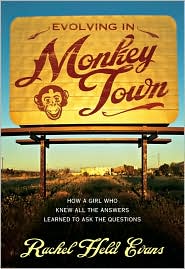
This weekend Jenny and I listened to Rachel Held Evans's memoir Evolving in Monkey Town: How a Girl who Knew All the Answers Learned to Ask the Questions. We loved it because it described a faith journey similar to ours, but also because Evans is such a vibrant writer, a woman who is able to condense tough ideas into clever phrases like, "If someone says that they follow the gospels to the letter, they're either lying or homeless."

Evans's biography reads so much like mine: her father was a preacher (check) who sent her to Christian schools (check) and on to a Christian college (check) where she majored in writing (check) and began to ask questions that would challenge the pillars of fundamentalism she had grown up with (check).

But Evans's story differs from mine in many ways, too. I find in it many of the same questions, many thoughtful answers, and insights into a culture both different from and similar to the Seventh-day Adventist culture of my youth.

Evans grew up trying to "prove" her faith in a society that was hell-bent on rejecting it. Even in high school, she was obsessed with Christian apologetics and soul-winning. I really related to the intellectual hunger that drives a lot of young fundamentalists into this branch of Christianity.

Most happy fundamentalists see "Truth" as a tank that reads "full." They load up on doctrines and master the proof texts for these doctrines. Then they have two options: (a) fill others up with texts and doctrines, or (b) man the barricades and take down anyone who might challenge the texts or question whether the tank is big enough. After all, the Truth that fills a one-gallon jug looks awfully small in a 100-gallon drum.

Evans's world needed a bigger drum once she saw the recorded execution of an Afghan woman in the weeks leading up to war in late 2001. She had grown up with the understanding that only Christians--the "right kind of Christians" at that--were saved. Everyone else would go to hell. She couldn't understand how a woman so victimized by injustice in this life could also be sentenced to eternal suffering because she was Muslim; she didn't know Christ. This leads Evans to use the phrase "genetic lottery" to describe why she was a Christian (born in the South, Christian parents) and others were not.

Her experience in a hell-believing church was quite a contrast to mine. Adventists are so heaven-focused that they rarely talk about hell (there is no eternally burning hell in their understanding, but an eternal separation from God). Still, I grew up wondering, "Am I going to heaven? Is that person going to heaven?" I have to say that I'm glad I didn't grow up with these horrors.

I always assumed that I grew up in the most strict, Bible-focused church in Christendom. There was the whole worship on Saturday thing, including no "worldly" activities from sundown Friday to sundown Saturday. I was vegetarian. I didn't drink caffeine. I had to sneak to the next county if I wanted to watch a movie like Star Wars. And I was lucky. I got to read novels. I could eat cheese and drink milk, unlike some of my more restricted fundamentalist friends.

But now I look at kids who grew up Missionary Baptist, Church of Christ, or other fundamentalist denominations/non-denominations, and I think, wow, I got off lucky. I didn't have politics shoved down my throat from the pulpit (until the Clinton Administration, Adventist services were thankfully apolitical). I wasn't forced to imagine hell in all its fury. I wasn't spoon-fed backwards views about women. I am so grateful for that.

Evans finds solace in two surprising thoughts:
  • First, she spent a summer rooting her faith in the gospels. She returned to Jesus, and she made him the center of her resurgent faith. Battles over evolution, climate change, Republican vs. Democrat, culture wars, etc. may yield short-term gains for some Christians, but they take us further and further from the Author and Finisher of our Faith. Christians are called to act like Christ, not act like Levites, Corinthians or Pharisees.
  • Second, she seizes on the idea of 'evolving faith.' It's obvious that Christianity has evolved over time, adjusting to times of oppression, then rule; war then peace. Christians who have adapted to revelations in science and polity have survived; Christians who have refused to adapt have disappeared. Compared to other religions that were focused primarily on race or ruling families, Christianity has also endured.
Five years ago Jenny and I found a faith home in a mainline denomination. It was a huge change for us at the time, but looking back, it was the step we needed to grow in faith and put Christ's teachings at the center of our lives. There is very little to miss about fundamentalism--other than the wonderful friends we have who remain in that denomination.

I don't know that I have 'evolved' in the way that Evans describes. I was always a Christian, not a denominationalist. I see the sea change in my church attendance as an affirmation, not an evolution, of the faith into which both Jenny and I had grown. The idea of 'evolving' in faith brings me to one word that seemed to hang over this book, but one which Evans never mentioned: post modernism.

I want to close with a note about Evans's home town, Dayton, Tennessee. Dayton's claim to fame is the Scopes Monkey Trial of 1925, the high water mark of 20th-century Christian fundamentalism. In a trial outside the courthouse there, lawyer Clarence Darrow of the American Civil Liberties Union eviscerated the testimony of William Jennings Bryan, who had tried to defend literalistic interpretations of the Bible and prosecute John T. Scopes for teaching evolution.

I traveled to Dayton with my dad in 2000 to write an article on the 75th Anniversary of the Scopes Trial for Adventist Review. Dayton is an amazing place--especially for anyone who has a background in the culture wars. It is a battlefield, and a visit there raises many of the same questions and allegiances that a visit to Gettysburg or Normandy might do. I remember touring the museum in the bottom of the courthouse and visiting the campus of Bryan College (where Evans would have been a freshman at that time).

Although I spent a mere two days in the town, the questions that Dayton and Scopes raised about the fundamentals of my own faith really stayed with me. I diligently researched both sides of the evolution issue, and my hard word paid off with a cover story for the Review. I can understand what living on this battlefield has done for someone like Evans. "Monkey Town" looms over her book--and it looms over the beliefs of ever Christian fundamentalist today.

12 November 2008

What Reverend Abner Stood For

This is a short story I wrote back in college.  At the time, the country was transitioning from Bush the Better to President Clinton, and there was a lot of fear in the air (my college wasn't what one would call "progressive" by any measure).  I like to revisit it whenever my country is recovering from an election and moving into an uncertain future.  My prayer is that it helps to put politics into perspective, in light of our Christian calling.

15 December 1992

Few Christmases in our nation’s history have been as desperate as the Christmas of 1777.  George Washington and the Continental Army were bottled up in Valley Forge.  The British held Philadelphia and New York City.  All sings pointed to defeat for the struggling colonies.

Nowhere was the disappointment felt more severely in than in the town of Fredrick, Maryland; nowhere was the patriotism more intense.  The leader of the revolutionary struggle in Frederick was none other than the Anglican minister, Douglas Abner.  Since before the revolution—before the Declaration of Independence—Abner had railed against the injustices of the British monarchy from his pulpit every Sunday.  “We have no king but Christ on high,” he often said, “no government but that which every free man chooses for himself within these 13 colonies.”

By Christmas of 1777, the patriotic fervor had grown into anti-British mayhem.  Loyalist houses and businesses were looted and burned.  Tea was boycotted to show solidarity with the residents of Boston.  Even in little ways, the colonists showed their contempt for the British.  Playing cards which had once included four sets of kings and queens were now printed with likenesses of George Washington and Betsey Ross instead.

Despite the bitterness, Christmas crept ever closer.  Townspeople readied themselves for the holiday season, and looked forward to Frederick’s Christmas tradition—the community symphony’s annual rendition of Handel’s “Messiah.”  Thirty-five years earlier, at the oratorio’s debut, the majestic strains of the Hallelujah Chorus had brought King George I to his feet.  At the sight of this standing king, the other concert-goers had followed suit.  Since that time, standing during the Hallelujah Chorus brought to mind the King of England as well as King of the Jews.

The Sunday before the performance, Reverend Abner condemned the English for being slaves to a tradition set by despotic rulers—a tradition that refused to let the colonies have their freedom.

The members left the church bewildered in spite of their patriotism.  What about “Messiah”?  Would this Christmas tradition continue?  Would anybody stand?

The community orchestra practiced pensively that week for the Friday performance.  The church choir seemed distracted as they went over the songs they had sung every year since 1760.  No one talked about the final chorus.  No one thought of standing.  No one mentioned the word, Hallelujah.

The night before Christmas finally arrived.  Colonists came from Frederick and several nearby villages to hear the oratorio—more than had ever come before.  But Christmas joy was nowhere to be found.  Every jaw was set.  Every eye looked unwaveringly forward.

Reverend Abner set a somber tone for the evening when he began the program with a special prayer for the American soldiers on the front lines.  He included a moment of silence for five of Frederick’s sons who had died in battle that year.

After Abner’s prologue, the concert progressed horribly.  The orchestra had to stop four times to retune.  The soloists sang without any hint of emotion or praise as Christ’s story unfolded.  Every eye in the hall was on Reverend Abner.  Every hand moved in applause with his hands.  Every head nodded in approval with his.

At last the moment came.  The strings sang the joyous entrance to the Hallelujah Chorus; the choir began to sing.  Everyone watched Reverend Abner’s jaw become suddenly tense.  He clutched his hands together.  He crossed his legs.  He stayed seated.

Back in the tenth row sat Francis Weaver, the 8-year-old son of a Frederick carpenter.  He couldn’t see Reverend Abner over the heads of the other concertgoers.  He could only see the choir and listen to the words as the choir sang distractedly:  “For the Lord God omnipotent reigneth, Hallelujah.”

Francis didn’t know what omnipotent meant.  He didn’t even know where England was.  But somehow he knew exactly what the music had called him to do.  Francis stood up.

No one noticed at first—that is, until Francis stood up on the chair to get a better look at the orchestra.  Then a murmur arose.  Reverend Abner turned to quell the talking, only to look with horror at little Francis standing in the tradition of King George.

Next others stood in acclamation as the choir sang—a little more boisterously now—“And He shall reign for ever and ever, Hallelujah.”  The strings seemed to pick up the tempo, and soon that hall in Frederick, Maryland, barely a hundred and fifty miles from Valley Forge, was ringing with the music of angels.  Abner sat still, a lone dimple in the rejoicing, standing mass of Marylanders.

He lowered his head and squeezed his eyes shut.  “King George, King George,” he muttered, “That’s all that it is.  I am a patriot.  I will not honor such a king.”

But the choir continued, building to the song’s climax: “And His name shall be called, Wonderful, Counselor, the Mighty God, the Everlasting Father, the Prince of Peace.”

Abner looked up at the words, “Prince of Peace.”  Like Paul before the gates of Damascus, he opened his eyes to see something he had never expected.  Instead of a haughty, white-wigged King George of England, the King of Kings reached out to him.  Calling him.  Electing him.

“Hallelujah,” the choir sang.  “Hallelujah!”

Abner looked around at the festive citizens of Frederick.  With a loud sigh he looked forward at the choir and stood—a testament to the fact that no revolution nor war nor evil empire could stay seated before the King of Kings.

When the Chorus ended, the applause filled the church.  Francis’s father hoisted him up on his shoulders as the mass of patriots clamored for more.  The choir obliged and sang the Chorus again, this time even livelier and more joyously than before.  Next the orchestra played Christmas carols.  The throng joined the choir, and that tiny hall in colonial Frederick, Maryland, literally glowed with the joy of the Christmas season until midnight.

As the gathering dispersed, a Christmas star shone in the heavens.  The colonists went happily to their homes, festive and merry.  No one watched Reverend Abner slip away into the cool night.  No one noticed the tears flowing down his cheeks or his shaking hands.  No one saw him gaze up into heaven, nor did they hear him whisper the word, “Hallelujah.”