I posted a week and a half ago about Josiah and how the exile finally established monotheism as the dominant theology of the Jews. Since then, I've been on a mission. I've been obsessed with trying to find the historical moment in time when it all clicked for the Jewish people--where Yahweh was no longer a God superior to the gods of Judah's neighbor kingdoms, but when he became the ONLY God for them.
This is what I absolutely love about being a believing Christian, by the way. I love how the Bible has answers to more questions than we could ever imagine even asking. All we have to do is seek...and find.
So here were some questions that I asked:
What if there were one point in the Bible at which I could say--
there, they get it! The Jews are finally monotheists and they aren't going back!
What is there were one person or prophet--a proto-Messiah--who could be identified as the lynchpin of monotheism? Who could he be?
In my first post on the topic, I mentioned how the history of Israel from Exodus to Exile had been one of henotheism (the belief that only one out of many gods is worthy of worship), albeit with a consistent fringe movement--my dad loves the Adventist-standard word, "remnant,"--of believers who worshipped only Yahweh and none other, according to the 1st Commandment.
Nowhere was this henotheism more evident than in the Temple itself. The reforms of Josiah, staged about 20 years before the Fall of Jerusalem, clearly point out the different gods worshipped in the Temple at this time. There was the Most Holy Place, of course, for the worship of Yahweh (the Ark of the Covenant was long gone, looted by Pharaoh Shishak just five years after the death of Solomon (1 Kings 14.25-26)). There was also an Asherah pole as well as dormitories to house male prostitutes who served Asherah there.
I searched for answers to my questions throughout the Old Testament, focusing on exilic and post-exilic prophets. Ezekiel didn't work. He prophesied during the captivity, and while he foresaw a united Judah created out of dry bones, he bewailed creeping idolatry--a polytheistic problem for sure.
The post-exilic prophets which close the Old Testament, Haggai, Zechariah and Malachi. Haggai ministers to a new people. The context of his book shows that idol worship has not crept back into the culture, but he issues warnings just in case.
Zechariah is triumphal. The Second Temple is almost complete. This temple will serve as a beacon to all nations. Consider Zechariah 1:16, "Therefore, this is what the Lord says: 'I will return to Jerusalem with mercy, and there my house will be rebuilt. And the measuring line will be stretched out over Jerusalem." This is a prophet to a culture that is redeemed. There is a concern for sinfulness, as there is in Malachi, but there is little mention of the threat of henotheism.
Did I miss something? The act of the Nation of Judah returning to God may not seem exceptional (they did it again and again), but did the fact that they stayed with Him--as they continue to do today--get overlooked in the Old Testament?
The answer is hidden within one of the greatest books of the Old Testament: the book of Isaiah, which is actually a collection of prophecies by two different prophets. Much as the books of Ezra and Nehemiah were once stuck together in the Hebrew Bible, the Second Isaiah's prophecies follow upon those of the First Isaiah, who wrote during the reign of King Hezekiah of Judah (727-698 BC).
Consider the demarcation between the First Isaiah's writings and those of the Second Isaiah in chapter 40 of the book. The last verse of Chapter 39 states,
"The word of the Lord you have spoken is good," Hezekiah replied. For he thought, "There will be peace and security in my lifetime."
Hezekiah, who has just hosted emissaries from Babylon, has been warned that later generations will pay the price for his arrogance.
Chapter 40 begins,
"Comfort, comfort my people, says your God.
Speak tenderly to Jerusalem,
and proclaim to her
that her hard service has been completed,
that her sin has been paid for,
that she has received from the Lord's hand
double for all her sins."
This isn't spoken to Hezekiah at all. The words are for a people stuck in exile, waiting for the "hard service" of their penitence in Babylon to end. I might add, they are words spoken to a people who are on the verge of total change.
So if there is another prophet who prophesied to post-exilic Judah, could he provide hints as to the kind of change that was made?
Definitively.
The exact point at which God becomes the only God for the Jews is found in Isaiah 45:18.
For this is what the Lord says--
he who created the heavens,
he is God;
he who fashioned and made the earth,
he founded it;
he did not create it to be empty,
but formed it to be inhabited---
he says: "I am the Lord,
and there is no other."
Compare this with previous statements about God/gods.
Elijah said on Mount Carmel, "How long will you waver between two opinions? If the Lord is God, follow him; but if Ball is God, follow him." Elijah's is a battle for supremacy.
The First Commandment says, "You shall have no other gods before me."
Second Isaiah shows distinct evolution from these two claims. His God is not in a battle with any other god--"there is no other." It is impossible to have another God since they don't exist. In fact,
Ignorant are those who carry about idols of wood,
who pray to gods that cannot save" Isaiah 45.21
How could this happen? Moreover, how could this happen to a people in exile--apart from their own country, subject to worshippers of Marduk and Ishtar, with no temple, no priesthood and few, isolated prophets? How could a people addicted to idolatry turn themselves into monotheists under such circumstances?
It took a messiah.
Isaiah 45 is the lynchpin of the Bible. Located near the middle of the Bible, it returns the People of God from the brink of annihilation, and sets up a culture into which Jesus will be born and grow to save His people from their sins.
Before the Messiah, however, Judah needed a messiah.
The chapter begins,
This is what the Lord says to his messiah,
to Cyrus, whose right hand I take hold of
to subdue nations before him
and to strip kings of their armor...
For the sake of Jacob my servant,
of Israel my chose,
I summon you by name
and bestow on you a title of honor,
though you do not acknowledge me. (Isaiah 45.1, 4)

It seems strange for God to provide a messiah who does not acknowledge him. Cyrus the Great (pictured right) had many good qualities that led him to conquer the empires of Persia (ruled by his grandfather Astyages), Lydia (modern Turkey) and Babylon. He did not worship Yahweh, yet he was a messiah for the Jewish people.
Why? I think it is because he was a monotheist.
The Greek traveler, Herodotus, described the beliefs of the Persians in the 5th Century (100 years after Judah's return from exile).
- the Persians have no images of the Gods, no temples nor altars, and consider their use a sign of folly. This comes, I think, from their not believing the Gods to have the same nature as men, as imagined by the Greeks.
A clue to the source of Cyrus's belief is an understanding of the religion of
Zoroaster, a prophet who wrote around the time of the Exodus. He said that there was one God, whom he called Ahura Mazda. In opposition to God was the power of capital-E Evil, known as "The Lie" or Angra Mainyu.
Scholars who have researched Cyrus have not found any records that confirm his Zoroastrianism, but we know that it was the dominant faith of his home kingdom of Persia. By all accounts he was tolerant of all gods, and he was magnanimous toward those he conquered. Consider this engraving, now in the British Museum:
- I am Cyrus, King of the World, Great King, Legitimate King, King of Babylon... When I entered Babylon as a friend and when I established the seat of the government in the ruler's palace with jubilation and rejoicing, Marduk, the grat god, induced the magnanimous inhabitants of Babylon to love me, and I daily endeavored to worship him... I returned to the sacred cities on the other side of the Tigris, the sanctuaries which have long lain in ruins, as well as the images which used to live in them... I also gathered all their former inhabitants and returned them to their homes.
These are the words of no religious fanatic, but someone experienced in the diplomacy and the art of statesmanship.
Are they the words of a messiah? I believe they could be. The answers to Judah's abrupt turn towards monotheism during exile may lie not in Babylon but in Persia. Rather than being forged in an atmosphere of persecution, Judah's monotheism developed under an empire that itself embraced monotheism.
When Alexander would conquer Palestine 200 years later, he continued tolerance toward Judaism, as would the Ptolemies who would rule for the next 160 years. It wasn't until 168 BC, after Palestine had been conquered by the Seleucid Empire, would Judaism face an enemy in the form of the zealous paganism of Antiochus Epiphanes who erected an altar to Jupiter in the middle of the Temple. This time the Jews would stand firmly with God, as they have every since.
Of course this opens up more questions. How I wish I could learn more about Cyrus, his conquests and beliefs! Also, how does an understanding of Persia's Zoroastrianism inform us of other Biblical stories during this period such as those of Daniel and Esther? Finally, I know that Zoroaster founded a group of wise men known as Magi--does he have any connection to the Christmas story found in Matthew? It will take more blog entries to answer these questions.
(A key source for this essay was the book In Search of Zarathustra by Paul Kriwaczek (Knopf, 2003).

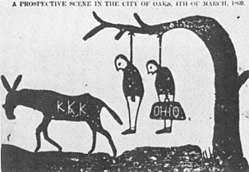 Forrest's days as the first "Grand Wizard " of the KKK were short but effective. In modern parlance, he claimed that the KKK was a "fair and balanced" alternative to the Republican "Loyal Leagues." As one Alabama newspaper put it, "The League is nothing more than a nigger Ku Klux Klan." One editorial cartoon of the period showed a KKK lynching: its victims were white, and written on one victim's carpet bag was the word, "Ohio."

