OK, it's time for a victory lap of sorts. If you're wondering what's on my mind, take a look at the books I read this year. I'm at 66, and while I'll finish a few over the Christmas break, I'm not sure I'll make it to 70 before 2015 begins and brings with it new experiences (trips to New Orleans, Germany, the Republic of Georgia, and a return to Philadelphia and New York City) to read up on.
Looking back at 2014, I spent a month reading fiction from countries competing in the World Cup--Germany's win was capped by my reading of five novels by German writers:Goethe's The Sorrows of Young Werther, The Mussel Feast, A Minute's Silence, Thomas Mann's His Royal Highness, and Peter Longerich's massive biography of Josef Goebbels. Looking back, though, I think my favorite World Cup-related novel was Paolo Giordini's The Solitude of Prime Numbers, a thoughtful love story.
My trips to New York were aided by Kevin Baker's Dreamland and John Dos Passos's Manhattan Transfer. I read four Dos Passos books this year, and he just blew me away. He is truly America's greatest modernist writer.
My favorite novel of the year was Henderson Smith's Fourth of July Creek, which was lyrical and which vividly described themes that began during the book's historical setting (Reagan's first two years in office) and which resonate today.
The best nonfiction I read was Timothy Egan's Short Nights of the Shadowcatcher: the Epic Life & Immortal Photographs of Edward Curtis. Curtis's quest to capture the images and ceremonies of the remaining Native American tribes in the American West in the 1910s rendered him divorced and penniless, but it preserved traits of those cultures that were dying out, and they allow Americans today to appreciate them. Egan is one of the best writers working in America today, whether you read his columns for The New York Times or others of his fine books, the best of which might be The Worst Hard Time about the Dust Bowl.
I crossed a few more classics off my list of to-reads: Alex Haley's Roots, Kate Chopin's The Awakening, Harper Lee's To Kill a Mockingbird (yes, that's right), Edith Wharton's The Age of Innocence, and the Goethe book (my Audible subscription really helps me to get through these). I also got to re-read John Steinbeck's East of Eden and The Old Man and the Sea.
A few other books that I would recommend that I didn't mention above:
1. Two historical novels, Sue Monk Kidd's The Invention of Wings begins with the gift of a slave to a Charleston teenager, and follows her repulsion to slavery to Philadelphia and a prominence in the abolitionist movement. Anthony Doerr's All the Light We Cannot See was an epic tale and brought back to me a visit I made to St. Malo, France, hitchhiking over my spring break in 1991.
2. Books that I put right to use in my teaching included Edgar Sawtelle, The Smithsonian's History of America in 101 Objects, Where'd You Go Bernadette (a delightful surprise), and Boy, Snow, Bird.
If you have any recommendations for 2015, post them below. I'm already building a collection, and I'm looking forward to sharing some recommendations with my brother-in-law, Don Gates over the Christmas holiday. I can't wait to read more!
21 December 2014
07 December 2014
The "We Three Kings" Wormhole into another Time and Space
At choir practice today, I was assigned a solo to sing along with our Three Wisemen.
The thing about getting into your mid forties is this: the space-time continuum starts to break down. We're in the church, getting ready to go over the song, and all of a sudden, I'm in my home church in Athens, Ohio, eleven years old, with a towel on my head, with several extra-large rubber bands clamping the towel to my cranium, with my buddies, Seth Jasovsky and Eric Jasovsky, getting ready to walk down the aisle with me, singing "We Three Kings" for the Christmas pageant.
I'm not sure if the space-time continuum is fuzzy or if it was just too long ago, but I can't see how ridiculous I/we must have looked in our costumes that night. At the time, we either thought we were cool--or we just didn't care. What was cool was this: hanging around ANYWHERE with Seth & Eric and Julie Dittes Gates and Sonia and Paul Jasovsky that Christmas in the "magical land of Ohio," or any other for that matter.
In church, reveling in the memory, I was grinning so much, I missed the first note or so of the solo. It's OK. I have until the weekend to get it right. I just know that my solo will NEVER top the trio singing "We Three Kings" that shuffled down the main aisle, dragging the hems of fathers' bathrobes, that unforgettable Advent evening at the Athens Seventh-day Adventist Church over 30 years ago.
The thing about getting into your mid forties is this: the space-time continuum starts to break down. We're in the church, getting ready to go over the song, and all of a sudden, I'm in my home church in Athens, Ohio, eleven years old, with a towel on my head, with several extra-large rubber bands clamping the towel to my cranium, with my buddies, Seth Jasovsky and Eric Jasovsky, getting ready to walk down the aisle with me, singing "We Three Kings" for the Christmas pageant.
I'm not sure if the space-time continuum is fuzzy or if it was just too long ago, but I can't see how ridiculous I/we must have looked in our costumes that night. At the time, we either thought we were cool--or we just didn't care. What was cool was this: hanging around ANYWHERE with Seth & Eric and Julie Dittes Gates and Sonia and Paul Jasovsky that Christmas in the "magical land of Ohio," or any other for that matter.
In church, reveling in the memory, I was grinning so much, I missed the first note or so of the solo. It's OK. I have until the weekend to get it right. I just know that my solo will NEVER top the trio singing "We Three Kings" that shuffled down the main aisle, dragging the hems of fathers' bathrobes, that unforgettable Advent evening at the Athens Seventh-day Adventist Church over 30 years ago.
30 November 2014
Some Tips I've Learned for the College Bound
This blog is in response to the New York Times article, "For Accomplished Students, Getting into a Good College Isn't as Hard as it Seems"
Bottom line: 80% of top students get into the schools they want, and ridiculous acceptance numbers (<7% at the Ivies) are because of students applying to too many schools. Ellie is at the end of the application process now. She targeted four schools, applied to three, and has been accepted by two of the three (we're waiting on the last one, which also happens to be her dream school--Penn).
Most of my Facebook friends have kids who are younger than Ellie, so let me break down the college process for you, to save you some stress and ensure that your child controls their educational & fiscal destiny.
1. Any school is a be-all, never an end-all. "Be all you can be" is no longer the motto of the U.S. Army, but it is the key to successful education in every kind of school. The value of a school isn't in its tennis courts or travel programs; it's in the teachers, the curriculum, and the range of classes offered there. More importantly, it is in that school's ability to prepare the child for the next step: elementary school for middle school, middle school for high school, high school for college, college for career, and career for the next career (today's students will work for 10-14 different employers by the age of 38). A smart parent doesn't say, "My kid is at a great school," anymore. They say, "My kid is getting great opportunities."
2. Connect present with future. It wasn't good grades that made Ellie think she could attend the top schools. It was her school business club--especially when she placed first at nationals in International Business as a sophomore. "You punched your ticket," I told her at the time. I said it a lot--every time she brought back a high test score or excelled at competition. Good schools, whether they are public or private, prepare kids to compete and excel, and having the word "champion" on a resume moves the student to the front of the college application line.
3. Every dollar spent is an investment. I'm not just talking about tuition here. How much is the family spending on books, classical concerts, museum visits? When there is travel, is there learning, too? Some technology investments--computers, music players--are better than others. A trip to Yellowstone National Park or a week at music camp is a better investment than Disney. A lot of the money I saved by putting my kids through public schools, I spent on travel, music and books. The money is all the same, it all got spent, but I had more control over the quality of the spending.
4. Tests are tools, not lotteries. Ellie took every practice test she could: the PLAN in 10th grade, the PSAT in 10th & 11th grades, and, of course, the ACT, which she took three times from December of her junior year to June before her senior year. Together we shamelessly used the testing companies to build interest in colleges (who buy the testing information) and increase her scores, knowing that above a certain level, every added point on the ACT is worth $1000-$2000 more in scholarships. If colleges are going to make it that easy to game the system, we'll take it!
On her first ACT, Ellie scored a 29, which was the score both her mother and I earned on our single experiences with the test. Ellie hated the score and acted like ACT had sent her a poop sandwich instead of a ticket into 95% of American colleges. The score included a perfect 36 in reading, but showed room for improvement in writing and math. She was already in AP Writing, so we knew the score would go up. We added a community college precalculus class to her schedule that spring. In the March ACT, her score was up a little, but she hadn't matched that perfect 36 in reading from the original test, while the other scores were higher. In the June ACT she came back with a 32 (which to her still wasn't high enough, despite she was up to qualifying for 98% of universities). It wasn't until we met with a Penn recruiter and learned that Penn "superscores" the ACT results, meaning that they take the highest grades from among the various tests, that she was satisfied. The 36 in reading held up, and added to her final test score, meant that she how had a 33 composite: another ticket punched.
A final thing about testing: I disagree with those who say they "don't test well." Tests are timed exercises in reading, writing and computation. They are not a mysterious portal between the world of high school and that of college. As a teacher, I know that if I can prepare my students to read every word of the prompt, or write an outline in preparation of a written prompt, their test scores will go up. I pity the poor kids who have been coached in "testing strategies" and spend more time gaming the answers than actually reading or computing the questions they're given. These kids "don't test well" because they haven't been taught well, because they believe that test results are 'magical' and not 'earned.'
5. Talk, talk, talk. Every college has a floor filled with offices and cubicles known as The Admissions Office. People go to work there every day, and they're there to recruit prospective students from specific regions of the state or country. They love to talk to kids. They answer e-mails in less than an hour. They record every interaction, hoping that it will result in an application. It was through talking with recruiters that we learned about the superscore. Through talking with a South Carolina recruiter, Ellie learned she needed a 3rd lab science, allowing her to drop an easy class and add Anatomy & Physiology to the Chemistry and Biology grades on her transcript. Through talking with a Penn recruiter, she learned that they prefer students with a calculus background for their business school, so she added an extra math class and devoted considerable time her senior year to AP Calculus. Without talking, she would have a solid transcript (a better GPA perhaps), but she would have gaps in her record that might cost her a place at her dream school.
6. Tour, tour, tour. No one would spend $5,000 on a car without test-driving it. No one should spend $50,000-$200,000 on a college education without visits. Every college visit offers an opportunity for learning, whether it's a drive-by or a full college tour. And you're not just touring the community and facilities, you're looking at the kids who go to school there--and want to go to school there. We toured NYU and Georgetown together, but didn't find either a good fit worth the price of application. We drove by Ohio University, West Virginia University and Temple. Ellie made two official visits to South Carolina and three additional informal visits. Interestingly, Ellie wasn't sold on Temple until she had both toured the campus AND worked out ways to use the Philadelphia subway to find her way around the city by herself. She felt at home there--without Daddy's help--and it helped her see herself studying and living in the city. Another ticket punched.
7. Dream, dream, dream. The final determination of where a student attends is NOT the college admissions or financial aid office. It's the parent or student who signs the deposit check. It frustrates me to hear finances brought up during the Talking Phase, the Touring Phase, or the Dreaming Phase, which should be about students reaching for the best opportunities available and preparing themselves to be successful in life. (When Ellie learned to walk, I imagined her in the Olympics; after her first piano lesson, I started thinking about Carnegie Hall; when she played soccer, I took her to see Mia Hamm and the US Women's Team.) It wasn't for me to tell her she would never be great because we. just. couldn't. afford. it.
Parents should identify students' strengths, help them identify programs or careers that will let them use those strengths, and take them to the colleges/ locations of their dreams. (Parents, this also makes an indelible impression on your child as to the depth of your love and respect for them.) The local community college or commuter state school will still cash the check, whether you've toured Harvard or not. A student who says, "I was accepted to X Unversity, but I chose Y College," is a student who is in control of their destiny and one who will live their life looking forward without regret.
--
Let me be clear. Ellie is an extraordinary kid. I'm not here to toot my horn, or act like anyone else's child has the same drive and dedication that she has shown over the past four years.They might. We have learned some important lessons over the past two years of looking at and preparing for college admission, and I just wanted to share them with all of you.
Bottom line: 80% of top students get into the schools they want, and ridiculous acceptance numbers (<7% at the Ivies) are because of students applying to too many schools. Ellie is at the end of the application process now. She targeted four schools, applied to three, and has been accepted by two of the three (we're waiting on the last one, which also happens to be her dream school--Penn).
Most of my Facebook friends have kids who are younger than Ellie, so let me break down the college process for you, to save you some stress and ensure that your child controls their educational & fiscal destiny.
1. Any school is a be-all, never an end-all. "Be all you can be" is no longer the motto of the U.S. Army, but it is the key to successful education in every kind of school. The value of a school isn't in its tennis courts or travel programs; it's in the teachers, the curriculum, and the range of classes offered there. More importantly, it is in that school's ability to prepare the child for the next step: elementary school for middle school, middle school for high school, high school for college, college for career, and career for the next career (today's students will work for 10-14 different employers by the age of 38). A smart parent doesn't say, "My kid is at a great school," anymore. They say, "My kid is getting great opportunities."
2. Connect present with future. It wasn't good grades that made Ellie think she could attend the top schools. It was her school business club--especially when she placed first at nationals in International Business as a sophomore. "You punched your ticket," I told her at the time. I said it a lot--every time she brought back a high test score or excelled at competition. Good schools, whether they are public or private, prepare kids to compete and excel, and having the word "champion" on a resume moves the student to the front of the college application line.
3. Every dollar spent is an investment. I'm not just talking about tuition here. How much is the family spending on books, classical concerts, museum visits? When there is travel, is there learning, too? Some technology investments--computers, music players--are better than others. A trip to Yellowstone National Park or a week at music camp is a better investment than Disney. A lot of the money I saved by putting my kids through public schools, I spent on travel, music and books. The money is all the same, it all got spent, but I had more control over the quality of the spending.
4. Tests are tools, not lotteries. Ellie took every practice test she could: the PLAN in 10th grade, the PSAT in 10th & 11th grades, and, of course, the ACT, which she took three times from December of her junior year to June before her senior year. Together we shamelessly used the testing companies to build interest in colleges (who buy the testing information) and increase her scores, knowing that above a certain level, every added point on the ACT is worth $1000-$2000 more in scholarships. If colleges are going to make it that easy to game the system, we'll take it!
On her first ACT, Ellie scored a 29, which was the score both her mother and I earned on our single experiences with the test. Ellie hated the score and acted like ACT had sent her a poop sandwich instead of a ticket into 95% of American colleges. The score included a perfect 36 in reading, but showed room for improvement in writing and math. She was already in AP Writing, so we knew the score would go up. We added a community college precalculus class to her schedule that spring. In the March ACT, her score was up a little, but she hadn't matched that perfect 36 in reading from the original test, while the other scores were higher. In the June ACT she came back with a 32 (which to her still wasn't high enough, despite she was up to qualifying for 98% of universities). It wasn't until we met with a Penn recruiter and learned that Penn "superscores" the ACT results, meaning that they take the highest grades from among the various tests, that she was satisfied. The 36 in reading held up, and added to her final test score, meant that she how had a 33 composite: another ticket punched.
A final thing about testing: I disagree with those who say they "don't test well." Tests are timed exercises in reading, writing and computation. They are not a mysterious portal between the world of high school and that of college. As a teacher, I know that if I can prepare my students to read every word of the prompt, or write an outline in preparation of a written prompt, their test scores will go up. I pity the poor kids who have been coached in "testing strategies" and spend more time gaming the answers than actually reading or computing the questions they're given. These kids "don't test well" because they haven't been taught well, because they believe that test results are 'magical' and not 'earned.'
5. Talk, talk, talk. Every college has a floor filled with offices and cubicles known as The Admissions Office. People go to work there every day, and they're there to recruit prospective students from specific regions of the state or country. They love to talk to kids. They answer e-mails in less than an hour. They record every interaction, hoping that it will result in an application. It was through talking with recruiters that we learned about the superscore. Through talking with a South Carolina recruiter, Ellie learned she needed a 3rd lab science, allowing her to drop an easy class and add Anatomy & Physiology to the Chemistry and Biology grades on her transcript. Through talking with a Penn recruiter, she learned that they prefer students with a calculus background for their business school, so she added an extra math class and devoted considerable time her senior year to AP Calculus. Without talking, she would have a solid transcript (a better GPA perhaps), but she would have gaps in her record that might cost her a place at her dream school.
6. Tour, tour, tour. No one would spend $5,000 on a car without test-driving it. No one should spend $50,000-$200,000 on a college education without visits. Every college visit offers an opportunity for learning, whether it's a drive-by or a full college tour. And you're not just touring the community and facilities, you're looking at the kids who go to school there--and want to go to school there. We toured NYU and Georgetown together, but didn't find either a good fit worth the price of application. We drove by Ohio University, West Virginia University and Temple. Ellie made two official visits to South Carolina and three additional informal visits. Interestingly, Ellie wasn't sold on Temple until she had both toured the campus AND worked out ways to use the Philadelphia subway to find her way around the city by herself. She felt at home there--without Daddy's help--and it helped her see herself studying and living in the city. Another ticket punched.
7. Dream, dream, dream. The final determination of where a student attends is NOT the college admissions or financial aid office. It's the parent or student who signs the deposit check. It frustrates me to hear finances brought up during the Talking Phase, the Touring Phase, or the Dreaming Phase, which should be about students reaching for the best opportunities available and preparing themselves to be successful in life. (When Ellie learned to walk, I imagined her in the Olympics; after her first piano lesson, I started thinking about Carnegie Hall; when she played soccer, I took her to see Mia Hamm and the US Women's Team.) It wasn't for me to tell her she would never be great because we. just. couldn't. afford. it.
Parents should identify students' strengths, help them identify programs or careers that will let them use those strengths, and take them to the colleges/ locations of their dreams. (Parents, this also makes an indelible impression on your child as to the depth of your love and respect for them.) The local community college or commuter state school will still cash the check, whether you've toured Harvard or not. A student who says, "I was accepted to X Unversity, but I chose Y College," is a student who is in control of their destiny and one who will live their life looking forward without regret.
--
Let me be clear. Ellie is an extraordinary kid. I'm not here to toot my horn, or act like anyone else's child has the same drive and dedication that she has shown over the past four years.They might. We have learned some important lessons over the past two years of looking at and preparing for college admission, and I just wanted to share them with all of you.
24 May 2014
Last of the Jims
I can think of three dates that determined the outcome of these 43 years I have spent so far on this wonderful green globe:
- 22 May 1997 I became a father.
- The weekend of 3-7 May 1991 Destiny thrust me into the great love of my life
- In January of 1984, just a few weeks shy of my 13th birthday, I moved from Amesville, Ohio, to Portland, Tennessee.
A story from those first days in Tennessee came back to mind this week, when I learned that my classmate at Highland Elementary, James "Bobo" Ayers, had passed away due to cancer. Like me, he was 43.
I have always had a problem with my name. Growing up, my family called me "JD," which always seemed like a baby name to me. To make things worse, my mom tells the story that the name had been given to me while I was still in utero, given by a man who assumed I would be "Junior Dittes."
When I was ready for 1st grade, I came up with a plan. I was going to leave "JD" behind and become "Jimmy." I remember writing "Jimmy" over and over on my wide-lined, elementary writing book, curling the y's this way and that. It didn't phase my parents--nor did it seem to matter to the other seven kids in the one-room Adventist school I attended.
A Return to the Question of Satan
A couple of events this week led me back to explore the topic of Satan.
I have admitted earlier in this blog my difficulty in really believing in the Evil One--or at least with the certainty that many of the Lucifer-wielders seem to have for him.
Two events this week brought Satan back to light and led to some interesting new takes on the subject.
First, at a Bible study this week, a group leader resorted to Satan to prove a supposition that cannot be supported by the Bible: in this case it was the erroneous belief that Paul and other early Christians didn't worship on Sunday, among other days.
"The Devil wants us to believe," he began. My blood began to boil. "It's all part of Satan's plan." I wanted to walk out. This was a blatant logical fallacy--as if I made decisions or interpreted scripture with any care what some made-up entity really wants!
Later, a friend posted on Facebook a question about atheists and Satan. Two brushes with the Evil One in one week. I took to Google to figure out the term for "a person who refuses to believe in Satan."
The answer I found was "atheist." An atheist, I learned, rejects any form of the divine, whether good or evil.
I have admitted earlier in this blog my difficulty in really believing in the Evil One--or at least with the certainty that many of the Lucifer-wielders seem to have for him.
Two events this week brought Satan back to light and led to some interesting new takes on the subject.
First, at a Bible study this week, a group leader resorted to Satan to prove a supposition that cannot be supported by the Bible: in this case it was the erroneous belief that Paul and other early Christians didn't worship on Sunday, among other days.
"The Devil wants us to believe," he began. My blood began to boil. "It's all part of Satan's plan." I wanted to walk out. This was a blatant logical fallacy--as if I made decisions or interpreted scripture with any care what some made-up entity really wants!
Later, a friend posted on Facebook a question about atheists and Satan. Two brushes with the Evil One in one week. I took to Google to figure out the term for "a person who refuses to believe in Satan."
The answer I found was "atheist." An atheist, I learned, rejects any form of the divine, whether good or evil.
13 March 2014
Living My Grandpa's Life
Woke up this morning in my grandpa's bed.
Put the kettle on for coffee on my grandpa's stove
Took a walk down Grandpa's driveway
looking up at constellations--
the very ones I learned from him.
I paused next to Grandpa's arched, white mailbox,
Stared up at Venus to the east-southeast.
That was when I realized
Today, March 13
Is the day I lost my grandpa--
Seven years ago,
the world at this very point in its wide orbit
end-of-winter stars in these places overhead--
a Universe eternal save his heartbeat.
He died
On a Tuesday
24 December 2013
Playing for Peace on Christmas Eve
So this is Christmas: Fort McAllister, Georgia, the Confederate fort that marked the end point of General William Tecumseh Sherman's epic, two-month scramble from Atlanta to the Atlantic--the "March to the Sea" that gutted the Confederacy, ensured Abraham Lincoln's re-election, and gave to humanity the phrase, "War is Hell."
So this is Christmas--or almost so: a short battle raged for fifteen minutes on the 13th of December, 1864. Thirty men died, including twelve of the fort's defenders. Over 200 were injured (the Confederates had laced the woods with land mines. One hundred ninety-five of the fort's defenders were taken prisoner. When the battle was over, a Union soldier raced to the ramparts and waved the Stars & Stripes, informing the U.S. Navy gunboats that the fort had fallen. By water and by land the way was now open to Savannah. Confederate forces quickly, humanely--abandoned the city and slipped into the swamps of South Carolina. Sherman entered the city on December 21 and sent a message to President Lincoln, presenting him the city as "a Christmas present."
So this is Christmas: four boys advance on the fort, 149 years after Sherman's forces did. They advance at a run--double-time as Sherman might have ordered. But there is no order in their assault. One advances through the open gate, the others leap into the moat, slide through the palisades, and climb the sandy walls. "One, two, three...not it!" one of them calls. A chorus of "not it" replies, and a game of hide-and-seek commences. A fort is a great place to play hide-and-seek.
So this is Christmas: the prophet Isaiah thunders:
"Every warrior's boot used in battle
and every garment rolled in blood
will be destined for burning,
will be fuel for the fire.
For to us a child is born,
to us a son is given,
and the government will be on his shoulders.
And he will be called
Wonderful Counselor, Mighty God,
Everlasting Father, Prince of Peace.
Of the greatness of his government and peace
there will be no end" (9. 5-7)
I find myself drawn to this kingdom--this government--where swords are used only as plowshares, spears become pruning hooks (2.4); where "the wolf will live with the lamb" and "the young child will put its hand into the viper's nest. They will neither harm nor destroy on all my holy mountain" (11.6-9).
But I am not living in the Era of Isaiah, nor is it 1864. I circumambulate the fort, walking between the rampart walls and the river, trying to imagine the sight of ironclads in the water, tuning my ears to the echoes of guns.
My thoughts are invaded from time to time by calls from the battlements, "Dad?"
"I'm over here," I call back.
"Uncle JD?"
"Don't worry."
So this is Christmas: I think of Isaiah again, and I grin. I think of a new poem:
The field of glorious battle will become a ground of hilarious fun
Your ramparts will become jungle gyms
Shouts will sound from children who use your cannon as see-saws
Your artillery shells will roll like bowling balls
In the place where your ancestors were killed and imprisoned
Your sons will hide and seek, your daughters will run and shout
So this is Christmas: a time when the Prince of Peace haunts the grounds of war.
So this is Christmas: war is over--at least here in Georgia it is.
And this Christmas Eve, in a prayer for peace, I long for boys to play in Afghanistan and Syria and in South Sudan the way I have seen my sons and my nephews play here.
So this is Christmas.
And this Christmas Eve, in a prayer for peace, I long for boys to play in Afghanistan and Syria and in South Sudan the way I have seen my sons and my nephews play here.
So this is Christmas.
02 September 2013
Book Review: Willa Cather's One of Ours
One of Ours by Willa CatherMy rating: 3 of 5 stars
I love-love-love Willa Cather's work. She's one of my favorite authors. Why doesn't she get the respect she deserves?
I think it boils down to the era in which she wrote. The inter-war renaissance of letters that found Ernest Hemingway at his peak, F. Scott Fitzgerald, Faulkner and eventually John Steinbeck (a regionalist whose works compare well to Cather's). Think of it this way. Do you remember the third-best hitter on the 1927 Yankees after Babe Ruth and Lou Gehrig? Would you believe Bob Meusel hit .337 with 105 RBI? That's where Cather stands among the American writers of her day--and in my book, that's pretty darn good.
In One Of Ours Cather focuses on the story of Claude Wheeler a farm boy who is trapped between two worlds: he's smart enough to go to a Christian college--and excel at a public university, too, much to his father's chagrin--but he's tied to the land, and he returns to farm his property when his brother, Ralph, gets a farm out in Colorado.
Claude is passionate enough to attract a girl-next-door type named Enid, but again, he's trapped between two worlds, able to provide amply for Enid, but unable to receive passion in return (which she saves for her religious activities, ultimately ditching him for the chance to be a missionary in China).
The war arrives, then, to solve an existential crisis of Claude's. This is where Cather moves from My Antonia territory into topical stuff: America's reasons to join the war.
Europeans who read One of Ours will find its treatment of World War I vastly inferior to the rich literature that Europeans produced--and continue to write--around the conflict. But OOO is one of the few American novels that described the war from our perspective (again, it suffers against the competition of Hemingway's superior A Farewell to Arms).
But Cather brings out a central truth of the American Expeditionary Force that I haven't found in another American source on the war. Claude isn't fighting for empire, and his soldiers joke about the silly slogan, "making the world safe for democracy." Americans like Claude fight for existential reasons:
"But as for me, I never knew there was anything worth living for till this war came on. Before that, the world seemed like a business proposition" [Claude says]
"You'll admit it's a costly way of providing adventure for the young," said David drily.
Americans fought for personal reasons, not political ones. That's the way we waged the bloody wars of the 20th Century, and it's why our culture found something to glorify in every battle, unlike the Europeans who had fought and died on the very same ground in France, Indochina and the Middle East.
The war passes almost as a series of R&R visits to households in France. The battles are short and graphic. The final two chapters are well researched and vividly rendered, but they can't get away from the shallow self-indulgence that was Claude's war...and in relation, was America's as well.
View all my reviews
24 March 2013
Give Me This Cup: A Meditation for Holy Week 2013
It's almost Easter.
The senses awaken: a whisper in the air, "spring is almost come," and the smell. Dirt writhes with worms, flowers burst to life.
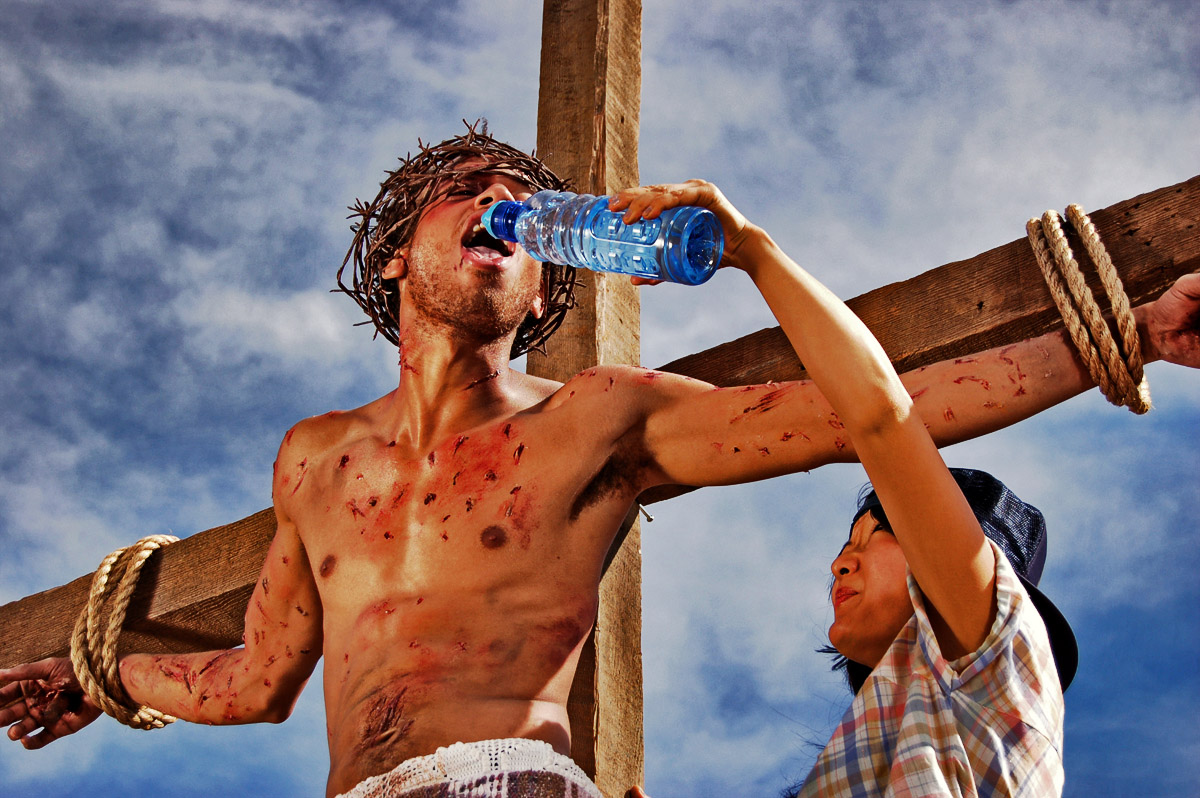
My mind goes back. I see a cross.
And hanging there, a man looks back at me.
Or maybe he's not looking directly at me. His eyes seem distant--deadened by pain and heartbreak
He says, "I thirst."
My first instinct is to help him, although soldiers guard the condemned, and his mouth would be three feet out of reach even if I did make it to the cross. I see a soldier wrap a dirty rag around the end of a branch. Perhaps he was listening, too.
The soldier dips the rag into a wooden bucket. He twists it in there.
I wave my arm at the soldier. He doesn't see me.
I cry out--he doesn't understand a word I say--"That's not what he meant!" I call.
"I thirst."
The senses awaken: a whisper in the air, "spring is almost come," and the smell. Dirt writhes with worms, flowers burst to life.
My mind goes back. I see a cross.
And hanging there, a man looks back at me.
Or maybe he's not looking directly at me. His eyes seem distant--deadened by pain and heartbreak
He says, "I thirst."
My first instinct is to help him, although soldiers guard the condemned, and his mouth would be three feet out of reach even if I did make it to the cross. I see a soldier wrap a dirty rag around the end of a branch. Perhaps he was listening, too.
The soldier dips the rag into a wooden bucket. He twists it in there.
I wave my arm at the soldier. He doesn't see me.
I cry out--he doesn't understand a word I say--"That's not what he meant!" I call.
"I thirst."
13 February 2013
30 Psalms
The weeks between Epiphany and Lent are among the darkest of the year.
Sure, the sun sets before I can return home from my teaching job on most days, but they are spiritually muddled, too.
I blame New Year's resolutions. The Christian calendar has plenty of opportunities for reflection and the practice of discipline (like Lent), but resolutions throw a secular wrench into the works. I often spend January trying to lose weight, exercise more, avoid eating out, etc. It is usually one of the more unexciting times of the year to practice my faith.
This year, I made a resolution that resolved this dilemma. In the six weeks between Epiphany Sunday and Ash Wednesday, I would write out 30 psalms by hand. This idea isn't new, but the practice was for me. I accomplished my goal this week with two days to spare.
(Here's I need to give a shout out to my academy friend, Doug Pratt, who posted the idea to Facebook before Christmas. At the time I read it, I thought how silly it would be to try something like this during the busy, holiday season, but later I was inspired to try writing out 30 psalms after Advent.)
I just wanted to post some of the things I learned about the psalms during this encounter. I have extended my obsession with the Jewish Temple to meditating on psalms 42, 84, 95, 103, 130, and 40 in other blogs on this site, so I won't spend a lot of time on analysis on this blog.
Sure, the sun sets before I can return home from my teaching job on most days, but they are spiritually muddled, too.
I blame New Year's resolutions. The Christian calendar has plenty of opportunities for reflection and the practice of discipline (like Lent), but resolutions throw a secular wrench into the works. I often spend January trying to lose weight, exercise more, avoid eating out, etc. It is usually one of the more unexciting times of the year to practice my faith.
This year, I made a resolution that resolved this dilemma. In the six weeks between Epiphany Sunday and Ash Wednesday, I would write out 30 psalms by hand. This idea isn't new, but the practice was for me. I accomplished my goal this week with two days to spare.
(Here's I need to give a shout out to my academy friend, Doug Pratt, who posted the idea to Facebook before Christmas. At the time I read it, I thought how silly it would be to try something like this during the busy, holiday season, but later I was inspired to try writing out 30 psalms after Advent.)
I just wanted to post some of the things I learned about the psalms during this encounter. I have extended my obsession with the Jewish Temple to meditating on psalms 42, 84, 95, 103, 130, and 40 in other blogs on this site, so I won't spend a lot of time on analysis on this blog.
- I tried to be "led" to psalms. I'd hear one referenced in a sermon or on a Facebook post, and I'd plan to transcribe it. For example, after one NFL playoff game, I saw Baltimore Ravens linebacker Ray Lewis wearing a shirt that said, "Psalm 91." I hate the Ravens with the bitterness only a Cleveland Browns fan can know, but that night I transcribed the psalm.
- I saved Psalm 30 for one of my last. It was a most pleasant discovery, especially given the context of Lent:
- "What is it to be gained by my spilled blood, by my going down into the pit? Does dust thank you? Does it proclaim your faithfulness? Lord, listen and have mercy upon me! Lord, be my helper!" (verses 9-10).
- What follows soon after is a foretaste of Easter: "You changed my mourning into dancing. You took off my funeral clothes and dressed me up in joy so that my whole being might sing praises to you and never stop. Lord, my God, I will give thanks to you forever."
- I was surprised how many of the 30 psalms dealt with the theme of revenge and retribution. I think of psalms as expressions of praise and devotion. In fact, many of them follow a pretty simple formula:
- "I acknowledge you, God, and I write your praise
- ---> "No other divinity is like you."
- ---> "No other nation is like yours."
- ---> "There are people who oppose your king/your nation" (they're the same thing in the psalms).
- ---> "Please punish them severely. OK?"
- ---> "Then you will be acknowledged and praised once again."
- I love to worship, and I believe the Psalms represent exemplars of worship.
- But I consider the act of begging God to avenge himself upon my enemies to be a sacrilege.
- I transcribed from the Common English Bible--a recent translation that is supported by a number of mainline Protestant denominations--that had been given to Owen when he completed confirmation classes at church. It was the first chance I'd had to really get into this Bible.
- The language of the CEB was, well, common--as opposed to rich (I prefer the NIV or TNIV). For example, I searched and searched the words, "Be still and know that I am God" (46:10). So many translations of the Bible fail with the psalms because the King James owns the rhythm and the texture of the words. Reading a translation of the 23rd Psalm without "he leadeth me beside still waters" is about as off-putting as versions of Shakespeare's that rephrase Hamlet, saying, "To exist or maybe not to."
- In the CEB, Psalm 46:10 reads: "That's enough! Now know that I am God!"
- Really? Can one replace "be still" with an exclamation point? It's jarring. And the rhythm is totally off. At least the double meaning remains
- The CEB overuses exclamation points. I get it with the psalms--they're emotional, they're passionate. But only poor writers mistake exclamation points for passion, yet that's what the translators of this version have done. I won't bother to count them, but 40-60% of the sentences in the psalms I transcribed ended with exclamation points, which is 39-59% too many of them!
- I'm not sure if you can read from the picture, but the psalms I transcribed were the following: 2, 5, 8, 14, 18, 19, 22, 27, 30, 40, 42, 45, 46, 51, 63, 77, 79, 81, 89, 90, 91, 100, 110, 115, 121, 127, 137, 139, 146, 150.
02 December 2012
Of Spider Fathers and Christmas Day

This article in the Economist magazine just blew my mind. Researchers took wolf spiders and ran experiments to see why female spiders consumed their mates following copulation.
What they found was shocking. When they looked at the hatchlings of mothers that feasted on fathers and those that didn't, here's what they found: when mommy ate daddy, 48% of babies survived one month after hatching. When daddy survived mommy, only 12% of the hatchlings survived.
Put simply: a dead daddy produced four times as many surviving hatchlings as a live one.
So what's more important: babies' lives or daddy's? The researchers hypothesize that, in giving up his life to his mate, the male wolf spider provides fuel to his offspring that make their survival more likely.
While I am happy to relate that I survived the creation of three children (100% of which survive, thanks be to God) with the partnership of a vegetarian wife, this story reminds me that fatherhood is filled with sacrifice. American fathers aren't consumed by our wives but by our children: braces, clothes, Christmas presents--and don't even get me started about the cost of college or driving.
Whether it's hobbies that we give up or careers, human fathers make these sacrifices for the same reason that wolf spiders do: because seeing our children prosper is more precious than anything--including Life Itself.
I'm reminded as we enter Advent today, of a father who gave up home, reputation and livelihood for the sake of a Son he did not create. There is no record that Joseph survived to see Jesus' adulthood, but Joseph's sacrifice set history in motion.
17 November 2012
Idols in our Pockets
"What's in your wallet?"
It's a fair question, considering the world we live in.
What's in my wallet is identification. There is some cash in there--or at least there was before my daughter asked me for some money to cover her weekend expenses. There are credit cards, health insurance cards, "frequent shopper" benefits, and stuff like that.
"What's in your wallet?"
It's the tag line for a credit card company, too. I won't promote the name, but their ads often feature pagan spokespeople who take time from pillaging (and Christmas shopping) to inquire about viewers' means of payment.
"What's in your wallet?"
It's a leading question, one that was asked by Jesus Christ at a time and in a context that placed his ministry in political peril. Every student of the gospels know that Jesus instructed his followers to "Give unto Caesar that which is Caesar's" (Mark 12 and Luke 20).
Few may remember that before he stated that, Jesus asked: "What's in your wallet?" (Or something like that.) In my version of the Bible, the TNIV, he actually says, "Bring me a denarius and let me look at it" (Mark 12.15).
It's a funny question because it was supposed to be a trap. Should we pay taxes to Caesar? There was no easy answer to that question in 1st-century Judaea. No one liked taxes, yet there was one thing more fatal to a public career than endorsing Roman taxes, and that was challenging them.
It was a trap that Jesus answered first with the words, "what's in your wallet?" or "show me a denarius."
We infer from Jesus' words that he didn't have a denarius on him. We might even wonder if Jesus knew what a denarius looked like. With a little digging into scripture, we can understand why he didn't have one.
A Roman denarius was worth a day's wages for a laborer, around $80 today, so perhaps it's not surprising that Jesus didn't carry these coins around with him. But it wasn't just the value that may have prevented Jesus from carrying one of his own, it was the appearance of these coins, too: encircling the image of Caesar on the "heads" side were the words, "Son of the divine (Augustus)," and on back, the words, "high priest" surrounded the image of a goddess.
In other words, the coins born inscriptions quite similar to those that Jesus' followers would make about him in the weeks after his Resurrection. But Christ's accusers carried more than words in their wallets.
The engravings of Tiberius and the godess found on the denarius would seem to violate the prohibition in the 2nd Commandment: "You shall not make for yourself a graven image in the form of anything in heaven above or on the earth beneath or in the waters below" (Ex 20.4). The word, "graven" (from the Middle English word "grafen,") carries two meanings. It can mean an image that is sculpted, much like the idols of the near east. It can also mean "to stamp or impress deeply." After all, it's the root of the word, "engrave."
Deuteronomy 4.16 strengthens this prohibition. It warns Israel against making "any shape, whether formed like a man or a woman, or like any animal on earth or any bird that flies in the air." A similar prohibition continues in Islam today, which forbids the use of images in art, particularly those of Mohammed.
Pagans and wallets. They weren't merely subjects for an ad campaign in Jesus' day, they were at the center of contentious, theological debate.
In a way, Jesus' question, "What's in your wallet?" was another way to demand, "Bring out your idols."
And when someone produced a coin, it meant that Jesus had out-radicalized them before he could get to the words, "Give unto Caesar...." The questioner carried in his wallet Caesar's image--which happened to be very valuable to the bearer--far too valuable to give back in the form of a tax. Jesus didn't carry Caesar's image. Therefore there was little for him to hold onto--little for him to tug back and forth with the Roman authorities--little for Jesus to hold closer to his heart than the Father.
I am left to wonder, then, what's in my wallet--whether I might be carrying idols around on my person.
Foreign Coins, Foreign Figures
I've long been as fascinated with the appearance of money as with the accumulation of it. The bill and the coin is an avenue into the heart of a nation's culture--and the more I have traveled, the more I have learned to appreciate how coins represent cultures.
I have a jar of coins on my living room mantle left over from my days adventuring over Europe before the age of the Euro. There are about ten countries represented. When I look for gods I find them on the "heads" of coins from Switzerland, France, Greece and Italy. All but Greece feature goddesses. Italy and Greece feature the heads of the goddess & god in profile while France and Switzerland feature the image from head to toe.
Other countries feature political figures. England and Canada are engraved with Queen Elizabeth's image. I have two Spanish coins, one with the dictator Franco (1966) and one with King Juan Carlos (1980). I have a Turkish coin and one from Hungary that feature their nations' founders, Kemal Ataturk and Lajos Kossuth, respectively. (The coins featured in the picture are--clockwise from top left--England, Turkey, Italy, US nickel (front), US penny (tails), Greece and Switzerland.)
Even more fascinating than the coins are the bills. Coins have changed very little since the days of Tiberius Caesar. Bills are a modern development, and they are far more customized to describe their country. From my travels in Europe throughout the 1990s, I remember the British pound proudly promoting three titans of the nation's history: the Duke of Wellington, William Shakespeare and James Watt. I have a ten-pound note that I keep (my first paid writing commission) that bears the image of Florence Nightingale Of course every British banknote also features one side with Queen Elizabeth's portrait.
I don't have a wide collection, but my 100,000 Turkish Lira note bears Ataturk's image on both sides--his portrait on one, and a picture of him accepting flowers from children on the other. I collected this note in 1999, 60 years after Ataturk's death, no less, demonstrating the enormous power that Turkey's founder continues to wield. My 1,000,000 Turkish Lira note (which was worth about $2.50 when I visited in 1999) had a picture of a dam.
My 1000 Italian Lira note bears Maria Montessori's image. I can't emphasize how cool it is that a nation would feature a teacher on a banknote. My communist-era Albanian note is a fascinating look at the darkest year (1976) of that nation's red paranoia. A pickaxe and a gun mark one side, guarding the construction of an apartment building (complete with cranes and scaffolding), while on the other side young men and women march in military formation, carrying the Albanian flag (and Kalashnikovs) [Pictured].
I remember seeing Austrian "schilling" bills with doctors and engineers on them and thinking to myself: wow, science and technology is really important to this country. What is important in mine?
American Gods
A look at American coins and bills shows a fascination with government, plain and simple. The graven images on the coins that Americans carry are of politicians, not of gods (I'll let someone else explain the "tails" sides of American coinage). Do Americans worship great presidents? I think we do to a certain extent. One need only visit the U.S. Capitol, tour the Rotunda and stare up at the Apotheosis of Washington painted on the dome's interior in 1865 to verify this tendency.
Moreover, the presidents featured on American coins share one common feature: they presided over significant steps in the establishment and expansion of American government. Washington fought to establish the United States, presided over the Constitutional Convention, and served only two terms as the nation's first president. As president, Jefferson doubled the size of the nation with the Louisiana Purchase and presided over America's first overseas military adventure "to the shores of Tripoli," as the Marine hymn says. Lincoln fought to keep the Union together in the face of rebellion and then oversaw an enormous increase in federal power established in the 13th, 14th and 15th amendments. And FDR set the federal government on the course to where it is today, acting more as an insurer of economic security than a defender of national security. These men weren't gods, per se, but they were key players who brought the U.S. government to greater heights of power.
Now look at American bills. Washington, Lincoln and Jefferson have their own bills. The other bills feature general-presidents like Andrew Jackson, who crushed native power in the Southeast as a general and expelled them as president, and Ulysses S Grant whose generalship saved the union in the Civil War and whose presidency shamelessly rewarded private railroad and mining interests. Two non-presidents are also featured as well, Benjamin Franklin and Alexander Hamilton.
Apparently no public figure since Grant has been worthy of having his or her image on a bill. I think that part of this is because few people idolize public figures anymore. World War I ended the age of kings in Europe, and it is no coincidence that--in America at least--no public figure since (with the exception of FDR on the tiny dime) has been engraved into metal or paper.
The backs of U.S. bills are no less revealing. With the exception of the $1 (US symbols) and the $2 (portrait of the signing of the Declaration of Independence) bills, they all feature government buildings: the White House, the Capitol, the U.S. Treasury, the Lincoln Temple/Memorial.
What's in my wallet? It's the United States government and the men who consecrated it.
It isn't Caesar's graven image that holds me in thrall, it's Washington's, Lincoln's and Franklin's. It isn't a priestess engraved on the "tails" side but martial eagles, eye-capped pyramids, and public temples
And despite every coin's engraving, "In God we Trust," my money isn't God.
It is as divisive as it was in Christ's day. In an era when pushing the nation over a "fiscal cliff" is seen by some as preferable to paying taxes, "what's in your wallet?" engenders a religious fervor equivalent to that which confronted Jesus in the day of the Tiberian denarius.
And I think that Christ's question remains a challenge that may be even more difficult for Christ-followers to accept today than it was among his homeless band of disciples. "Show me a denarius." A denarius was anathema to Christ and his followers, who trafficked a currency that--like its kingdom--was not of this world.
Looking back, I think that the best response to Jesus' direction, "show me a denarius," would have been this: "What's a denarius?"
Looking forward, perhaps Christians' best responses to "what's in your wallet?" just might eventually become--in that perfect Kingdom--"What is a wallet?"
Two Notes:
If I were in Congress (don't worry, I never will be), I would like to see U.S. currency feature a broader range of historical figures, much like the European bills did in the decades before the Euro. To me, American Inventors should be celebrated for a time. I would nominate
Possible alternatives: Benjamin Franklin, Robert Fulton, Samuel F.B. Morse, Cyrus McCormick, Steve Jobs
Comment below and tell me what you think. Would you add writers? Civil Rights Figures? Movie Stars?
This blog owes a debt to N.T. Wright's book, How God Became King, and his description of the exchange found on pages 147-149. Suffice it to say, I recommend the book. This is one of many fascinating ideas I got from reading it.
It's a fair question, considering the world we live in.
What's in my wallet is identification. There is some cash in there--or at least there was before my daughter asked me for some money to cover her weekend expenses. There are credit cards, health insurance cards, "frequent shopper" benefits, and stuff like that.
"What's in your wallet?"
It's the tag line for a credit card company, too. I won't promote the name, but their ads often feature pagan spokespeople who take time from pillaging (and Christmas shopping) to inquire about viewers' means of payment.
"What's in your wallet?"
It's a leading question, one that was asked by Jesus Christ at a time and in a context that placed his ministry in political peril. Every student of the gospels know that Jesus instructed his followers to "Give unto Caesar that which is Caesar's" (Mark 12 and Luke 20).
Few may remember that before he stated that, Jesus asked: "What's in your wallet?" (Or something like that.) In my version of the Bible, the TNIV, he actually says, "Bring me a denarius and let me look at it" (Mark 12.15).
It's a funny question because it was supposed to be a trap. Should we pay taxes to Caesar? There was no easy answer to that question in 1st-century Judaea. No one liked taxes, yet there was one thing more fatal to a public career than endorsing Roman taxes, and that was challenging them.
It was a trap that Jesus answered first with the words, "what's in your wallet?" or "show me a denarius."
We infer from Jesus' words that he didn't have a denarius on him. We might even wonder if Jesus knew what a denarius looked like. With a little digging into scripture, we can understand why he didn't have one.
A Roman denarius was worth a day's wages for a laborer, around $80 today, so perhaps it's not surprising that Jesus didn't carry these coins around with him. But it wasn't just the value that may have prevented Jesus from carrying one of his own, it was the appearance of these coins, too: encircling the image of Caesar on the "heads" side were the words, "Son of the divine (Augustus)," and on back, the words, "high priest" surrounded the image of a goddess.
In other words, the coins born inscriptions quite similar to those that Jesus' followers would make about him in the weeks after his Resurrection. But Christ's accusers carried more than words in their wallets.
The engravings of Tiberius and the godess found on the denarius would seem to violate the prohibition in the 2nd Commandment: "You shall not make for yourself a graven image in the form of anything in heaven above or on the earth beneath or in the waters below" (Ex 20.4). The word, "graven" (from the Middle English word "grafen,") carries two meanings. It can mean an image that is sculpted, much like the idols of the near east. It can also mean "to stamp or impress deeply." After all, it's the root of the word, "engrave."
Deuteronomy 4.16 strengthens this prohibition. It warns Israel against making "any shape, whether formed like a man or a woman, or like any animal on earth or any bird that flies in the air." A similar prohibition continues in Islam today, which forbids the use of images in art, particularly those of Mohammed.
Pagans and wallets. They weren't merely subjects for an ad campaign in Jesus' day, they were at the center of contentious, theological debate.
In a way, Jesus' question, "What's in your wallet?" was another way to demand, "Bring out your idols."
And when someone produced a coin, it meant that Jesus had out-radicalized them before he could get to the words, "Give unto Caesar...." The questioner carried in his wallet Caesar's image--which happened to be very valuable to the bearer--far too valuable to give back in the form of a tax. Jesus didn't carry Caesar's image. Therefore there was little for him to hold onto--little for him to tug back and forth with the Roman authorities--little for Jesus to hold closer to his heart than the Father.
I am left to wonder, then, what's in my wallet--whether I might be carrying idols around on my person.
Foreign Coins, Foreign Figures
I've long been as fascinated with the appearance of money as with the accumulation of it. The bill and the coin is an avenue into the heart of a nation's culture--and the more I have traveled, the more I have learned to appreciate how coins represent cultures.
I have a jar of coins on my living room mantle left over from my days adventuring over Europe before the age of the Euro. There are about ten countries represented. When I look for gods I find them on the "heads" of coins from Switzerland, France, Greece and Italy. All but Greece feature goddesses. Italy and Greece feature the heads of the goddess & god in profile while France and Switzerland feature the image from head to toe.
Other countries feature political figures. England and Canada are engraved with Queen Elizabeth's image. I have two Spanish coins, one with the dictator Franco (1966) and one with King Juan Carlos (1980). I have a Turkish coin and one from Hungary that feature their nations' founders, Kemal Ataturk and Lajos Kossuth, respectively. (The coins featured in the picture are--clockwise from top left--England, Turkey, Italy, US nickel (front), US penny (tails), Greece and Switzerland.)
Even more fascinating than the coins are the bills. Coins have changed very little since the days of Tiberius Caesar. Bills are a modern development, and they are far more customized to describe their country. From my travels in Europe throughout the 1990s, I remember the British pound proudly promoting three titans of the nation's history: the Duke of Wellington, William Shakespeare and James Watt. I have a ten-pound note that I keep (my first paid writing commission) that bears the image of Florence Nightingale Of course every British banknote also features one side with Queen Elizabeth's portrait.
I don't have a wide collection, but my 100,000 Turkish Lira note bears Ataturk's image on both sides--his portrait on one, and a picture of him accepting flowers from children on the other. I collected this note in 1999, 60 years after Ataturk's death, no less, demonstrating the enormous power that Turkey's founder continues to wield. My 1,000,000 Turkish Lira note (which was worth about $2.50 when I visited in 1999) had a picture of a dam.
I remember seeing Austrian "schilling" bills with doctors and engineers on them and thinking to myself: wow, science and technology is really important to this country. What is important in mine?
American Gods
A look at American coins and bills shows a fascination with government, plain and simple. The graven images on the coins that Americans carry are of politicians, not of gods (I'll let someone else explain the "tails" sides of American coinage). Do Americans worship great presidents? I think we do to a certain extent. One need only visit the U.S. Capitol, tour the Rotunda and stare up at the Apotheosis of Washington painted on the dome's interior in 1865 to verify this tendency.
Moreover, the presidents featured on American coins share one common feature: they presided over significant steps in the establishment and expansion of American government. Washington fought to establish the United States, presided over the Constitutional Convention, and served only two terms as the nation's first president. As president, Jefferson doubled the size of the nation with the Louisiana Purchase and presided over America's first overseas military adventure "to the shores of Tripoli," as the Marine hymn says. Lincoln fought to keep the Union together in the face of rebellion and then oversaw an enormous increase in federal power established in the 13th, 14th and 15th amendments. And FDR set the federal government on the course to where it is today, acting more as an insurer of economic security than a defender of national security. These men weren't gods, per se, but they were key players who brought the U.S. government to greater heights of power.Now look at American bills. Washington, Lincoln and Jefferson have their own bills. The other bills feature general-presidents like Andrew Jackson, who crushed native power in the Southeast as a general and expelled them as president, and Ulysses S Grant whose generalship saved the union in the Civil War and whose presidency shamelessly rewarded private railroad and mining interests. Two non-presidents are also featured as well, Benjamin Franklin and Alexander Hamilton.
Apparently no public figure since Grant has been worthy of having his or her image on a bill. I think that part of this is because few people idolize public figures anymore. World War I ended the age of kings in Europe, and it is no coincidence that--in America at least--no public figure since (with the exception of FDR on the tiny dime) has been engraved into metal or paper.
The backs of U.S. bills are no less revealing. With the exception of the $1 (US symbols) and the $2 (portrait of the signing of the Declaration of Independence) bills, they all feature government buildings: the White House, the Capitol, the U.S. Treasury, the Lincoln Temple/Memorial.
What's in my wallet? It's the United States government and the men who consecrated it.
It isn't Caesar's graven image that holds me in thrall, it's Washington's, Lincoln's and Franklin's. It isn't a priestess engraved on the "tails" side but martial eagles, eye-capped pyramids, and public temples
And despite every coin's engraving, "In God we Trust," my money isn't God.
It is as divisive as it was in Christ's day. In an era when pushing the nation over a "fiscal cliff" is seen by some as preferable to paying taxes, "what's in your wallet?" engenders a religious fervor equivalent to that which confronted Jesus in the day of the Tiberian denarius.
And I think that Christ's question remains a challenge that may be even more difficult for Christ-followers to accept today than it was among his homeless band of disciples. "Show me a denarius." A denarius was anathema to Christ and his followers, who trafficked a currency that--like its kingdom--was not of this world.
Looking back, I think that the best response to Jesus' direction, "show me a denarius," would have been this: "What's a denarius?"
Looking forward, perhaps Christians' best responses to "what's in your wallet?" just might eventually become--in that perfect Kingdom--"What is a wallet?"
Two Notes:
If I were in Congress (don't worry, I never will be), I would like to see U.S. currency feature a broader range of historical figures, much like the European bills did in the decades before the Euro. To me, American Inventors should be celebrated for a time. I would nominate
- Thomas Edison ($1)
- Eli Whitney ($5)
- Orville & Wilbur Wright ($10)
- George Washington Carver ($20)
- Alexander Graham Bell ($100)
Possible alternatives: Benjamin Franklin, Robert Fulton, Samuel F.B. Morse, Cyrus McCormick, Steve Jobs
Comment below and tell me what you think. Would you add writers? Civil Rights Figures? Movie Stars?
This blog owes a debt to N.T. Wright's book, How God Became King, and his description of the exchange found on pages 147-149. Suffice it to say, I recommend the book. This is one of many fascinating ideas I got from reading it.
11 February 2012
"Tree of Life" and the Search for God
Every year, I get the chance to see one "grown-up movie." Usually it comes around my birthday at the end of January, just after Academy Awards nominations are made. With the help of On Demand this year, we've been able to watch both The Help and Tree of Life, and it's the latter movie that I feel is worthy of an Oscar-season review here at Point Pleasant.
I'm always amazed at the overt spirituality of the best films that are released every year. Hollywood seems like such a bastion of secularism, but time and again I am humbled by the spiritual connections made in some of my favorite movies. Two years, I blogged about the Easter-connected film, Slumdog Millionaire. I didn't have time last year to discuss my favorite movie of 2010, True Grit.
First, a note about the term, "Tree of Life." As I grew up, I understood that this was the tree that grew in the Garden of Eden, a symbol of eternal life that Adam and Eve consumed, and from which they were blocked by an angel with a flaming sword after their capital-f, Fall (Genesis 3.22-25).
(Four years ago, I blogged about this Tree of Life after I had found the species of tree that grew in the garden.) This tree makes a return appearance in Revelation 22.1-5, bearing twelve different fruits every season and engendering "the healing of the nations."
But there is a different Tree of Life I have studied in recent years--one that draws from Charles Darwin. When I studied biology in school, I understood the plant and animal kingdoms, and I broke those into phyla and other, smaller groups, each kingdom was a pyramid that grew broader and broader toward its base, where I found homo sapien among the list of primate species..
The biological Tree of Life illustrates the biological principal that life is truly broader than mere plants and animals. Ninety percent (or more) of all living things cannot be seen by the human eye, and the Tree of Life tries to incorporate bacteria, viruses, fungi, and the huge assortment of living things into one, circular family--quite a contrast to the pyramidal structure of life that I learned in my high school biology classes (a picture of this tree of life is included into the blog, a more three-dimensional representation can be found here).
This is the proper setup for the movie, Tree of Life, which is obsessed with spirituality, with prayer, with God, but not with Genesis. Instead, the film begins with a quote from the book of Job (my favorite creation account found in the Bible):
"Where were you when I laid the earth's foundation?
Tell me, if you understand." Job 38. 4
The central character in the film is a man named Jack O'Brian (yes, the initials spell, "Job"), who has come to question his faith following the death of his brother. The plot of the film takes place inside Jack's head, in a series of recollections of childhood, of whispered prayers, and of wildly fantastical imaginings. Because it takes place inside Jack's head, don't necessarily expect a beginning and middle--nor should the viewer expect to know for sure which of Jack's two brothers has died--I think it's pretty easy to figure out.
At his core, Jack has a God problem. There are two forms of God who battle for Jack's affection and respect--a conundrum that most people of faith would understand. The dilemma is stated succinctly by Mrs. O'Brian: "There are two ways through life - the way of nature and the way of grace. You have to choose which one you'll follow.
Jack's mother represents God the Nurturer--the way of grace. She is full of wonder. She is loving. She comforts Jack and his brothers. In one of her voiceovers, she whispers, "Do good to them. Wonder. Hope." This is the kind of God she is--and Jack adores her.
But there is a second embodiment of God, found in Jack's father: God the Naturer, the Striver, the Responsible. "You are not to call me, 'Dad,'" he bellows in one contentious scene, "You are to call me 'Father!'" He tries to instruct Jack, to teach him manners, to toughen him up for the challenges that life will throw at him. (In a particularly heartfelt scene, Mr. O'Brian teaches Jack to fight him, challenging the son to punch him in the face.)
These two forces seem to tear at Jack, who like St. Paul wrestles with the desires to do the things he doesn't want to do while failing to do that which he should do. An illustration of this comes in one of the scenes at church. Soon after a funeral where Mr. O'Brian's strictness and reverence has been on display, Jack can be seen in the empty sanctuary walking across the tops of the pews!
The movie never gives one form of God preference over the other. In the scene where Jack enters transcendence, both of them are there, and both greet him warmly.
The whisper is an important part of the movie. By my recollection, about 15% of the dialogue is whispered in voice over, sounding almost like prayers:
- "Are you there?"
- "Do you know what happened? Do you care?"
- "Where do you live?"
- "Are you watching me? I want to see what you see."
I'm not sure how this appears to someone who doesn't have a faith background. It must seem terribly random, this hidden, disembodied dialogue. To me, though, this is the "true" story of experience--the questions that linger, that bring both sadness and wonder.
I was also struck by the dynamic between the two oldest brothers featured in the movie. While Jack is frustrated by the different natures of his parents, his younger brother, R.L, seems to embody them effortlessly. In another transcendent scene, R.L. practices his guitar on the porch outside the room in which his father plays the piano. The two instruments gradually fade into an impromptu duet on Pachelbel's Canon. The look of pride on Mr. O'Brian's face is unmistakable--"This is the one who gets it."
And with mother, the relationship is also warm. R.L. asks Mrs. O'Brian, "Tell us a story from before we can remember," and the movie launches into it's most talked-about scene: a cosmos-spanning depiction of the creation of the Universe. This stunning, watching galaxies spin into existence, seeing the sun emerge through the dust of forming planets, peeking in on two dinosaurs that play in a riverbed.
But R.L. is an Abel to Jack's Cain. Jack's deepest conflicts come to the fore when he is around his brother. At one point, Jack demands that R.L. stick a wire into a lamp. When he isn't shocked, R.L. says, "I trust you." Later, though, Jack asks R.L. to put his finger over the tip of his BB gun, and here R.L.'s faith is destroyed. If Mr. and Mrs. O'Brian are the two sides of God, then R.L. and Jack are the two sides of humanity.
Tree of Life. It's a prayer and a meditation more than it is a story--which is why I don't necessarily think of it as a great movie. Still, it was an opportunity for me to seek God and see God again through Job's eyes and through those of the fictional O'Brian family, too.
26 December 2011
Book Review: Wyoming Stories by Annie Proulx
Fine Just the Way it Is by Annie ProulxMy rating: 3 of 5 stars
I've been to Wyoming. Once. It was late spring. I crossed the northern part of the state from the Black Hills to Yellowstone, then climbed down the spine of the Tetons to Colorado. It was the most beautiful place I've ever seen: lush and green, bursting with wildlife, hot springs, and geysers. The worst thing I can say about Wyoming is that I've never been back...
...save through the writing of Annie Proulx. She's been to Wyoming, too, and she's been there a long time. And her time in Wyoming wasn't just a verdant two weeks in spring. And her writing captures with stark realism a Wyoming that isn't just smiling hotel clerks, and dude-ranch cowboys. And yet there is real beauty hidden throughout this book--beauty that one finds in no other American place.
For example, the spectacular scenery of Catlin's hike in "Testimony of the Donkey": hidden lakes, decades-old signatures on the rocks, a splendid scene, all for one dangerous element. I loved the fairy-tale feel of "The Sagebrush Kid" and the interweaving of various histories of the West into the tales.
I completely skipped the two stories about the Devil, though. And while Proulx's prose is often praised, I tried to read "The Sagebrush Kid" out loud to my wife, and found myself tongue tied and stammering.
Still, the book is a pleasant return to a wonderfully beautiful, haunted place: Wyoming.
View all my reviews
17 December 2011
And His Name... Shall be Called... Ishmael
The Advent Season is the best time to be a Christian, and it's not just because of Christmas presents or the yummy food at Grandma's house.
The Advent Season is a season of promise. Emmanuel is coming! And the promise of "God with Us" is a realization that I treasure year after year after year.
It's just that every year, I find Emmanuel in a new place. It may be in the glow of candlelight or in the words of a Christmas carol. I may find it in a gift or scrawled on the back of a Christmas card. It's always such a surprise. I know I will find "God with Me," and I will be blessed by that revelation.
There is one place I find Emmanuel more than any other, and that is in the Bible. Advent is a time for scripture, and whether it is in the Psalms, the Gospels, or the lyrical prophecies of Isaiah, Emmanuel is often there waiting.
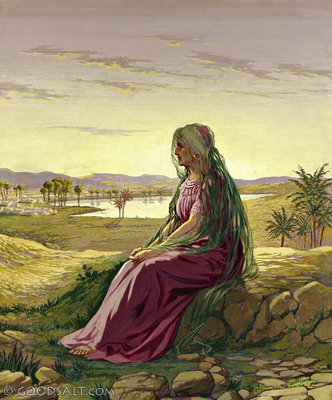
This year I found it in a Bible study I attend at Oasis Church. We've been making our way through Genesis, and the text for study was chapter 16: the birth of Ishmael. What I found there was the Christmas story--yes, perhaps one with Father Abraham instead of St. Nicholas, but a story with a special meaning for gentile Christians (like me) nonetheless.
The chapter begins with the matriarch of the Jewish faith, Sarai. (Abram was a patriarch, indeed, but he fathered many different nations. The strain of the Jewish story in the Old Testament wends back to Sarai/Sarah and the child God promised through her, not through Abram.)
Sarai gives up waiting for a child, and she gives her slave to Abram as a surrogate mother. There is no mention of the enslaved woman's feelings about this arrangement--the prospect of a union with an 85-year-old man could not have felt too enticing. The slave--an exiled Egyptian girl named Hagar who was part of the human bounty of Sarai's brief marriage to Pharoah--becomes pregnant, however, and soon begins to "despise her mistress" (verse 4). The context of the verse implies an "I'm pregnant and you're not" attitude,
but I would posit that Hagar is enslaved by Sarai, forced into a sexual union with Sarai's elderly husband, and impregnated with a child that will legally become Sarai's. I would argue that there are very many reasons for Hagar to "despise her mistress."
What follows is abuse. Sarai mistreats Hagar; Abram abandons her to Sarai's vengeance, "Your servant is in your hands" (verse 6).
What follows is escape. Hagar runs away, and she doesn't stop running until she's on the road back home to Egypt.
What follows is Christmas.
The way to Egypt is perilous for a pregnant young woman to travel alone. Hagar finds a well and waits there for help. The Bible doesn't say it explicitly, but it's safe to say that Hagar prays for help there--begging from the merchants who passed by, and calling out to the God of her elderly protector. (To understand the scene and her need for assistance at the well, consider the assistance her nephew, Jacob, would later give Rachael at a well in Genesis 29: 6-10).
It is at this well that Hagar meets "the angel of the Lord."
The angel encourages Hagar to return to Abram and Sarai, promising not just one child but many descendants.
The angel of the Lord also said to her:
"You are now with child
and you will have a son.
You shall name him Ishmael,
for the Lord has heard you" (Genesis 16.11)
Christmas suddenly seems closer. This seems very close to the directions an angel later gave to Mary:
"You will be with child and give birth to a son, and you are to give him the name Jesus. For he will be great and will be called the Son of the Most High" (Luke 1.32)
The names are different, but the stories share key elements. The message is delivered by an angel; the promise is for everyone.
Ishmael means "God listens." In Hagar's distress, God listened. And the woman whom God heard was no patriarch or matriarch, but an enslaved, abused, runaway, foreign girl.
I know far less of Mary's background than of Hagar's, but the words of her Magnificat echo back in time to paint the picture of Hagar's redemption at the well which she would later name, Lahai Roi, or "The Living One who Sees Me."
My Soul glorifies the Lord
and my spirit rejoices in God my Savior
for he has been mindful
of the humble state of his servant" (Luke 1.46-48).
The name Ishmael--"God listens"--seems very close in spirit to the name that Mary gave her child, Immanuel, "God within us."
Even as Advent is a time when I rededicate myself to "God within," the message of Ishmael's name also resounds. God listens. When we are trapped in the desert, God listens. When we are enslaved, God listens. When all hope seems lost "God listens"...Ishmael--"God listens"...Ishmael, Ishmael, Ishmael.
I'm not the only writer to connect Mary with Hagar. Muhammad, the prophet of Islam, included in the Qur'an a description of Jesus' birth much different from the ones found in the gospels.
"So [Mary] conceived [Jesus]
And she retired with him
To a remote place.
And the pains of childbirth
Drove her to the trunk
Of a palm tree:
She cried in her anguish"
"Ah! would that I had
Died before this...!
But a voice cried to her
From beneath the palm tree:
"Grieve not! for thy Lord
Hath provided a rivulet
Beneath thee
And shake towards thyself
The trunk of the palm tree;
It will let fall
Fresh ripe dates upon thee...
At length she brought
The babe to her people,
Carrying him in her arms. (Surah 19. 22-27)
When I read this text, I don't see Mary. I need Joseph in my Christmas narratives, and a cave in Bethlehem is just too much for me to give up for a lonely birth at the base of a date palm.
When I read this text, though, I see Hagar. She is alone. The son she carries isn't hers--it's Sarai's. A return to her mistress may not necessarily be a return to slavery, but it feels just as bad. Yet here in the desert, Ishmael--God listens. And a stream appears (a reference to Hagar's final escape in Genesis 21.19). And sweet, nourishing dates fall all around her as she strains against the tree in her labor.
I freely admit that I read the Qur'an just as I read the Old Testament: not as a believer, per se, but as a Christian seeking to understand the truth of my Savior, Emmanuel. But I must also admit that I am rooting for Hagar and Ishmael as this story unfolds.
God promises, and the birth of Abram's second son, Isaac, would fulfill the promise that Sarai had sought to circumvent by giving her slave to her husband. It was through Isaac's line that David would rise and the Christ child would be born.
But God listens, as Ishmael's name attests, and God blessed Ishmael and Abraham's other sons with another promise of source. At the time Isaac and Ishmael were being born, I had ancestors living. Most likely they roamed the forests of Northern Europe completely unaware of the machinations of Sarai and her slave. The hope of their deliverance--and of mine--comes through Ishmael as well as Isaac.
God listen then (Ishmael), and God Ishmael's today
And that is the special message Advent has given me this year.
I freely admit that I read the Qur'an just as I read the Old Testament: not as a believer, per se, but as a Christian seeking to understand the truth of my Savior, Emmanuel. But I must also admit that I am rooting for Hagar and Ishmael as this story unfolds.
God promises, and the birth of Abram's second son, Isaac, would fulfill the promise that Sarai had sought to circumvent by giving her slave to her husband. It was through Isaac's line that David would rise and the Christ child would be born.
But God listens, as Ishmael's name attests, and God blessed Ishmael and Abraham's other sons with another promise of source. At the time Isaac and Ishmael were being born, I had ancestors living. Most likely they roamed the forests of Northern Europe completely unaware of the machinations of Sarai and her slave. The hope of their deliverance--and of mine--comes through Ishmael as well as Isaac.
God listen then (Ishmael), and God Ishmael's today
And that is the special message Advent has given me this year.
(I did not have time to add Paul's commentary from Galatians 4.21-28. Suffice it to say, he takes a different take on the Ishmael story--demeaning him as a representative of the old law, not as a part of the promise that Isaac represented.)
11 December 2011
"One Day" takes me back to my own British Romance
The movie follows two friends whose relationship begins on July 15, 1988, the night of their college graduation, and follows them through every July 15 for the next 23years. They engage with other lovers, and they forge new careers, but their friendship remains a constant and pushes them inexorably toward romance.
This blog isn't meant to be a review of the movie, which has its flaws, but it was easy to connect the movie with some experiences that had a huge impact on my life--and it is my own story (and that of my Bride) that the movie brought to life for me.
There are two connections: one basic and one much, much deeper, that the movie raised for me.
I went to college in England for a year, my sophomore undergraduate year, 1990-91. When I left at the of the year, I had built a close friendship with a woman named Jenny George (among many of the close, lifelong friendships I formed that year). Emma and Dexter, the characters in "One Day," are thrown together on the last night of the year. My friendship with Jenny grew over the course of the year, and involved numerous adventures which have been posted on this blog and will continue to present themselves, I'm sure, as the years go by.
One of the great challenges that our friendship faced that year--and in the years that followed--was how it would impact our relationship going forward. At one point during the year, Jenny talked to me about becoming more than friends, but I wasn't ready for a "real" relationship yet. It was the frank honesty of our relationship that allowed me to express that to her--and let us remain friends.
By the time of my sophomore year, when I met Jenny at Newbold College, I had been through many swift romances, and I had had my share of dead-end physical relationships. I needed friendship, I knew, and while I had many close female friends, I knew that doomed, whirlwind, physical relationships were sure ways to kill a friendship. By the time I got to know Jenny, I had drawn a clear line between "Women I was Friends With" and "Women I Wanted to Date." She definitely fell into the former category.
Suffice it to say, it is a challenge to manage the expectations of a close relationship with a member of the opposite sex. A few years later, I "saw the light," as I described in this blog from Valentine's Day, 2007.
In "One Day," it takes Emma and Dexter twenty years to consummate their friendship. And for them, it works out just as well as it did for Jenny and me, who were married four years after we became friends. Had we followed the twenty-year timeline of the movie, we would have been married in the fall of 2010!
I can only imagine the dramatic ways in which our lives would have been different had we followed the "One Day" path--the dead ends, the bad relationships, the adventures and misadventures. I'm so grateful for my friendship with Jenny George; that it was able to blossom into love; and that our love has endured through 17 years of marriage. One day has become one lifetime with person whom I respect and love immensely.
01 October 2011
The Seven-Sided Box: the Symbol of the Cube in the Bible

The Book of Revelation ends with a fascinating image: It is a a "new heaven and a new earth," reborn after the final judgement and the expulsion of sin.
"And I heard a loud voice from the throne, saying, "Now the dwelling of God is with men, and he will live with them. They will be his people, and God himself will be with them and be their God."
One of the actors in this final set piece, one of seven angels who had held seven bowls which poured out seven plagues in the destruction of the "first earth," emerges from the scene, takes the prophet to the top of a mountain, and gives him a preview of the coming kingdom--the New Jerusalem. And is what is striking about the New Jerusalem is this:
It's a cube.
The near wall is 1,400 miles long (the distance between my house in Tennessee and Gallup, New Mexico, going west). It is another 1,400 miles deep (I calculated this would take me to the middle of Hudson's Bay, Canada, traveling due north). It is also 1,400 miles high (about ten times further away than the International Space Station).
So the Bible ends with a giant, gleaming cube descending to planet Earth.
There's more to that cube that I'll cover later, but I'm fascinated by the fact that the New Jerusalem is a cube...until I consider the rest of the Bible, and realize that the whole story is cube after cube after cube--box after box after box--beginning with Genesis 1 and ending in Revelation 21.
Moreover, the cube ties in neatly with another important element of Biblical symbolism: the Number 7.
There is another cube in the Old Jerusalem, the city where Christ taught and died, and it was a copy of a cube constructed by Solomon in his temple. 2 Chronicles 3 states that Solomon laid out the Most Holy Place of that temple to be 30 feet X 30 feet X 30 feet, a perfect cube, separated from the temple's Holy Place by a curtain. (So important was the cube to Solomon's design, that a series of steps climbed from the high-ceilinged main room of the temple to the higher, cubic Most Holy Place.
Within the Temple cube was another box, the Ark of the Covenant (this was not a cube, but a box, about 2.25' X 2.25' X 4'). Within this box was the law of God.
Solomon's design dominated the Jewish imagination all the way to the time of John the Revelator--and not just Judaism, either. The fire-worshipping Zoroastrians incorporated the cubic room into their temples. (Pictured, right, is the Kaba-ye Zartosht, "The Cube of Zoroaster" in Persepolis, Iran, which has origins in the time of Persian King Darius I in the 5th Century BC.)
The Arabic word for cube, "Kaaba," echoes the name of the most sacred site in the religion of Islam: the curtained black cube in the Masjid al-Haram Mosque in Mecca toward which every Muslim directs prayers. (This cube is larger than Solomon's holy room, roughly 40' X 40' X 40'.)
I will describe more about this second cube later as we make our way backwards to Genesis,. Needless to say, Muslims are very aware of Biblical symbolism (moreso than western Christians), and provide an insight into the deep importance that the cube plays with God.
Of course Solomon didn't invent the cube. He based his design for the temple on that of the tabernacle revealed to Moses from Mount Sinai. The tabernacle (also known as the Tent of Meeting) also had a cube-shaped room, 15' X 15' X 15', exactly half the scale of Solomon's room. At the center of this room was also a box, the same box as the one Solomon placed in his Holy of Holies. Within this box were a few artifacts besides the Ten Commandments: a budding rod (a symbol of Aaron's power) and a bowl of manna were missing when the box's contents were chronicled in Solomon's day (1 Kings 8.9).
Creation, the Cube, and the number Seven
Islamic mythology traces the cube back to Adam, who built a cubic worship space in the lands westward of Eden to the specifications of God himself. Future prophets Noah and Abraham would return to Mecca, the site of the Kaaba, to rebuild the shrine (it is important to note here that the current Kaaba dates back to the early 10th Century).
Indeed the creation story can be seen as the building of a cube. Creation is divided into six days--the six sides of a cube. Imagine the creation story as the sides of a cube. There is a square of light at the bottom. The four sides are (1) land and water, (2) sky & vegetation, (3) sun, moon, and stars, and (4) birds & fishes. The top square of this box is the creation of beasts and humans on the sixth day.
When you see the creation story in the form of this cube, I think it grows stronger as a story--and explains some of the scientific contradictions that arise in more literal readings of Genesis 1. The foundation of the cube is light--as John 1 affirms--and its top is mankind. The middle four days are the walls, leaving the fact that Genesis shows plants on the earth a full day before there is a sun to sustain them, as a description of space, not linear time.
One could rewrite Genesis 1 along the lines of Revelation 21 this way: In the beginning, the Cube of Creation descended into chaos This is how the first heaven and first earth were made.
We have known about the linear week, and I know that I have practiced it all my life. But there is a cubic week in Genesis 1: a complete, six-sided box in which everything is complete.
Imagine creation as a cube. Turn it around in your mind and look at its individual sides. See the light, the water, the sky, the fishes, all moving in concert. It is beautiful, isn't it? It's amazing.
It isn't yet perfect.
Genesis 2 begins with the seventh side of the box.
"By the seventh day God had finished the work he had been doing; so on the seventh day he rested from all his work. And God blessed the seventh day and made it holy because on it he rested from all the work of creating that he had done" (verses 2-3).In terms of the box, God needed a seventh side. That seventh side was holiness, and I believe that he put it in the middle of the box--a.k.a. the seventh side. No one waits until the seventh day of the linear week to rest; no, we sprinkle rest throughout the week--it touches all six sides. Nor was holiness intended--I believe--to be a linear idea but a spatial one.
Look back through the Biblical cubes I mentioned. The cubes--the Holy of Holies in the tabernacle and the temple--have boxes in them. And in these boxes is the Law of God. These cubes are filled with holiness.
As always, the prophet Isaiah describes the Seven-Sided Cube far better than I could ever do:
"This is what God the Lord says--Here we have the sides of the box (heavens, earth) and the box's top--the "breath of its people and life to those who walk on it." But there is also righteousness, holiness, the seventh side that touches upon all others. It isn't just attached to the "man" side of the cube, it touches all sides of the creation.
he who created the heavens and stretched them out,
who spread out the earth and all that comes out of it,
who gives breath to its people,
and life to those who walk on it;
'I, the Lord, have called you in righteousness...." (Isaiah 42.5-6)
The New Jerusalem and Me
There is another number in the Bible that has a symbolism quite opposite to the number 7. Revelation states that "it is man's number. His number is 666" (13.18). If the number 7 represents a created cube filled with holiness, it's pretty easy to interpret 666. It means "empty, empty, empty."
I want to close with the first cube--the massive New Jerusalem--because now that I understand the seven-sided box, I want to know this:
What's inside the big cube?
There is no temple in this New Jerusalem (I have written about this wrinkle in a previous blog). This is
"because the Lord God Almighty and the Lamb are its temple. The city does not need the sun or the moon to shine on it, for the glory of God gives it light, and the Lamb is its lamp" (21.22b-24).That's the inside of the box--the seventh side--and it touches on all six sides: the jewel-encrusted foundations, the four golden walls, and the crystal ceiling that glows with the light of the Creator.
There is so much to learn from this paradigm, but I want to close this blog and get your feedback. Here are some questions I hope to answer in the future:
- Did Jesus understand the seven-sided cube? What are some of his teachings that can be understood spatially?
- There are many references to empty boxes in the Bible--a desire to place God's law in the empty hearts of mankind. Can these be better understood by the seven-sided box?
- What are some other cubes mentioned in the Bible? I almost added Noah's Ark to this discussion, but it wasn't a cube--although it was a box. Another nominee might be Joseph's casket as it was carried to Caanan.
10 September 2011
9/11 and Faith, My Journey after that Dreadful Day
CNN posted a story recently on 9/11 and its impact on Americans' faith.
It really struck a chord with me, because it took me back over ten of the most decisive years of my life.
CNN's writer, John Blake, found three significant changes in Americans' faith practices since then:
For me, 9/11 was a faith touchstone. It didn't seem like such a big deal at the time. I was a practicing Christian then; I am a Christian today. But looking back, I think it raised some questions that I had no hope of finding answers to at the time.
CNN's writer, John Blake, found three significant changes in Americans' faith practices since then:
- The humiliation of the attacks had altered Americans' self-identification as a "chosen" nation
- Interfaith forays were more acceptable, with Muslims making inroads to mainstream culture and cooperating with Christian groups more often.
- Atheism had become a forceful, militant idea. It came out of the closet.
- I would add a fourth: the unholy marriage between Christian fundamentalism and Zionism that lured the nation into two world wars--and nearly a third in Iran, had not cooler heads prevailed.
For me, 9/11 was a faith touchstone. It didn't seem like such a big deal at the time. I was a practicing Christian then; I am a Christian today. But looking back, I think it raised some questions that I had no hope of finding answers to at the time.
22 August 2011
Your Education Policies: A View from the Depths
I've had a really tough time so far this year. A passel of new regulations, passed by a viciously anti-teacher legislature last spring, have tied me up in knots and wasted a lot of my time. I wrote this essay between midnight and 1:30 a.m. just to blow off some steam. It's not like I had time to write during my 11-hour workdays. I'm planning to share it with my legislators and with SCORE, a Trojan-horse organization founded by Republicans in Tennessee to de-fund public education and drive every last well-meaning teacher either out of the state or into private or charter school jobs.
I teach at a school that you represent, Station Camp High School in Gallatin. I’m beginning my third week of the school year, teaching German, Creative Writing and 11th-grade English. I sponsor three clubs at our school (yours and mine and my 9th-grade daughter’s).
I’m burned out. That’s right, and it’s only the third week.
Someone needs to tell what’s going on. Someone needs to describe all the work that has been wasted by the onerous regulations placed on public school teachers and administrators in the 2011 legislative session. Someone needs to get you to see the effects of decisions you made six months ago. I will do my best to try.
This is my eighth year at my high school. During that time I have taught every grade level of English, and every strata of each class except A.P. I have also taught--as I am teaching now--German 1 & 2 and creative writing. After three years here--years in which I was observed regularly, and I carefully worked out lesson plans under the direction of my administrators--I earned tenure back in 2007.
While politicians, movie producers and journalists tried to disparage tenured teachers like me with allegations of ineptitude and stories of mysterious “rubber rooms,” I was proud of my tenure. I knew how hard I had worked to earn it. I also knew the ways it could be used to benefit both me and the students who would study in my classes in subsequent years.
Tenure gave me the freedom to turn my classroom into a learning laboratory. I knew how to teach, plan, and manage a classroom--that’s what I understood my tenure to mean. It meant that I had the freedom to experiment with new styles of learning, to reach out and form community partnerships that might benefit learners in my classroom, to organize learning experiences outside the classroom and collaborate with teachers across subject areas and grade levels. I wouldn’t have gotten tenure in the first place if I hadn’t shown mastery of basic teaching methods over three years. Tenure gave me a solid foundation from which I could reach higher.
Over the past three years, this foundation has produced amazing results both for me and for my students at SCHS. My love of experimentation and my creativity--with the support of my school administration--really began to blossom in new ways. I formed a close bond with TPAC Education which brought teaching artists into my school to help make lessons more meaningful. I learned Google Docs and used a donation of 32 used laptops from Volunteer State Community College to create my school’s first “paperless classroom.” This past summer I won a fellowship from the National Endowment for the Humanities to study American history through song at the University of Pittsburgh, where I developed ways to use folk music to augment my literature classes.
I returned from Pittsburgh four days before the administrative day where we learned about the new evaluation system: that tenure was transitory, that teachers who didn’t perform “above expectations” or “significantly above expectations” for two years in a row would return to probationary status. When I saw the regulations--about 30 minutes of paperwork per 90-minute lesson (and I teach three different lessons a day)--I knew that my days as a tenured teacher were numbered. But that didn’t bother me as much as knowing that the freedom I had worked so hard to gain, build, and share with my students, was also transitory.
You need to know what is going on in the schools you represent. If you’re working for teachers, parents and students, you need to understand the results of your policy actions.
This is how Tennessee Educaton Reform 2.0 has worked for me so far:
I’m just speaking for myself. I cannot speak for the administrators whose work loads have doubled with the additional evaluation responsibilities. I cannot speak for the colleagues who were a year away from tenure and now have to wait for three. My kids are all in school now (my youngest is eight), I can’t speak for teachers with young families or those expecting babies, who are now facing this increased workload. You need to talk to them. It is you who need to listen.
I share with SCORE and many others the desire to see Tennessee’s public education system become the best in the South, and I hope that I have demonstrated a willingness to do the hard work that profound change in education requires without explicit, step-by-step direction from the state department of Education.
I just fear that we’re missing out on opportunities for implementing real learning by treating teachers like numbskulls who have to fill out a planning guide and list out standards-based questions on their forms before they can teach a German class how to say “What’s up?” or lead an English 11 class through the turbid waters of Moby Dick.
Last Sunday’s New York Times featured a number of respected thinkers who finished the thought, “If I were president....” James Dyson, the engineer who re-invented the vacuum cleaner, wanted to change education in the right way:
Part of me is willing to accept a lower TVAAS score because I chose to teach my students about thinking and not “box-ticking.” I would rather see a student demonstrate a love for learning than a high score on an end-of-course exam. As a teaching professional, of course I want to grow towards both goals, but as an overworked, maligned public school teacher, I feel hung out to dry.
In your capacity, you attend a meeting, you write a press release, you attend a luncheon or a fundraiser, and you feel like you have done something with your day, you might even feel like you did some good. Where I’m at now, I grade sixty papers and work 90 minutes on planning, and I feel like I have only fallen an hour further behind where I need to be. I haven’t contacted parents, I haven’t arranged extra time to help a student who isn’t yet up to speed, etc.
Tennessee has gone too far towards standardization in its onerous micromanagement of teachers, both tenured and non. Legislators and policy advocates have taken away from teachers and administrators the freedom to experiment with learning, the room to let students try--then fail--then explain and learn. I hope that this letter may apprise you of the situation on the ground and encourage you towards more balanced, more rational policies in the future.
Sincerely,
James Dittes
Station Camp High School
I’m burned out. That’s right, and it’s only the third week.
Someone needs to tell what’s going on. Someone needs to describe all the work that has been wasted by the onerous regulations placed on public school teachers and administrators in the 2011 legislative session. Someone needs to get you to see the effects of decisions you made six months ago. I will do my best to try.
This is my eighth year at my high school. During that time I have taught every grade level of English, and every strata of each class except A.P. I have also taught--as I am teaching now--German 1 & 2 and creative writing. After three years here--years in which I was observed regularly, and I carefully worked out lesson plans under the direction of my administrators--I earned tenure back in 2007.
While politicians, movie producers and journalists tried to disparage tenured teachers like me with allegations of ineptitude and stories of mysterious “rubber rooms,” I was proud of my tenure. I knew how hard I had worked to earn it. I also knew the ways it could be used to benefit both me and the students who would study in my classes in subsequent years.
Tenure gave me the freedom to turn my classroom into a learning laboratory. I knew how to teach, plan, and manage a classroom--that’s what I understood my tenure to mean. It meant that I had the freedom to experiment with new styles of learning, to reach out and form community partnerships that might benefit learners in my classroom, to organize learning experiences outside the classroom and collaborate with teachers across subject areas and grade levels. I wouldn’t have gotten tenure in the first place if I hadn’t shown mastery of basic teaching methods over three years. Tenure gave me a solid foundation from which I could reach higher.
Over the past three years, this foundation has produced amazing results both for me and for my students at SCHS. My love of experimentation and my creativity--with the support of my school administration--really began to blossom in new ways. I formed a close bond with TPAC Education which brought teaching artists into my school to help make lessons more meaningful. I learned Google Docs and used a donation of 32 used laptops from Volunteer State Community College to create my school’s first “paperless classroom.” This past summer I won a fellowship from the National Endowment for the Humanities to study American history through song at the University of Pittsburgh, where I developed ways to use folk music to augment my literature classes.
I returned from Pittsburgh four days before the administrative day where we learned about the new evaluation system: that tenure was transitory, that teachers who didn’t perform “above expectations” or “significantly above expectations” for two years in a row would return to probationary status. When I saw the regulations--about 30 minutes of paperwork per 90-minute lesson (and I teach three different lessons a day)--I knew that my days as a tenured teacher were numbered. But that didn’t bother me as much as knowing that the freedom I had worked so hard to gain, build, and share with my students, was also transitory.
You need to know what is going on in the schools you represent. If you’re working for teachers, parents and students, you need to understand the results of your policy actions.
This is how Tennessee Educaton Reform 2.0 has worked for me so far:
- I have attached below the lesson-planning form that was adapted by my school’s administration. It includes all the relevant data that will go into my evaluations this year. It took me 30 minutes to produce. The toughest part about the planning form isn’t the questioning or the assessment--I’ve been doing that since I started teaching, it’s how I gained tenure. It’s wasting time referencing the standards. In German 1 there are about 20 to utilize, but in English 11, there are almost 70 state performance indicators (SPI’s). I find myself asking, “This is a logic lesson. Is it 5.2 or 5.4?”
- This has tripled the amount of time it takes me to plan lessons. Usually I have lesson plans posted a week in advance of the lessons I teach. This year, I’m struggling to stay one to two days ahead.
- My grading has increased markedly--not directly because of the state regulations, but because of an ambitious goal I had set to make my classes paperless. With laptops at every desk, students generate about 30-35% more work for me to grade. This is an exchange that I’m willing to make, because (1) I am investing my time to see kids learning more, and (2) I’m optimistic that eventually technology will let me cut the grading load to what it was before or less. Before, the satisfaction of seeing successful learning and being a part of technological innovation made the extra work worthwhile. Now I feel like I’m doing a lot of work the State of Tennessee doesn’t necessarily want me to do, and instead I should spend more time acting and planning like a non-tenured teacher. You might imagine the frustration I feel there.
- I have no time. Last year I graded at home from 9 to 10 five nights a week; this year I am grading/planning from 8:30 to 11, and I have little to show for it. Last year I graded on Sundays only when I had a big batch of essays to complete. The first Sunday of this school year, I spent four hours at my school setting up for the launch of my paperless classroom. Last Sunday, my wife and kids went to the movies without me so I could spend five hours getting my grades ready to post and plotting out lessons for my three classes.
- I can’t perform the kinds of leadership roles I want to provide to other, less-experienced teachers. I mentioned earlier how I arranged for teaching artists from TPAC Education to come to our school. Last year I had three colleagues join me in an Arts in Education Unit. This year, we’re all so busy trying to keep our heads above water, we’ve all but given up on the idea, losing precious momentum toward Arts in Education that I had labored to build over two years. I learned some cool new teaching tricks at the NEH Summer Institute that I would love to share through a professional development, only I have no time to draw up a proposal, much less plan a three-hour training.
- I can’t develop the technology that I brought into my school last year, and I can’t train other teachers to use these 21st-century teaching tools. I want to train more teachers at my school about Google Docs and utilizing technology in the classroom. This summer the district brought in a “tech guru” from Atlanta as a keynote speaker. I got to have a private meeting with her to share some of the things I was doing with Google Docs in the classroom. While she had a broad knowledge of Google applications--and other forms of software--she hadn’t experimented with it in the classroom setting like I had, and she was very impressed. I don’t get paid four figures a day to visit Tennessee like she did (it would be nice, but let’s face it, I’m just fighting to keep my job in this state, much less tenure). I live here and have committed myself to my county’s education success, not just my own. I can’t do it, though. That’s what I’ve realized in just three weeks.
I’m just speaking for myself. I cannot speak for the administrators whose work loads have doubled with the additional evaluation responsibilities. I cannot speak for the colleagues who were a year away from tenure and now have to wait for three. My kids are all in school now (my youngest is eight), I can’t speak for teachers with young families or those expecting babies, who are now facing this increased workload. You need to talk to them. It is you who need to listen.
I share with SCORE and many others the desire to see Tennessee’s public education system become the best in the South, and I hope that I have demonstrated a willingness to do the hard work that profound change in education requires without explicit, step-by-step direction from the state department of Education.
I just fear that we’re missing out on opportunities for implementing real learning by treating teachers like numbskulls who have to fill out a planning guide and list out standards-based questions on their forms before they can teach a German class how to say “What’s up?” or lead an English 11 class through the turbid waters of Moby Dick.
Last Sunday’s New York Times featured a number of respected thinkers who finished the thought, “If I were president....” James Dyson, the engineer who re-invented the vacuum cleaner, wanted to change education in the right way:
“Standardization and rote learning lead to sub-standard results because they don’t inspire or challenge. My solution: get rid of binary right and wrong answers. Experimentation is learning. Only through making mistakes do we find out what works, what to do differently and how to get better. Box-ticking does not correlate with world winning. Certificates won’t beat global competition. Creativity will.” --Kornbluth, Jesse, “If I Were President,” New York Times, Sunday Review Section, 21 August 2011.
Part of me is willing to accept a lower TVAAS score because I chose to teach my students about thinking and not “box-ticking.” I would rather see a student demonstrate a love for learning than a high score on an end-of-course exam. As a teaching professional, of course I want to grow towards both goals, but as an overworked, maligned public school teacher, I feel hung out to dry.
In your capacity, you attend a meeting, you write a press release, you attend a luncheon or a fundraiser, and you feel like you have done something with your day, you might even feel like you did some good. Where I’m at now, I grade sixty papers and work 90 minutes on planning, and I feel like I have only fallen an hour further behind where I need to be. I haven’t contacted parents, I haven’t arranged extra time to help a student who isn’t yet up to speed, etc.
Tennessee has gone too far towards standardization in its onerous micromanagement of teachers, both tenured and non. Legislators and policy advocates have taken away from teachers and administrators the freedom to experiment with learning, the room to let students try--then fail--then explain and learn. I hope that this letter may apprise you of the situation on the ground and encourage you towards more balanced, more rational policies in the future.
Sincerely,
James Dittes
Station Camp High School
Subscribe to:
Posts (Atom)