25 November 2010

I waited patiently for the Lord: A Meditation on Psalm 40

Destiny is an old man's game.

Trust me. I've spent years trying to teach teens about Fate, about ancient beliefs that our lives were out of our control. I felt like I had to teach this--it is essential to understanding works like The Iliad and The Odyssey. Yet I was teaching it to teenagers. Considering the audience, you can imagine that I would have been more successful peddling acne creams in an old-folks home.

I guess that's both the most fascinating and yet also most demoralizing aspect of being a teenager: that age's rejection of anything resembling destiny. On the one had, the teen years usually feature a struggle for control of one's life. This requires a rejection of destiny and a desire to pursue one's own path.

On the other hand, looking back, I realize how many choices I made as a teenager--both bad and good--set my life on the course it has followed.

If I sound like an old man who is writing this...well, I am. As of this writing, I am just three months shy of turning 40. I don't think that's why I chose Psalm 40. I don't think that it's because Psalm 40 inspired a rock song of the same title by my favorite group, U2. I think it's about destiny--the psalm that is.

I didn't choose Psalm 40; it chose me.

I have spent the last few months reading the psalms in Solomon's Temple. I don't own a time machine--just a Bible, an imagination, and a real desire to get to "the heart of worship," i.e. a vision of worship as it might have appeared in Solomon's day, the era during which most of the psalms were written.

And while I have been able, thus far, to consider many aspects of the temple service--the pilgrimage to Jerusalem, the rhythm of the songs, the roles and the speakers in the songs, and the role that the temple and its surroundings played in worship--there has been one aspect that has been missing: the order of service.

Over the years I have served on many church worship committees. Because so many of the parts of a service--the offering, the hymns, the sermon--are so traditional, committees often seek re-ordering the service to enhance worship. We place the announcements in the middle of the set of hymns, for example, or we move the offering to the end of the service. Psalm 40 is personal reflection on one act of worship. Hidden therein is a full worship service--and links to two of the Old Testament's most fully realized worship experiences.

The Pilgrimage
Psalm 40 begins with waiting--a theme that will carry throughout the Psalm.
"I waited patiently for the Lord;
he turned to me and heard my cry" (verse 1).
Worship isn't the place where we wait for God. That can happen anywhere. It is the place where he turns--where he hears--and bends toward us. It is not a proposal. It is an engagement.

The psalm continues with the words of pilgrimage. As I described in an earlier blog, the way to worship is as important as the celebration in the temple courts. Worshipers have risen from the "slimy pit" of suffering, the "mud and mire" of despair. Our feet have a firm place to stand on the rock of Mount Zion, in the temple proper (verse 2).

A new song graces our lips as we enter his courts with thanksgiving and praise (verse 3, Psalm 100:4) We look around at the temple courts, packed with people--the music blending with the sounds of animals--and we cannot help but think:
"Many will see and fear
and put their trust in the Lord" (verse 3).


Pilgrimage is a theme of many Old Testament worship services. If I could go back in time and attend just one worship service, it would be singing praises with Miriam by the Red Sea (Exodus 16.19-21), following the pilgrimage from Egypt to Freedom and full of the images of a "muddy pit." Who wouldn't love to be present to hear the praises Jacob uttered as he raised his pillow at Bethel or witness the sacrifice of Abraham and his redeemed son at the top of Mount Moriah?

But my focus in this series is temple worship, and as Psalm 40 leads me into the order of service as it would have appeared in the temple, I want to focus on two services: the dedication of the temple, found in 2 Chronicles 5 and (for details) the dedication of the tabernacle as described in Leviticus 9. The temple dedication--and Solomon's speech there--is the Old Testament's most glorious worship service.

It began with pilgrimage--a journey of the nation's leaders and a very special box:
When all the work Solomon had done for the temple of the Lord was finished, he brought in the things his father David had dedicated--the silver and gold and all the furnishings--and he placed them in the treasuries of God's temple.
Then Solomon summoned to Jerusalem the elders of Israel, all the heads of the tribes and the chiefs of the Israelite families, to bring up the ark of the Lord's covenant from Zion, the City of David. And all the men of Israel came together to the king at the time of the festival in the seventh month.
When all the elders of Israel had arrived, the Levites took up the ark, and they brought up the ark and the Tent of Meeting and all the sacred furnishings in it. The priests, who were Levites, carried them up; and King Solomon and the entire assembly of Israel...were before the ark, sacrificing so many sheep and cattle that they could not be recorded or counted (2 Chronicles 5.1-6)
I imagine this pilgrimage, as it choked the streets of the city with songs of praise and the cries of animals. Before the ark even reached the temple, the blood of sacrifice ran down the streets. Few could contain their excitement

Many could see. Many feared. Many trusted.


Verse four begins, "Blessed is the man." The Levites are gathered, the singers ready, the worship leader stands above the entrance to the inner courtyard and calls out:
"Blessed is the man
who makes the Lord his trust,
who does not look to the proud,
to those who turn aside to false gods" (4).
The choir echoed the invocation in the next verse of the psalm:
Many, O Lord my God,
are the wonders you have done.
The things you planned for us
no one can recount to you;
were I to speak and tell of them,
they would be too many to declare" (5)
The choir for the temple dedication included the families of Asaph (author of twelve psalms), Heman (Psalm 88) and Jeduthun (psalms 39, 62 and 77). "[They] stood on the east side of the altar, dressed in fine linen and playing cymbals, harps and lyres" (2 Chronicles 5.12). An additional 120 trumpeters backed up the choir, which sang, "He is good; his love endures forever" as "the glory of the Lord filled the temple of God" (verses 13-14).

God had turned; he had heard and filled the worship place with glory.

The Sacrifice
Psalm 40 continues with a meditation on the sacrifice. The speaker understands its role in the service, but he seeks a deeper meaning.
Sacrifice and offering you did not desire,
but my ears you have pierced;
burnt offerings and sin offerings
you did not require (6).
There is a lot to this simple verse, which summarizes the three types of worship sacrifice that were initiated by Moses:
  1. Fellowship Offering. The fellowship offering wasn't connected to sin but to joy and gratitude. At the dedication of the tabernacle in Leviticus 9, Aaron and his sons sacrificed an ox, a ram and sheaves of grain dipped in olive oil. They smeared the blood of the sacrifices along the sides of the altar, and they roasted the choice parts of meat over the fire until the fat had melted away (verses 16-21). At the dedication of the temple, the spontaneous sacrifices that preceded the dedication service (2 Ch 5.6) probably filled this role.
  2. Sin Offering. Separate offerings for priests (a bull calf) and the people (a male goat), this sacrificed took the blood from the victims, touched portions on each of the four horns of the altar, and poured the rest around the base of the altar. Only the fat of the victims was burned in the altar fire (Lev. 9.2, 9-10). Solomon's sin offering was 22,000 bulls and 120,000 sheep and goats (2 Ch 7.5). Considering the volume of Solomon's sins...ahem...no, this sacrifice covered the total population of priests and residents in Israel.
  3. Burnt Offering. The burnt offering was an ongoing fire of sacrifice, meant to be celebrated daily. The blood of the victims was poured on the sides of the altar, the head and guts were burned completely (Lev. 9.12-14). God had said of this offering, "The fire on the altar must be kept burning; it must not go out. Every morning the priest is to ad firewood and arrange the burnt offering on the fire and burn the fat of the fellowship offerings on it" (Lev 6.12) Solomon's burnt offering would be consumed at the climax of his dedicatory prayer as "fire came down from heaven and consumed the burnt offering and the sacrifices, and the glory of the Lord filled the temple" (2Ch 7.1).
So what could the Psalmist mean that God would not desire such sacrifice? The 6th through 9th chapters of Leviticus reveal a God who is quite concerned with sacrifice down to the finest detail--down to the destruction of Nadab and Abihu for performing the sacrifice incorrectly.

I think that he understands that the attitude of sacrifice is what God desires, not the blood of the victims itself. The sin offering represented a plea for forgiveness, the fellowship offering stood for a posture of praise, the burnt offering was the wishes and the prayers directed to God throughout the day. As Paul would later write to the Thessalonians, "Pray continually" (1Th 5.17). This was the burnt offering that God required of committed Christians.

Entering the Temple
The psalm moves from the altar into the temple in verses 7 and 8.
Then I said, 'Here I am, I have come--
it is written about me in the scroll.
I desire to do your will, O my God;
your law is within my heart'

My favorite verse of the psalm, this time in the temple achieves two things.

One, I find it surprising that a psalm that began with waiting--"I waited patiently for the Lord"--now reveals that God had waited for man. "It is written about me in the scroll," would imply that God's destiny for the speaker was written long before, only awaiting revelation to spring into action. Before we could breathe, much less seek God in our sorrow, he had written of us in the scroll.

Second, the psalmist desire's God's will. This mirrors the use of the word, "desire," in verse 6 which stated, "Sacrifice and offering you did not desire." God does not desire sacrifice; we desire to do his will. I would summarize it like this: "God does not desire sacrifice; he desires our desire to do his will."

Following the thank offerings and praise of the temple's dedication, the Ark of the Covenant was carried into its place in the Most Holy Place and set between two huge statues of cherubim (these angel statues were in addition to those carved above the gilded box, Ex. 25.21). "The cherubim spread their wings over the place of the ark and covered the ark and its carrying poles" (2 Ch. 5.8). A priestly auditor inspected the contents of the box and found "two tablets that Moses had placed in it at Horeb, where the Lord made a covenant with the Israelites after they came out of Egypt" (verse 10).

Psalm 40 can be adapted to describe this scene:
"I have come--it is written about me on the tablets.
We desire to do your will, O Lord, your law is within our temple"
It seems strange, doesn't it, almost out of place? The blood of sacrificial victims, the huge cherubim statues, the temple itself are not themselves essential to worship. Our desire--submitted full to God's will--yields worship.

Blessing the People
A sermon closes the public portion of worship in Psalm 40, which follows a worship outline of six steps:
  1. pilgrimage or entrance
  2. invocation
  3. sacrifice
  4. reading of the law (entering the temple with the ark or incense)
  5. sermon, and
  6. personal dedication
The speaker has a message to share with others in "the assembly:"
"I proclaim righteousness in the great assembly;
I do not seal my lips,
as you know, O Lord.
I do not hide your righteousness in my heart;
I speak of your faithfulness and salvation.
I do not conceal your love and your truth
from the great assembly" (verses 9-10).
The speaker disappears into this message--it's not about him, it is about God. He praises "your righteousness" and "your salvation." He reveals "your love and your truth" to the members of his congregation.

After God's glory had filled the temple, accepting the sacrifices, the praises and the deposit of the law, the dedication of the temple continued with a public blessing. "While the whole assembly of Israel was standing there, the king turned around and blessed them" (2 Ch 6.3).

Solomon proclaimed that "the God of Israel...has fulfilled what he promised with his mouth to my father David" (verse 4). He listed the steps that had led to the building of the temple. Sadly, the closing of his blessing lacked the God focus of the psalmist and appears rather arrogant. Note how many times he refers to himself and how often he refers to God:
"The Lord has kept the promise he made. I have succeeded David my father and now I sit on the throne of Israel, just as the Lord promised, and I have bult the temple for the Name of the Lord, the God of Israel. There I have placed the ark, in which is the covenant of the Lord that he made with the people of Israel" (verses 10 & 11).

The Prayer of Personal Dedication
Following his declaration in front of the full assembly, the speaker who closes Psalm 40.11-17 seems quite different from the confident, inspired public speaker. While all is well with God, it is not well with him.

1. He is overcome with sin. He fears his hold on God's mercy, he acknowledges sins "without number...they are more than the hairs of my head" (verse 12). This is not a public acknowledgement. It is a private plea, meant for God's ears alone.

2. He is under threat of attack. He follows a plea for mercy with a petition for safety. Some enemies "seek to take my life," many more "desire my ruin," and still others "say to me, 'Aha! Aha!" (verses 14-15). These are the thoughts, I'm sure, of any political leader--as David was. They are also the fears that every person shares.

3. He is waiting...again. The psalm closes with the words, "O my God, do not delay" (verse 17). It is a return to the mood that opened worship, "I waited patiently for the Lord" (verse 1).

What could all of this mean? I think it shows that true worship is both uplifting and humbling. That may seem like a contradiction, but the psalms are very clear that God alone is lifted up. It is never man (see Psalm 8).

Worship is like looking through a telescope: the further into the heavens one looks, the smaller the world begins to look. God's righteousness makes ours seem feeble. His peace makes ours seem fragile. We wait...we worship...and we wait to worship again.

Solomon closed his service with a prayer of dedication. It was not a public address, per se. "He knelt down before the whole assembly of Israel and spread out his hands toward heaven" (2Ch 6.13). A scribe wrote down every word. While the prayer fills most of the chapter, verses 14-42, it follows the same structure as the prayer in Psalm 40:
  1. Sin. "Will God really dwell on earth with men?" Solomon famously asked (v. 18). He wants forgiveness for the people, beyond the thousands of sacrifices. "Hear the supplications of your servant and of your people Israel when they pray toward this place. Hear from heaven, your dwelling place; and when you hear, forgive" (v. 21).
  2. Security. The need for stability and security takes up the bulk of Solomon's prayer. He prays that God will judge disputes between citizens (verses 22-23), avert attacks from foreign enemies (verses 24-25, 32-39), and prevent famine and pestilence (verses 26-31).
  3. Waiting. The temple is already beaming with the glory of God, so it seems ironic that Solomon would ask, "Now arise, O Lord God, and come to your resting place, you and the ark of your might" (verse 41). It is the form of prayer that speaks here--the same form that inspired Psalm 40 a generation earlier. Solomon's prayer closes with a plea, "O Lord God, do not reject your anointed one. Remember the great love promised to David your servant" (42). It echoes the plea, "I am poor and needy" that closes Psalm 40.
Worship: The Aftermath
Psalm 40 closes with supplication, but 2 Chronicles continues with the amazing events that followed Solomon's prayer of dedication.

The "amen" or ending of Solomon's prayer is scarcely out of his mouth when fire from heaven consumes the sacrifices and glory pours out of the temple (as it had in 2Ch 5.13).

The people sing more praises. The courtyard and the outer courts throng with the song, "He is good; his love endures forever" (2Ch 7.3).

There are even more sacrifices. The chronicler records astonishing numbers of sacrificial victims: 22,000 cattle, 120,000 sheep and goats (verse 5). If the earlier sacrifices "could not be recorded or counted" this day's sacrifice--and the feasting that followed it, no doubt--was truly amazing (see 2Ch 5.6 for earlier sacrifices).

The celebration went on for weeks. Eight days after the dedication of the altar, Solomon inaugurates another festival (probably the Feast of Tabernacles, Lv 23.36, a Thanksgiving or All Saints Day), and the celebration continues for another week. Finally Solomon sent the people home. They were "joyful and glad in heart for the good things the Lord had done" (2Ch 7.10).

Solomon received a special visit from God, a personal assurance that "I have heard your prayer and have chosen this place for myself as a temple for sacrifices" (2Ch 7.12). But God's appearance is full of destiny, the kingdom is not eternally secure: its stability rests on choices that Solomon and his descendants will make.

The worship of the psalmist emerges from Psalm 40 in a vibrant way. It reflects the details of the single-greatest worship event described in the Old Testament. It is a guide to worship today.


04 November 2010

Better is One Day in Your Courts: A Meditation on Psalm 84

There is a right way to worship.

I can't count the number of discussions I've had over the years regarding this way to worship. Yet, looking back, I realize that most disagreements about worship dealt with items within the worship service--hymns, scripture readings, sermons, prayers.

There is another way to worship--a right way, a true way--and it takes place en route to worship. After all, the psalmist writes
"Enter his gates with thanksgiving, and his courts with praise;" Psalm 100.4
Worship is something that begins outside the sanctuary. It is carried into the holy place and fulfilled there.

(Incidentally, I look back on other theological questions I have struggled with, and I realize now that many dealt with a misunderstanding of the word, "way." When Christ states, "I am the way," is he claiming to be the way/method or the way/road?)

In Psalm 84, like the psalms of ascents later in the book, the way to worship is a road--one paved with celebration and one that ends in worship.

It is fun to look back on times that I worshiped and try to remember how I got there. For many years here in Portland, the kids and I walked to church most Sabbaths on a path I had carved through the woods. When I was a kid, the way to worship followed the winding, hilly roads of southern Ohio.

One way to worship comes to mind when I read Psalm 84. In June of 1996 I spent a weekend with relatives in Diedelsheim, Germany (a village so small it is now a vorort of the town of Bretten, about 25 miles outside of Karlsruhe). On Sunday morning, the bells of the village's Lutheran church summoned me to worship, much as they had summoned my ancestors who had lived in the village from 1589 to 1901 (when my great-grandfather emigrated to America).

It's funny. I remember very little about the service that day, but I can recall nearly every step down Albert-Schweitzer-Strasse to Steinzeugstrasse to the church.

It was the way to worship--a worship I had never known. Or maybe I had. It was a way to worship that generations of Ditteses had known, after all. (Pictured at right, the caption, translated, reads, "Church with old Dittes House, today Guhl." The Dittes House is in the foreground. Perhaps the walk was even shorter--the bells louder--when my ancestors roamed these streets!)

Psalm 84 celebrates the way to worship.
How lovely is your dwelling place,
O Lord Almighty!
My soul yearns, even faints,
or the courts of the Lord;
my heart and my flesh cry out
for the living God (verses 1-2).
The vigor of this psalm overwhelms the reader. It seems like I am already in worship. Maybe I am, but "the courts of the Lord" are still some ways off. "My soul yearns [and] faints" for them. I haven't entered yet.

Temple worship began outside the temple, often a long way off. Summoned by trumpets, worshipers filled the streets of Jerusalem, dressed in their brightest colors as they danced to the Temple Mount. Pilgrims hurried through the valleys on either side of the city, their journey having begun before the sunrise.

The way to worship was a melange of sight and sound, too. Chariots of the king and his nobles clattered along the pavement, and heralds made way. Animals lowed as they were herded through narrow streets, destined for sacrifice.

One of the best visual images of this way to worship was captured by Athenian sculptors in the frieze around the Parthenon known today as the Elgin Marbles.* The scenes presented there show the procession of worshipers who celebrate the Panathenaic festival.

One of the great senses that one gets from viewing the Elgin Marbles is the joy of the worshipers. Boys grin and gesture as they rise toward the Acropolis. Cows struggle and buck as they are led to slaughter. Women parade in their finest clothes. This is a vivid scene from Athens. It hearkens to Jerusalem in the moments that led to worship--the moments described in Psalm 84.

A Search for Home
"Even the sparrow has found a home,
and the swallow a nest for herself,
where she may have her young--
a place near your altar,
O Lord Almighty, my King and my God.
Blessed are those who dwell in your house;
they are ever praising you" (verses 3-4).
I love this break in the meditation on God's dwelling place. A sparrow nests there. The temple is a place of worship, but it isn't pristine. It is a holy place, yet the humblest of creatures also has a dwelling place there, perhaps close enough to the altar to sing before kings!

When this stanza closes with the words, "blessed are those who dwell in your house; they are ever praising you," the songs I hear are bird songs, not (yet) the hymns of priests and Levites.

The Pilgrimage
The next section of the psalm is a pilgrimage allegory. See if you can catch the double meaning before I explain it below:
"Blessed are those whose strength is in you,
who have set their hearts on pilgrimage.
As they pass through the Valley of Baca,
they make it a place of springs;
the autumn rains also cover it with pools.
They grow stronger, ever stronger,
till each appears before God and Zion" (verses 5-7).
This is a psalm of the way to the temple. These verses fill my imagination with dreams of pilgrimage: climbing from the Jordan Valley, cresting the Mount of Olives, and hurrying through the Kidron Valley, always looking up toward the temple, listening for the sounds of trumpets.

The arid valley suddenly turns green as springs burst from the ground. The "autumn rains" are soothing and gentle (there is no winter in the Holy Land, and these rains would be the equivalent of the soft rains of January and February I remember from Arizona). This imagery brings to mind the Passover celebration, wedged as it is at the end of winter/autumn and just before the full rush of spring.

I thought I knew the valleys around Jerusalem, the Kidron Valley to the east and the Hinnom to the south. These verses took me aback, trying to find a valley called "Baca" or weeping. That's when the double-meaning really struck me. This wasn't a literal pilgrimage from Jericho to Jerusalem; it was a metaphorical pilgrimage through the "valley of the shadow of death."

As believers pass through a valley of weeping, "[their tears] make it a place of springs." How deep the suffering must be! This isn't a place of sadness, but despair--so much despair that the cool autumn rains are an afterthought which "also" fill the pools.

This valley of weeping is only a part of the journey for believers, who "go from strength to strength" (I interpret this line as "grow stronger and stronger" above) until they reach the temple courts in Zion, also known as the presence of God.

The Prayer
The pilgrimage is at an end. The psalm ends with a prayer and a dedication.
"Hear my prayer, O Lord God Almighty;
listen to me, O God of Jacob
Look upon our king, O God;
look with favor on your anointed one.
Better is one day in your courts
than a thousand elsewhere;
I would rather be a doorkeeper in the house of my God
than dwell in the tens of the wicked.
For the Lord God is a sun and shield;
the Lord bestows favor and honor;
no good thing does he withhold
from those whose walk is blameless.
O Lord Almighty,
blessed is the man who trusts in you" (verses 8-12).
This prayer takes me to the temple courts--even to the inner courtyard that surrounded the temple building. The king is here. He joins the sparrow--he joins me--in worship. I think, 'I could dwell in this place forever, just like God does.'

I've had the privilege of visiting many beautiful places in my lifetime--places where I would be happy just living in a tent or trailer, waking up to the beautiful view. You could give me a cave and a sleeping bag anywhere on the Gower Peninsula of Wales, and I would wake every day happy. A heater and a yurt would give me year-round pleasure in northern Wyoming. The shade of a Ponderosa is all the shelter I would need along the Arizona-New Mexico border.

As I think back to those beautiful places, I realize that I spent very little actual time in any one of them. A weekend camping trip, perhaps, or a glorious moment of sunset. Even so, they inspired a thousand moments of reflection, wonder and peace. "One day in your courts" is indeed a culmination of pilgrimage (both physical and spiritual), but it is also the moment of worship--of wonder--from which we gain inspiration over a lifetime.

What if there could be more? More wonder, more worship, day after day, leading to months, years, a lifetime? This is the feeling of the singer of Psalm 84. A doorkeeper isn't a great job. You sit around most of the day; you say, 'watch your step,' over and over again. Yet even this lowly job is superior to the luxuries of the wicked. (When the psalm mentions "the tents of the wicked," it isn't talking about "roughing it." These tents--of foreign nobles, of generals at war--were often as luxurious as palaces, with carpets, fine draperies and golden flatware.)

Besides, who needs warmth or shelter when "the Lord God is a sun and shield"?

There is one right way to worship. Psalm 84 shows the way.

It begins with a longing. It prevails through sorrow and weeping. It grows stronger as it climbs toward Mount Zion. It ends in a resting place where God himself is our warmth, our shield, our dwelling place.

* The Parthenon was built atop the acropolis in Athens about 150 years after the destruction of the first temple, so I'm not saying the images are contemporary in any way, only the way of worship through the streets of the city and the spirit therein.

13 October 2010

More than Watchmen Wait for Morning: a Meditation on Psalm 130

A psalm is word and rhythm and praise.

Think about that...then repeat--

a psalm is word and rhythm and praise.

Can you hear it? The rhythm rumbles the bones. It resonates.

a psalm is word and rhythm and praise--

Do you see the way the rhythm of that line makes "word" and "praise" ride the crests of the waves. The words just jump out and declare "I'm here"? When the rhythm is right, you can even feel it.

A psalm is word and rhythm and praise, and understanding that rhythm not only helps to mine the meaning of the psalms, it also helps to imagine how they were sung during temple worship, the ceremonies celebrated in Judea during the 377-year reign of the House of David.

In previous posts, I have tried to imagine the public spectacle of the psalms: their music, the way they sounded in the temple courts, the parts played by the choir, the musicians, the speakers and--most of all--the people.

In the fifteen "songs of ascents" (Psalms 120-134), a different kind of performance emerges, one that could be repeated--and danced--in the temple courts, most certainly, but also one that could be shared between two believers or at a small festival gathering.

One story goes that the "songs of ascents" were sung at the steps leading to the temple gates--others have them sung at the steps into the Holy Place. I like this scenario because it compliments the idea that these psalms were chanted and repeated, chanted and repeated. The leader climbed a step and chanted a line; then the assembly joined him on the step and repeated the line. Step by step, worshipers chanted the song until they had entered the temple.

As I listened to this psalm in my Bible study, I realized that I couldn't hear parts anymore--I heard rhythm, and I also heard repetition. I felt grateful for the NIV translators whose hard work preserved so much of the rhythm of the words--and I also felt empowered to tweak the rhythm once I had the gist.

I want to present the Psalm below, then, as a chant, not as straight text. I hear each line presented by a leader and repeated by an assembly. As the psalm develops, so does a natural rhythm. For me, it develops in 4/4 time, and that's the way I will present the psalm below.

Grab a tambourine or a cymbal, then!
OUT of the DEPTHS i CRY to you, LORD--
Out of the depths I cry to you, Lord
O LORD [beat] HEAR my
VOICE [three beats]
O Lord hear my
Voice
Can you feel the rhythm of the lines?
Moreover, I love the way the psalm begins. A song of ascents that begins in the "depths"? Of course it does! Where else could such a psalm start? My imagination races to think of ascents in the Holy Land: the incline leading from Jericho & the Dead Sea to the hills of Jerusalem; the walk upwards through the city to the Temple Mount; the climb up the steps of Solomon's Porch to the temple gates, or the steps that led from the courtyard to the temple entrance.
With each step I feel the beat--one, two, three four, "Out of the depths, I cry to you, Lord."
let your EARS be atTENtive to CRIES of MERcy
Let your ears be attentive to cries of mercy
if YOU, LORD, [beat] kept a REcord of
SINS [three beats]
If you, Lord, kept a record of
Sins
O.LORD [beat] WHO could
STAND? [3 beats]
O Lord who could stand?
But with YOU there IS forGIVEness
But with you there is forgiveness
THERE.FORE [beat] YOU are
FEARED [three bearts]
Therefore you are feared.
A plea for mercy emerges--"cries" is the third beat of the line--and the plea swells with the repetition. The rhythm slows down the words, and we spend a line (four beats) on the word, "sins." The speaker is humble, thoughtful, vulnerable. The words have slowed, but the beat will pick up in the 2nd half of the psalm
I WAIT for the LORD, my SOUL waits YET
I wait for the Lord, my soul waits yet
And in HIS.WORD i PUT my HOPE
And in his word I put my hope
My SOUL.WAITS for the LORD [beat]
My soul waits for the Lord
MORE than WATCHmen WAIT for MORNing
More than watchmen wait for morning
MORE than WATCHmen WAIT for MORNing
More than watchmen wait for morning
At this point, the key line of the psalm could be repeated forever, in my opinion. Waiting for the Lord is a theme of many psalms (40, 27, 89, 119, 62, to name a few). But the psalmist moves from "I wait for the Lord" to "my soul waits" so quickly that many readers may miss the transition.
I understand waiting, and I know darkness, yet I am so easily distracted. My soul understands waiting and darkness, and there is this idea that it doesn't give up, even if I do.

As an assembly we are almost to the top step, ready to enter the temple for worship. Dawn breaks, and the watchman lets out a shout. We can look back over the city, over the valley, toward the hills warming with glowing sunlight. The worship leader advances:
o ISraEL, place HOPE in the LORD
O Israel, place hope in the Lord
i SING the LORD'S unFAILing LOVE
I sing the Lord's unfailing love
in HIM is FULL reDEMPtion
in him is full redemption
the LORD himSELF reDEEMS us
the Lord himself redeems us
from ALL.OUR.SINS
from all our sins
In this last stanza, I have made changes to the NIV translation, mainly to preserve the rhythm, which slows from four beats to three in the last three lines and ends with the stark words: all. our. sins. It's a strange mix of emotions that I feel when I close this song

The chant began in the depths and climbed to a place where watchmen see dawn, where sinners find forgiveness. It climbed through calls for mercy. It ended with redemption from all our sins.

And as the rhythm flowed...and the chants repeated...the songs ascended, and the worship raised higher, higher, heavenward.

06 October 2010

Praise the Lord, O my Soul. Thoughts on Psalm 103

How does one lead worship?

In most churches today, worship is led by a screen that hangs down at the front of the church. One pastor of a small church in Lafayette admitted to me recently that "if you don't have a screen, you have a shrinking church." In decades past, worship was read from a hymn book or psalter and led by a speaker in the service.

In my study of temple-based worship from the era that stretched from Solomon to Josiah, I have tried to find a replacement for the screen and the psalter. I have investigated the sights and the sounds of worship, yet I must acknowledge that the vast majority of the population of Judah was illiterate at this time. No doubt the literate class, the Levites and priests, held primary roles in temple worship.

So how then did worship, well, "work" in this environment? Worshipers arrived in the temple courts expecting to worship, thousands of them on feast days, including pilgrims from the four corners of Judah and beyond. How could a worship leader coordinate the efforts of Levites and laity alike to present passionate, focused praise to God?

Having organized my fair share of worship services, I can attest to the challenge here. I guess that's what makes the psalms so amazing: they are worshipful, they are focused on praise, they connect the speaker with God in ways that are still powerful 3,000 years after they were written.

As I have studied Psalms over the past month, I have tried to put myself into the middle of temple-worship. In a recent blog I examined the role of the temple surroundings---the building, its courtyard, and the outer courts--in worship. As I have focus on the production of the worship service, I have found that four elements served to direct worship for all participants: Levites, musicians and laity.
1. Tradition. There is a reason why the vast majority of the psalms were written in the two generations over which the First Temple was built. David, Asaph (David's music director) and Solomon are credited with the authorship of a majority of the psalms. Many more of the psalms that weren't written at this time, carry on the traditions of the original psalmists. As generation followed generation over the 377 years of worship in the First Temple (Solomon's), the words of the psalms became ingrained.
2. Repetition. Each psalm uses repetition in praise of God. If we break down each psalm, we can find a simple line that would have been repeated by the common worshipers in the courts. With no screen or hymnbook, these lines would have been given at the gates of the temple or announced by the music director prior to worship.
3. Concentration. The Levites, whose role it was to amplify the words of the speaker, really had to listen to pick up on the cues of the speaker. The crowd in the courts needed a sense of the rhythm of the psalms--they needed to get their lines right, and they didn't want to miss a beat of the worship performance. I worship because I need spiritual and moral direction for my life. As a worshiper in Jerusalem, I would have needed direction for my worship.
4. Music. This is the wild card of the psalms--something we can never really recapture. Accounts of worship and psalms demonstrate that worship was LOUD, with trumpets, cymbals and lutes used. It is fun to read the psalms and look for breaks where musical interludes would fit. Psalm 103 gives a few such opportunities.

The Introit of the Psalm
Psalm 103 begins with the praise line: the line shouted from the courts, joined by the singers and worship leader: "Praise the Lord, O my soul." Six times throughout the psalm, the phrase, "Praise the Lord" (in Hebrew, "Hallelujah") is repeated. This is our link to the role of the laity. I love that the psalm begins with the people!

The choir joins the people with the words, "O my soul," and they continue alone with the lines, "all my inmost being, praise his holy name" (verse 1) and a similar response in verse 2.

I can hear music with these first two verses: a trumpet introit, perhaps, or cymbals keeping time to this remarkable rhythm of the words.

Verses 3-5 provide reasons why God is worthy of praise: "He forgives all our sings...redeems our lives from the pit...[and] satisfies our desires with good things." There is a call and response aspect to these verses, suggesting two voices in the performance. Consider verse 5:
Who satisfies your desires with good things
so that your youth is renewed like the eagle's
Can you hear the distinct voices built into the line? In my imagination choirs on either side of the courtyard proclaim the words to each other. The speaker is on hand, however, preparing for his sermon. It is possible that the speaker and the choir would be involved with this exchange.

Verse 6 is the climax of praise: "The Lord works righteousness and justice for all the oppressed." This is the reason to praise God, He is a doer of justice and a worker of righteousness. The praise is loud. Where does it come from?

I want the shout to come from the people, although this line goes well beyond the stock, memorized phrase, "Praise the Lord," that they would have repeated in this performance. Imagine the shout! I can hear a cheer break out with this exhortation.

It is more likely that the choir shouted it--although I must admit that I would have joined in from the courts with all my heart (and I doubt anyone in the courtyard would have minded).

After verse 6, the music blares an affirmation of praise. This isn't written in the psalm, of course, but there is a natural break here just asking to be filled with music.

The Message
The sermon begins in verse 7. God is a God of justice, and here's the proof. He guided Israel through the desert, He seeks ways to redeem us. I love the final line of the sermon. The speaker proclaims:
"He does not treat us as our sins deserve
or repay us according to our iniquities (verse 10)"
What I love about this Psalm is the intensity of the praise. The psalmist (David) has just given us an exquisite description of God's grace. Can it get better than this? It will, we aren't even to the midpoint of the psalm. I want to interrupt with "Praise the Lord," but I would be jumping the gun.

The choir joins the speaker in verses 11 through 13 in a call and response. I imagine that the speaker exhorts and the choir responds in each verse:
[S] "For as high as the heavens are above the earth,
[C] so great is his love for those who fear him;
[S] as far as the east is from the west,
[C] so far has he removed our transgressions from us.
[S] As a father has compassion on his children,
[C] so the Lord has compassion on those who fear him;
I would add here a geographic element to verse 12. The western end of the temple complex was the Most Holy Place. From the Most Holy Place, one would walk due east through the Holy Place, through the courtyard to a gate that opened into the courts. At the western end of the courts were Solomon's Porch, a grand staircase that entered the temple complex from the Kidron Valley below. "As far as the east is from the west," would have echoed through temple courts that featured dramatic differences: the height of the temple mount versus the valley floor; the common, dirty entranceway versus the sanctuary.

There is more call and response in verses 14 through 16, but I imagine these come from choristers on the north and south ends of the temple. Where has the speaker gone? He's waiting for the high point of the psalm. Of course the structure matches 11 through 13. Let's carry it on:
[S or C1] "for he knows how we are formed,
[C2] he remembers that we are dust.
[S/C1] As for man, his days are like grass,
[C2] he flourishes like a flower of the field;
[S/C1] the wind blows over it and it is gone,
[C2] and its place remembers it no more.
One thing that amazes me about this call and response is the dynamic aspect it adds to worship. I will admit that I "amen" regularly throughout a service. I don't make a big deal about it--or do it loudly. However, these responses do more than affirm the voice of the speaker, they affirm it and take it a step beyond!

The worshipers aren't just listening, they are talking back. They aren't affirming the speaker's voice, they are expanding it. God isn't just using the speaker in this worship, He is speaking through the choir; He is ministering to the minister.

Verses 17 & 18 are a solo. The call and response style has ended. The words have a musical quality. The speaker (or the singer) calls out:
But from everlasting to everlasting
the Lord's love is with those who fear him,
and his righteousness with their children's children--
with those who keep his covenant
and remember to obey his precepts.
The people join in. Verse 19 caps the build-up. The choir and speaker have shown what God has done. The choir answers the singer:
The Lord has established his throne in heaven,
and his kingdom rules over all.
The Conclusion
There is time for a final musical interlude. The psalm will end with praise. The drums boom, the trumpets dance, the cymbals clash. The people in the courts prepare for the summation.

Verses 20-22 combine all levels of speakers in a final paean. There is the memorized line for the people, "Praise the Lord/Hallelujah." There is the speaker and the director. There is the choir. (And for those with exceptional imaginations, there is much music, too.)

This is the way I hear the conclusion performed:
[People] "Praise the Lord,"
[Speaker] you his angels,
[Choir] you mighty ones who do his bidding, who obey his word.
[P] Praise the Lord,
[S] all his heavenly hosts,
[C] you his servants who do his will.
[P] Praise the Lord,
[S] all his works
[C] everywhere in his dominion.
[All] Praise the Lord, O my soul" (verses 20-22).
This is an amazing psalm--praise at its finest. What I like most about it is the way that it lets the reader hear the sounds of temple worship. The participants' roles are clear. We begin with the refrain, chanted or sung by the people. We see the way the speaker delivers the message--and the way the choir strengthens the words of the speaker. It is even easy to hear the music play between sections of the psalm or in accompaniment with the singers.

I want to move on through more psalms. There are still questions to answer. I'm hoping to unlock three or four more psalms before moving onward in my study.

One Welcome Dream

I had a dream last night, and I just had to tell someone about it.

What better person than both readers of 'Point Pleasant'?

The dream was about my grandpa. I just cannot describe how much I miss him, gone now for 3 1/2 years. Just thinking about him fondly seems like a privilege today, and waking up to thoughts of him this morning just turned my week around completely.

First, a little bit about dreams.

I know now that sleep is a pretty important time for the brain: it's when everything gets filed, and memories are sorted out and arranged within the various parts of the brain. It's like "defragmenting" a computer, and it's some pretty cool stuff that goes on in the brain, all while we sleep.

I also know enough about dreams and literature to understand archetypes and themes. One typical dream archetype is the 'unrealized known.' Within the dream, this is something that has existed in prior dreams but seems to always surprise the rational part of the subconscious.

For example, the college dream where I had to take a final exam for a class I hadn't attended all semester. The class was unrealized to my conscious mind, which had been using sleep to file away all the studying I had been doing, however it was a known entity to my subconscious.

One archetype that has popped up in recent years has been what I will call "the two-acre plot." It's a grassy, fenced field somewhere in the Portland area. (It's about the size of the old vacant lot that stretched between Grandma & Grandpa's driveway and Ms. Louder's house.) A few years ago, I dreamed about a horse that we'd been given. This grassy, fenced field suddenly came up--it wasn't mine, it belonged to the Ditteses--and we left the old horse there, grazing near an old barn that took up one corner of the two-acre plot.

Last night, my dream took me to the two-acre plot. As my rational sense insisted that this couldn't be real--no Dittes had paid property taxes on this land--I entered the barn and began to dig around in the corner.

I do a lot of digging around with Dittes stuff. After I moved into Grandma & Grandpa's house, I found all kinds of priceless artifacts. In the study I found the letters Grandpa had sent to Grandma from his posts overseas during World War II. In a closet I found an old .22 pistol. In the attic I found an old painting by Ronnie McDowell, one of the first he painted of old Richland Station after he got back from Vietnam--and one that I donated to the history room at the library two years ago.

In the barn at the corner of the two-acre plot, I found a box with a bunch of rolled envelopes. inside. I opened the brown paper around one of the envelopes, and a small piece of paper fell into my hands.

It was a blank check.

It was a blank check with only two names on it.

Next to "pay to the order" I read the name, "J.D." The date and the payment were blank, but on the signature line I read, "A.G. Dittes."

Grandpa! I turned the check over. Written on the other side was a message, "You can use this when you need it."

I'm not sure about the rest of the dream. I left the box in the barn, and I think I made a visit to the dream version of Farmer's Bank, but before I could make a withdrawal, Jonah climbed into our bed and woke me up.

I awoke with a real sense of peace and contentment. I've wasted too much time worrying about money of late. Watching Jenny face the challenges of raising the public and private funds to keep her clinic running has probably gotten to me--I think that's what my brain was sorting out last night. My mind is too full of things I want but cannot afford right now.

That's why the blank check meant so much to me. It wasn't about how much money would repaint the house or pay for a summer road trip; it was about the limitless gifts that Grandpa had given me and the priceless impact he had on my life.

So much of what I have is the result of a blank check I got from Grandpa. I'll name a few:
  • the house I live in was purchased by him 60 years ago and sold to me (at a generous discount) in hopes that my children would grow up here in the same way his children and grandchildren had done.
  • a work ethic like no other
  • great taste in women and the strength to choose a bride who was intelligent, beautiful and spiritually discerning, just as he chose when he married Grandma
  • a mind that reaches to the stars and playfully considers their mysteries
  • lessons in humor as the glue that can connect me to those I work for--and with
Priceless. It's funny, I think back to the box in my dream now, and I wonder about the other envelopes. I didn't examine them in my dream, but I imagine now that they were addressed to my cousins, aunts, uncles, father, children and nephews. I'm sure the all contained blank checks.

I'm pretty sure that the two-acre plot will pop up a time or two in future dreams, but I doubt I'll get another look at that blank check or recognize Grandpa's signature.

If I had the chance to actually hold it in my hand again, though, I know what I would write in the payment box.

I'd write "Thanks."

I couldn't ask for--or even imagine--a dime more than the sum of all that he's given me. I remember. How could I want more?

25 September 2010

A Hart that Pants for Worship: A Meditation on Psalm 42

The primary sense of worship is sound.

Don't get me wrong, I have been in churches that dazzled my eyes with stained-glass windows, engaging backdrops, or brightly costumed characters. I have smelled incense and tasted the warm, bitter ordinances of communion. I have felt the prayer rail and the wrinkled leather binding of my Bible.

Worship is truly a sensory experience, but sound is the sense that takes my spirit into God's presence.

I have spent the last five months of private study in the temple of Jerusalem. (And yes, there are many years' more worth of studies to pursue.) Recently, I was led into the Psalms, longing to experience true temple-worship through their insights. I had several weeks of study built up, a list of facts--a table, even (if you have read my histories of the Judaic kings, you know what I'm referring to).

But it wasn't until I was in church last weekend, that I could "hear" the Psalmic temple-worship and finally begin to feel this understanding ennobling my spirit and enlightening me.

We read Psalm 42 as the responsive reading. Psalm 42: it's one of the most popular psalms, and I'm sure I've read it dozens of times. It reminds me of the song we used to sing at Moor Close vespers at Newbold College, "As the deer pants for living water, so my soul longs after you."

But this reading transported me back in time. For a moment, I was standing in the temple courts. Solomon's Temple towered over me, and the bronze pillars, Jakin and Boaz shone. I could hear the sounds of worship, and I naturally took my part.

Worship in the First-Temple Period
It is best to begin with a look a diagram of the temple and its courts.


The temple building was surrounded on three sides by a courtyard. While the temple building was a place for a few priests, the courtyard was much busier, with a giant altar and a giant pool or "sea" as well as many movable altars used during busy times of festival. The Levites had access to the courtyard, along with Jewish men wealthy enough to sacrifice animals.

Outside the inner courtyard was a vast area known in Jesus' day as the "courts." It featured terraces, pools, other offering places (for modest offerings like grain and doves), and there was a colonnade along the outer rim of the courtyard where sellers sold religious wares and teachers set up shop. Women could enter this courtyard, and even--in a narrow, clearly defined section--so could gentiles. These outer courts--by my estimate--could have held over 10,000 worshipers (standing room only) on the busiest festival days. That doesn't include the animals which would have been there for sacrifice and/or sale.

To get the full effect of worship as it would have been celebrated in any given psalm, one must keep these features in mind: the temple, the courtyard, and the courts.

What was worship like in the temple? It was loud, very loud. There are many psalms that record the call to worship from trumpets and cymbals that echoed throughout the City of David. The best source for my imagination is 2 Chronicles 5, which describes the dedication service of the First Temple.
The priests then withdrew from the Holy Place. All the priests who were there had consecrated themselves, regardless of their divisions. All the Levites who were musicians--Asaph, Heman, Jeduthun and their sons and relatives--stood on the east side of the altar, dressed in fine linen and playing cymbals, harps and lyres. They were accompanied by 120 priests sounding trumpets. The trumpeters and singers joined in unison, as with one voice, to give praise and thanks to the Lord.
Accompanied by trumpets, cymbals and other instruments, they raised their voices in praise to the Lord and sang:

"He is good; his love endures forever."

Then the temple of the Lord was filled with a cloud, and the priests could not perform their service because of the cloud, for the glory of the Lord filled the temple of God (verses 11-14).

When I read this, I imagine the three places of worship: the temple building, filled with light as priests stumble out covering their eyes; the courtyard, filled with trumpeters, singers, Levites and members of the king's court; and the courts, packed with people from throughout Israel who had come to worship, to experience God's awesome power.

Psalm 42: The Performance
There are three characters in this worship experience--characters we would probably recognize from worship services today: the speaker, the choir and the people.
  • The speaker shares the lesson with the choir and the people. He speaks in the first person, sharing his own personal struggles.
  • The choir amplifies the speaker's message, often building upon observations made by the speaker.
  • The people have been given one verse to chant in response. They will wait for direction from the "director of music," whom I imagine stands atop the gate between the courtyard (where the singers and musicians are) and the courts (where the people are).

You will notice that there are two "sermons" or "testimonies" in the psalm, presented by the speaker.

The speaker begins:
"As the deer pants for streams of water,
so my soul pants for you, O God" (1)
(Note the rhythm of the line, even in English translation, you can't miss it. I would love to hear it in Hebrew.)
The choir responds, building on the speaker's words
"My soul thirsts for God, for the living God.
When can I go and meet with God?" (2)
(This is the most beautiful verse in the psalm to me. I want to hear it repeated again and again. I imagine that music follows this response. If I were one of the singers, I would want to repeat it three times.
It's like a call to worship. People in the courts are taking their places at this time, and as they hear "When can I go and meet with God?" followed by trumpets, they grow very still.)
Sermon 1: the speaker
"My tears have been my food day and night,
while men say to me all day long, "Where is your God?"
These things I remember as I pour out my soul:
how I used to go with the multitude, leading the procession to the house of God,
with shouts of joy and thanksgiving among the festive throng" (3-4)
(While this sermon is a meditation on a specific trial of faith, I can't help but see the i
mage in verse three: the worship leader, dancing through the streets, just after the trumpets and cymbals have called from the temple, leading a "multitude" who are dancing and singing all the way to worship.
And what would that singing look like? The famous Elgin Marbles from the Parthenon bring to life a similar worship procession from ancient Athens, capturing the excitement of man and beast, the well-dressed worship-goers, the various offerings. Granted the Elgin Marbles feature a time 600 years after Solomon, but they capture a key facet of ancient worship: the arrival to the temple was every bit as meaningful as the worship around it.
But now the speaker is down-hearted, lost in his struggle with faith. He calls upon memories of worship to sustain him, just as we can call on worship to sustain us today.)
The choir responds:
"Why are you downcast, O my soul?
Why are you so disturbed within me?
And the people chime in with their prepared chant:
"Put your hope in God,
for I will yet praise him,
my savior and my God" (5b)
(I wonder how this chant would have been taught to the people in the courts. I think it might have been a password that was whispered through the streets, which a worshiper uttered to gain admittance to the temple courts. Perhaps Levites filtered throughout the crowd, instructing the people. Perhaps it was part of a local psalter: a given week would be the "put your hope in God" celebration, and worshipers would be prepped ahead of time.)

The first sermon finished, there is a natural break in the psalm for music, for noise, for clapping, for praise.

The speaker continues:
"My soul is downcast within me;
therefore I will remember you" (6a)
The choir rejoinders:
"from the land of the Jordan,
the heights of Hermon--from Mount Mizar" (6b)
(The response amplifies the memory of the speaker, giving setting to the splendid promises of the psalm. From the temple courts, people could look out across the Kidron Valley and see geographical features in the distance.
The 'land of the Jordan' lay east and below the temple complex, Mount Hermon towered to the north. I'm sure that this stanza took on even greater significance when it was sung in exile as Jews remembered their homeland.)

The speaker returns:
"Deep calls to deep
in the roar of your waterfalls;" (7a)
(I love the word, "roar," is it is used here. Again I hear the sound of worship, the chants outside the temple would have sounded like the roaring of a crowd in a sports stadium today. "Deep calls to deep" echoes the call, song and response of the worshipers in the courtyard and the temple courts.)

The choir answers:
"All your waves and breakers
have swept over me" (7b)

Sermon 2: the speaker calls,
"By day the Lord directs his love,
at night his song is with me--
a prayer to the God of my life.
I say to God my Rock,
"Why have you forgotten me?
Why must I go about mourning,
oppressed by the enemy?"
My bones suffer mortal agony
as my foes taunt me,
saying to me all day long,
"Where is your God?" (8-10)
(One thing that strikes me about this second sermon is how much of a confession it seems. The speaker is troubled, and he wonders if he has been forgotten by God. It is the people who announce, "Put your hope in God," not the speaker.
It is almost the complete opposite of the way many Christians and ministers wage worship today. The people are considered feckless, faithless, we look to our pastors for answers and encouragement. In the temple worship of Psalm 42, the speaker took on the role of teacher: asking questions, developing problems that the people, through worship, will answer.
It's an interesting angle on worship, one that might prove fruitful in the modern day.)

With the 2nd Sermon finished, the choir and the people move into the closing song:
The choir:
"Why are you downcast, O my soul?
Why so disturbed within me?" (11a)
The people:
"Put your hope in God,
for I will yet praise him,
my Savior and my God." (11b)
(Music plays from the inner courtyard. The people dismiss. I can imagine that they continue the chant as they exit the courts and move into the street.)

What a sonic vision this is. I still have some questions, that further study may reveal:
  • How long was the worship service described in Psalm 42? One can read it in a matter of a few minutes, after all.
  • Was the psalm the full worship service, or was there more to it? Presumably there would have been sacrifices. There was plenty to do in the temple courts once the chants and songs had subsided, such as the smaller groups of teachers/students that the young Jesus found.
  • What was worship music like? My church in Bethpage uses the lyre (guitar) and cymbal (drums) every Sunday. Is that more "biblical" than a place that uses a keyboard or pipe organ?

A Moby Dick Breakthrough

I just finished "Whaling Week" with my 11th-graders. We voyaged with Moby Dick for two days, sang whaling songs, and engaged with three years' worth of resources I have collected on this amazing work of literature.

By my estimates, these students are now part of a select group: I would venture that fewer than 10% of American literature classes in land-locked Tennessee even attempt this work, much less spend a week on it.

I always end the week with a fun activity--a harpoon-throwing contest. "You have just read from Moby Dick," I told my standard-level juniors, "and you get it. Not even the kids in AP English can say that." We went out to the football field, where, in the end zone of the football stadium we would throw a rake handle (a.k.a. harpoon) at a plastic box (a.k.a. whale).

One student, Dee, was the last to leave the room. Dee is a challenge to teach. I have a lot of these 4th-block kids turned on to learning at this point of the semester. Quite a few come in asking "what are we doing today?" or "this is Slavery Week, right?" (When kids ask questions like these, they are ready to learn anything.)

Dee usually asks, "We're not doing anything today, are we?" He is usually the last to take out pen and paper. He just doesn't seem to care; he just doesn't seem to 'get it.'

I handed Dee the "harpoon" as we left. "I'm really tired," he told me. He had gotten his driver's license this week, maybe that explained it.

"It's OK, we're going to do something fun now," I answered. Then he said something that shocked me.

"With my last breath...."

I caught the reference immediately, "With my last breath, I stab at thee, though damned whale!" They are the last words of Captain Ahab. We had read them the day before. And Dee had been listening.

Later, on the football field, Dee threw a pretty straight harpoon, but he didn't win the competition. The boys blamed the wind at first for their bad aim. Then cheerleaders started practicing their dance routine at midfield. The boys couldn't have been more distracted!

(I asked them what would be harder, throwing a harpoon from a whaleboat bobbing on the ocean waves, or throwing a harpoon on a level football field with cheerleaders practicing nearby. We had trouble reaching consensus on that one.)

Another student, Matt, won the competition. I touched him on the shoulder three times with my model harpoon, and with every touch we shouted, "O Captain, my Captain!"

It was a great end to whaling week, but Dee's memory was probably the highlight for me.

19 September 2010

Evolving Faith: a Reflection and a Book Review

I grew up fundamentalist in the South.

That's a simple sentence that tells a lot more about me that I would like to admit. It implies the type of education I received, the way I spent much of my time as a youth, my hopes, my fears, even the age I lost my virginity.

It is also a simple sentence that appalls me. It implies many things that I'm not: intolerant, obese, gun-owning and Republican. Sure, I grew up fundamentalist in the South, but I didn't have to stay that way.

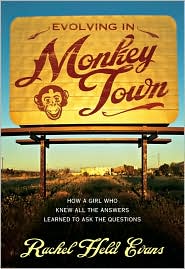
This weekend Jenny and I listened to Rachel Held Evans's memoir Evolving in Monkey Town: How a Girl who Knew All the Answers Learned to Ask the Questions. We loved it because it described a faith journey similar to ours, but also because Evans is such a vibrant writer, a woman who is able to condense tough ideas into clever phrases like, "If someone says that they follow the gospels to the letter, they're either lying or homeless."

Evans's biography reads so much like mine: her father was a preacher (check) who sent her to Christian schools (check) and on to a Christian college (check) where she majored in writing (check) and began to ask questions that would challenge the pillars of fundamentalism she had grown up with (check).

But Evans's story differs from mine in many ways, too. I find in it many of the same questions, many thoughtful answers, and insights into a culture both different from and similar to the Seventh-day Adventist culture of my youth.

Evans grew up trying to "prove" her faith in a society that was hell-bent on rejecting it. Even in high school, she was obsessed with Christian apologetics and soul-winning. I really related to the intellectual hunger that drives a lot of young fundamentalists into this branch of Christianity.

Most happy fundamentalists see "Truth" as a tank that reads "full." They load up on doctrines and master the proof texts for these doctrines. Then they have two options: (a) fill others up with texts and doctrines, or (b) man the barricades and take down anyone who might challenge the texts or question whether the tank is big enough. After all, the Truth that fills a one-gallon jug looks awfully small in a 100-gallon drum.

Evans's world needed a bigger drum once she saw the recorded execution of an Afghan woman in the weeks leading up to war in late 2001. She had grown up with the understanding that only Christians--the "right kind of Christians" at that--were saved. Everyone else would go to hell. She couldn't understand how a woman so victimized by injustice in this life could also be sentenced to eternal suffering because she was Muslim; she didn't know Christ. This leads Evans to use the phrase "genetic lottery" to describe why she was a Christian (born in the South, Christian parents) and others were not.

Her experience in a hell-believing church was quite a contrast to mine. Adventists are so heaven-focused that they rarely talk about hell (there is no eternally burning hell in their understanding, but an eternal separation from God). Still, I grew up wondering, "Am I going to heaven? Is that person going to heaven?" I have to say that I'm glad I didn't grow up with these horrors.

I always assumed that I grew up in the most strict, Bible-focused church in Christendom. There was the whole worship on Saturday thing, including no "worldly" activities from sundown Friday to sundown Saturday. I was vegetarian. I didn't drink caffeine. I had to sneak to the next county if I wanted to watch a movie like Star Wars. And I was lucky. I got to read novels. I could eat cheese and drink milk, unlike some of my more restricted fundamentalist friends.

But now I look at kids who grew up Missionary Baptist, Church of Christ, or other fundamentalist denominations/non-denominations, and I think, wow, I got off lucky. I didn't have politics shoved down my throat from the pulpit (until the Clinton Administration, Adventist services were thankfully apolitical). I wasn't forced to imagine hell in all its fury. I wasn't spoon-fed backwards views about women. I am so grateful for that.

Evans finds solace in two surprising thoughts:
  • First, she spent a summer rooting her faith in the gospels. She returned to Jesus, and she made him the center of her resurgent faith. Battles over evolution, climate change, Republican vs. Democrat, culture wars, etc. may yield short-term gains for some Christians, but they take us further and further from the Author and Finisher of our Faith. Christians are called to act like Christ, not act like Levites, Corinthians or Pharisees.
  • Second, she seizes on the idea of 'evolving faith.' It's obvious that Christianity has evolved over time, adjusting to times of oppression, then rule; war then peace. Christians who have adapted to revelations in science and polity have survived; Christians who have refused to adapt have disappeared. Compared to other religions that were focused primarily on race or ruling families, Christianity has also endured.
Five years ago Jenny and I found a faith home in a mainline denomination. It was a huge change for us at the time, but looking back, it was the step we needed to grow in faith and put Christ's teachings at the center of our lives. There is very little to miss about fundamentalism--other than the wonderful friends we have who remain in that denomination.

I don't know that I have 'evolved' in the way that Evans describes. I was always a Christian, not a denominationalist. I see the sea change in my church attendance as an affirmation, not an evolution, of the faith into which both Jenny and I had grown. The idea of 'evolving' in faith brings me to one word that seemed to hang over this book, but one which Evans never mentioned: post modernism.

I want to close with a note about Evans's home town, Dayton, Tennessee. Dayton's claim to fame is the Scopes Monkey Trial of 1925, the high water mark of 20th-century Christian fundamentalism. In a trial outside the courthouse there, lawyer Clarence Darrow of the American Civil Liberties Union eviscerated the testimony of William Jennings Bryan, who had tried to defend literalistic interpretations of the Bible and prosecute John T. Scopes for teaching evolution.

I traveled to Dayton with my dad in 2000 to write an article on the 75th Anniversary of the Scopes Trial for Adventist Review. Dayton is an amazing place--especially for anyone who has a background in the culture wars. It is a battlefield, and a visit there raises many of the same questions and allegiances that a visit to Gettysburg or Normandy might do. I remember touring the museum in the bottom of the courthouse and visiting the campus of Bryan College (where Evans would have been a freshman at that time).

Although I spent a mere two days in the town, the questions that Dayton and Scopes raised about the fundamentals of my own faith really stayed with me. I diligently researched both sides of the evolution issue, and my hard word paid off with a cover story for the Review. I can understand what living on this battlefield has done for someone like Evans. "Monkey Town" looms over her book--and it looms over the beliefs of ever Christian fundamentalist today.