27 July 2010

"The test of a first-rate intelligence is the ability to hold two opposed ideas in the mind at the same time and still retain the ability to function." F. Scott Fitzgerald, The Crack-Up.

This quote gives me some relief for the two books I'm listening to on my phone.

I'm listening to The Irresistible Revolution: Life as an Ordinary Radical by Shane Claiborne: a call to reject the world and insights into Claiborne's life as a "new monastic." He worked with Mother Theresa in India and returned to inner-city Philadelphia to set up a Christian commune for work with the poor.

Also on my Android is A Politically Incorrect Guide to Capitalism by Robert Murphy: a vapid expostulation on capitalism that insists that (a) deficits don't matter, (b) the environment would be better protected by industry, and (c) the minimum wage increases unemployment.

Vive la differance!

24 July 2010

The Temple: Icon or Idol?

One of my favorite stories in the Bible takes place at the beginning of Solomon's reign. God appears to him in a dream, offering the fabled choice of "one wish."

Solomon, Temple-builder, says: "Give me wisdom and knowledge, that I may lead this people, for who is able to govern this great people of yours?" (2 Chronicles 1.10).

I love that story! God responds, "Wisdom and knowledge will be given you. And I will also give you wealth, riches and honor, such as no king who was before you ever had and none after you will have" (verse 12). It's like the rule on the Price is Right, when someone guesses the correct price of the Showcase Showdown and wins both showcases.

What I hadn't realized until I began this series was the location of the dream. It isn't in Jerusalem or upon Mount Moriah, the site of the Temple. Solomon actually interacts with God near the old Tent of Meeting, the Tabernacle ordained by God through Moses, where Solomon had traveled to worship at the altar. The gilded box was in Jerusalem, the tent and the altar were in Gibeon--and that's where Solomon met God the first time.

Worship is about meeting with God. The ultimate worship experience comes when God speaks back--when He inspires me in return. In his charmed life, Solomon would worship twice. The initial experience happened not in a temple but near a tent, not in Jerusalem but in Gibeon.

The Legend
But it is easy to get lost in the stories of Solomon, who is among the most fabled ancient rulers of the Near East. In story, he is as legendary as Midas of Phrygia or Croesus of Lydia, but the chronicler provides us with enough details to look beyond the myth and provide Bible readers with a glimpse of the truly back-breaking cost of the Temple that Solomon erected.

Here is a sampling of the legends that grew up around Solomon. It is written that God gave Solomon many forms of wisdom, including the ability to interpret the speech of animals. He only realized this when he heard an ant telling its friends, "Get out of the way before Solomon steps on us!"

He could also summon angels--known as jinn, the word from which we get the term "genie"--to do his bidding. As he built the temple, he could summon winds, molten brass bubbled up from the rocks, and the angels followed his orders. "[The angels] worked for him as he desired, making high rooms, images, basins as large as reservoirs, and cauldrons," the legends state.

(And if these stories seem far-fetched, my dear reader, they actually come from the Koran, Surah 26 and Surah 34.)

The Bible Story
Solomon's story is told through the eyes of two authors in the books of 1 Kings (chapters 1-10) and 2 Chronicles (1-9). Therein I find no mention of genies or communication with insects but a fascinating view of the economic and political environment that supported Solomon's building spree.

The Chronicler reveals that Solomon the Dreamer left the Tent of Meeting, and in his next act as king he...acquired 1400 chariots and 12,000 horses (2 Chronicles 1.14). Moreover, he "made silver and gold as common in Jerusalem as stones, and cedar as plentiful as sycamore-fig trees" (15).

What? Wasn't Solomon supposed to build the Temple because he wasn't a warrior like his father, David? Why the arms build-up? This doesn't mesh with the fables or the ideal of the pious king seeking after wisdom.

The answer is found in Verse 17: Solomon was actually an arms dealer, using his geopolitical situation to import weapons from Egypt and sell them to the Hittites (modern Turkey) and Arameans (Syria). All this wheeling and dealing among the superpowers of the day was lucrative indeed, and Solomon's close ties to Egypt are among the most significant, unwritten aspects to his long reign.

The import/export business wasn't enough to fund Solomon's expensive tastes. He sent to Hiram of Tyre for skilled workers and supplies to augment the ones already set aside by David. We find in 2 Chronicles 2 the outlines of the contract in a letter from Hiram, King of Tyre:
Now let my lord send his servants the wheat and barley and the olive oil and wine he promised, and we will cut all the logs from Lebanon that you need and will float them in rafts by sea down to Joppa. You can then take them up to Jerusalem (verses 15-16).

Of course labor on a seven-year building project like the Temple would have cost even more than the materials, no matter how precious. Solomon solved this by enslaving the Canaanites who remained within the borders of his kingdom--153,600 in all--to complete the building (verses 17-18).

This fact adds new ironies to the Temple Story. The hands that cut the stones and set the blocks of the Temple were not Jewish hands but Jebusite (the original residents of Jerusalem); the voices that cried out under oppression were not Jewish but Perizzite or Amorite. The nation that God had called out of Egypt--where it was enslaved to construct temples to foreign gods--had now enslaved foreign peoples to build a temple for its God. The moral decay of Israel--indeed of Solomon himself--began long before the first Psalm could be chanted within the Temple courts.

A Splendid Temple
But oh what a Temple it was! It's possible to ignore the squalor, the slavery, the shady arms deals, when we think about that wonderful structure. The chronicler takes us through the temple--even into the Most Holy Place--for a first-hand look at the extravagant decorations. The walls were inlaid with images of palm trees and winged cherubim--and those images were coated with gold (a tablet from Solomon's era--right). In the Most Holy Place, two giant cherubim shaded the sacred ark and its modest figures, stationed on the box at the time of the Exodus. It is written that 600 talents (23 tons) of solid gold were used in the Most Holy Place alone (2 Chronicles 3.8)

Perhaps the online application, Wordle, allows us to enjoy the words of the chronicler in 2 Chronicles 3 and 4. The size of words is based upon the number of times they are used in the passage. Words like "gold" and "temple" loom large, and the word, "cubits," alludes to the precise measurements given by the chronicler.
Wordle: 2 Chronicles 3 and 4

And when the Temple was done, there was worship. A throng of musicians stood on the eastern side of the altar, praising God with cymbals, harps, lyres and trumpets. Singers rejoiced: "He is good; his love endures forever" (2 Chronicles 5.12-13). And God responded to this worship with utter brilliance:
"The the temple of the Lord was filled with a cloud, and the priests could not perform their service because of the cloud, for the glory of the Lord filled the temple of God" (13-14).

Solomon's Prayer
Solomon the Wise began his prayer with a rhetorical question.
"But will God really dwell on earth with men? The heavens, even the highest heavens, cannot contain you. How much less this temple I have built!" (2 Chronicles 6.18)
This is such a profound question that touches on so many theological points, that it would take books to mention them all. I will just point out two:
  1. I could rewrite the question using a name popular with Christians: "But will God really Emmanuel?" The idea of God dwelling with man went back to the Garden of Eden, and it wouldn't be resolved until the Incarnation.
  2. (Since mine is an anti-temple rant, I could point out here that John writes, "The Word came down and Tabernacled/tented with us." I have an idea why the most anti-temple writer of the New Testament would use this phrase, but it is interesting to point out here.)
  3. Solomon is also pointing to a definition of God--boundless, omnipotent, One--that won't really get fleshed out until the prophets just prior to and following the Exile. Basically, he's Ezekiel here.
  4. (What is your take on the second question, "How much less this temple I have built!"? Is this arrogance or humility? It seems to have a measure of both.)
Solomon looks into the future to see a Temple that will be the center of Jewish worship: one toward which both believers and nonbelievers will pray when they seek God's favor; a place where people will go to have their prayers heard; a place where sinners will find forgiveness (verses 20-23, 32-33).

But his is a national vision as well: the Temple is the place where wars will be won (34-35), famines will be ended (26-31), and rains will return (26-27). Solomon dreams--he dreams that he has built a Capitol from which God will govern human hearts. It will take a greater dreamer--Jesus Christ--to demonstrate that the individual human heart itself is the capitol God most desires.

God Answers Solomon
After Solomon's dedication, there was more song, more praise, and more fire. No one could bear to be inside the Temple, but this time the fire "consumed the burnt offerings and the sacrifices, and the glory of the Lord filled the temple" (2 Chronicles 7.1). The celebration continued for a total of two weeks.

A few nights later, God appeared to Solomon a second time. Solomon had raised the stakes with this building; God raised them back. God had heard, but he would be watching. His words to Solomon would seem to have two warnings for every blessing:
As for you, if you walk before me as David your father did, and do all I command, and observe my decrees and laws, I will establish your royal throne, as I covenanted with David your father when I said, 'You shall never fail to have a man to rule over Israel.'

'But if you turn away and forsake the decrees and commands I have given you and go off to serve other gods and worship them, then I will uproot Israel from my land, which I have given them, and will reject this temple I have consecrated for my Name. I will make it a byword and an object of ridicule among all peoples. And though this temple is now so imposing, all who pass by will be appalled and say, 'Why has the Lord done such a thing to this land and to this temple?' People will answer, 'Because they have forsaken the Lord, the God of their fathers, who brought them out of Egypt, and have embraced other gods, worshiping and serving them--that is why he brought all this disaster on them.' (verses 17-22).
This doesn't sound optimistic to me. It is as if God already knows the future, sees the idolatry. Or maybe that's just the chronicler--who will go on to describe the sad history that would follow.

An Aerial View of Jerusalem
Let's step back from the Most Holy Place to look at the City of David as it was in Solomon's day. Solomon's building project had doubled the size of the walled city, and the temple complex covered a wind-blown threshing floor that had been outside the gates of the city that David conquered.

As I look at the Temple in my minds eye, the first thing I notice are the two, bronze pillars that stood on each side of the main door. Each had its own name: one was Jakin (he establishes) and Boaz (in him is strength). They didn't support a roof; they just stood there, but how they must have shone as the rising sun rested upon them!

The temple occupied the highest ground in the city, but it was not the largest building by far. Solomon build three adjoining palaces: The Palace of the Forest of Lebanon, surrounded by wooden pillars, was almost twice as big as the Temple and held Solomon's armory and Hall of Justice. It also took twice as long to build. While the outer walls of this palace featured enough cedar trunks to resemble a hillside forest in Lebanon, the inner walls were lined with elaborate golden shields. Solomon ordered 200 large shields covered with gold (about seven pounds each), and 300 smaller shields which featured a mere four pounds of gold. (With today's gold prices, each of these large shields would be worth $114,000!)

Beyond the temple and armory, 1 Kings implies that there were two more huge, 5,000-square-foot palaces. The temple complex seems so choked with royal palaces that some historians have gone so far to speculate that the the Temple was a royal worship place rather than a national one.

Government Debt, Moral Decay
Solomon kept building. By the time the temple & palace complexes were finished, Solomon had begun building an astonishing harem of foreign wifes, each of which demanded a temple for her own god. The Mount of Olives became the site for this new wave of building, and it featured temples to Chemosh of Moab, Molech of Ammon and various other gods (1 Kings 11.7-8).

In some ways, Solomon didn't have a choice. He had become a regional leader. At the time he took power, Israel was a small kingdom, based in the hills around the Jordan River. Solomon pushed the kingdom westward, toward the Mediterranean Coast, by building up the cities of Joppa and Beth Horan, acquiring the town of Gezer from the Egyptian Pharaoh.

He also moved southward. His most significant conquest was Ezion Geber, which lay at the tip of the Gulf of Aqaba and the Red Sea. His control of Joppa and Ezion Geber meant that all the land routes to Egypt passed through his dominions. The tariff revenue must have been incredible, for Egypt was a superpower, and this made Solomon's arms dealing even more valuable. With these trade routes under his control, the Queen of Sheba's visit takes on new meaning, and one can understand why cedar, gold and silver would have been common in Jerusalem.

Egypt responded in various ways. Pharaoh gave a daughter to Solomon and with her the city of Gezer (which had been captured from the Philistines--perhaps in a joint campaign with Israel). But the Bible shows that Pharaoh's daughter began a cultural conquest of Solomon that would gain her a palace of her own and a temple for her gods on the Mount of Olives.

But Egypt also hedged its bets. It became a safe place of exile for Solomon's enemies, who included Jeroboam (future ruler of the northern ten tribes) and Hadad the Edomite (1 Kings 11.18-19, 40). This doesn't seem like the behavior of a strong ally.

More fascinating is Solomon's relations with Hiram, king of Tyre, the source of the cedar and skilled workmen that built the temples and palaces. Solomon seems to act as a vassal king to Hiram, not as an equal.

The reason was probably debt.

First Kings describes an interesting exchange that took place midway through Solomon's rule:
At the end of twenty years, during which Solomon built these two buildings--the temple of the Lord and the royal palace--King Solomon gave twenty towns in Galilee to Hiram, king of Tyre, because Hiram had supplied him with all the cedar and pine and gold he wanted. But when Hiram went from Tyre to see the towns that Solomon had given him, he was not pleased with them. "What kind of towns are these you have given me, my brother?" he asked. And he called them the Land of Cabul (good-for-nothing), a name they have to this day" (1 Kings 9.10-14).
In Jerusalem, "Nothing was made of silver, because silver was considered of little value in Solomon's days," but in the hinterlands, the appalling level of public debt was beginning to peel away cities from Solomon's empire (1 Kings 10.21).

Hiram would also have his own hand in the economy of Israel. His sailors and captains would man the ships Solomon built at Ezion Geber to trade in the Red Sea, and one wonders how many of the 420 talents of gold these ships brought from Ophir to Solomon eventually ended up at Hiram's palace in Tyre (see 1 Kings 9.28).

Was the Temple the Center?
While the Bible writers treat the Temple as the focal point of Solomon's ambitious building plan, it is easy to see the seeds of destruction sown in its building and ornate decoration. The Bible demonstrates that this was hardly Solomon's greatest project (in terms of size or luxury) nor was it his only temple.

Moreover, the steps that Solomon took to fund the project--through tariffs, taxes, and slavery--left the kingdom in deep debt, left the populace at the edge of revolution, left Israel with little moral vigor to pursue worship in the way Solomon's father had envisioned.

As Solomon's 40-year reign ended, the seeds had grown into a forest of danger for his successors. Within five years of his death, his kingdom would be divided and his fabulous temple would be stripped of nearly every ounce of inlaid gold.

But that is for a future time and a future post.

17 July 2010

The Temple: Who Needed It?

If you read the Bible beginning to end, you will find a verse near the end of the final book of Revelation that will surprise you.

John the Revelator, given a prophetic glimpse of the World Made New, makes an astonishing observation:
"I did not see a temple in the city, because the Lord God Almighty and the Lamb are its temple" (Revelation 21.22).

I have read this verse scores of times without really "getting it." It is fanciful--inspirational even--the thought of worshiping out in the open with the Lamb of God, my Savior.

Now, I begin to suspect that it is far more than that.

It's ironic.

I mean, have you read the Bible? It's obsessed with the Temple--or rather, a series of temples built sequentially in Jerusalem. The Temple is a place, an idea that unites Abraham with Isaac, Moses with David, Solomon with Ezra, Ezekiel with Jesus, and Paul with destiny.

Yet twenty verses before the end of his Revelation, John speaks out of prophetic ecstasy, peers into the center of the New Jerusalem, and he does not see a temple.

John Lennon, one of the most outspoken 20th-century atheists, sang,
"Imagine there's no heaven, it's easy if you try.... Nothing to kill or die for, no religion too."
If you are a Christian believer who is annoyed by that lyric, then you have some inkling of how Jews might feel about someone who writes, "Imagine there's no temple, it's easy if you try."

Granted, Revelation was written 30 to 40 years after the final Jerusalem Temple had been obliterated by Titus's army, so most of John's readers would have only known a world without a temple. Still, the prophecy would have had a huge impact on a worldwide church that was still equal parts Jew and Gentile.

But why?

Had not God said through Zechariah, "I will return to Zion and dwell in Jerusalem...and the mountain of the Lord Almighty will be called the Holy Mountain"? (Zechariah 8.3). Anyone who reads the Old Testament begins to believe that The Temple is really the point of the whole thing--'the belly button of the world' as Jewish tradition believed. It was the central point of worship, the focal point of the Jewish nation. Who did John think he was?

As the sheer irony of John's statement began to sink in, it really took me back into scripture. All of the stories of the temple had reached a peak for me now--a place where I could see that there was no need for a temple. The Temple is vestigial. That's what John seemed to be saying to me, and I had to hunt through the Bible to find out how it got to be that way.

In order to really understand the Temple, it is important to identify the multiple perspectives in play. The Bible writers--mostly from the priestly class that rose up after the Temple had been built--stressed the religious nature of society and the role of God in history. Outside the Bible writers, one can also see glimpses of empires like Egypt and Phoenicia (Philistia, Tyre and Sidon are outposts of this superpower that was based in Carthage). Kingdoms like Judah and Israel rise and fall. Empires like Assyria and Babylon wander in and out of the narrative. Everyone sees the Temple at the center.

Everyone, it seems, but God.

The Temple Idea
The Temple wasn't God's idea. If you read through the five books of the Torah, books in which the minutest details of Jewish culture are spelled out, there is no mention of a Temple. Moses ordered a tent to be built, and inside this tent he placed a modest-sized, gilded box or "ark." There was s no Temple--not even a recognized need for one. Presumably, after efforts to utilize the golden box in conquest were unsuccessful, it was forgotten for a generation, left not in a tent but in the house of Abinidab.

The rescue of the golden box and the idea for the Temple come from the same man: David. The first six chapters of 2 Samuel are a flurry of nation-building, as David crushes remaining opposition from the House of Saul, defeats the Philistines, conquers Jerusalem and consolidates the kingdom under his command.

In the context of events, the House of God would seem to be David's final conquest. Israel's dominion over Jerusalem is barely a year old, David isn't done fighting, just taking "a rest from all his enemies around him" (2 Sam 7.1), when he makes a wily declaration:
"Here I am, living in a palace of cedar, while the ark of God remains in a tent" (2 Samuel 7.2)
Who could argue with this? The prophet Nathan can't--at least not at first. We don't see conquest here; we fall for David's piety, his humility, his concern for God's gilt box.

God takes exception. God doesn't seem pleased. "Did I ever say to any...I commanded to shepherd my people Israel, 'Why have you not built me a house of cedar?'" (verse 7). There is only one Creator, God points out, and He creates spaces for His people--both physical and spiritual. To God, David's plan is like a child declaring to its mother: "I'll make a womb where you can be safe and warm and fed."

"The Lord declares to you that the Lord himself will establish a house for you," the message continues, again emphasizing that David's "house of cedar" may not be the ultimate house God has in mind. The promise extends, however, to David's son: "He is the one who will build a house for my Name" (verse 13).

God rejects David's proposal of conquest. Later, David will claim that the rejection was based on his reputation as a warrior (1 Chronicles 28.3), but that isn't supported by the actual text. David had conquered everything that stood between his shepherd's staff and the king's scepter. He would not control the box as well. That would remain under God.

Taxation and Oppression
David seizes on one element of the promise: he prepares to build the temple anyway, letting his (unborn) heir take the credit. Again, this can be seen as yet another canny political move. Battles over succession and legitimacy were endemic in royal houses. David's heir would achieve on the drafting board what David had claimed on the battlefield: legitimacy, primacy, and fame.

Without laying a single stone, David designs the temple portico (verse 11), sets up a schedule for the temple workers (13), "he designated the weight of gold for all the gold articles to be used in various kinds of service, and the weight of silver for all the silver articles" (14). He foresees two golden cherubim, spreading their wings across the gilt box to lend it glory (!).

And he does this in a spasm of spiritual ecstasy: later he will tell Solomon, "All this I have in writing from the hand of the Lord upon me, and he gave me understanding in all the details of the plan" (19).

But there is one problem--it's a problem that faces every king and president sooner or later--where will the gold and silver come from?

The people. The people always pay.

Again, one can look back at God's "no thank you" and see the reason why. God was happy in a tent, why would he need a house? A wooden box, inlaid with gold was enough for His Covenant, was there a need for more? Taxation...taxation without consecration quickly leads to a corrupt church and compromised forms of worship.

David offers his fortune: three thousand talents of gold, with thousands more of silver, bronze and iron. "The task is great," he proclaims, "because this palatial structure is not for man but for the Lord God" (1 Chronicles 29.1). The people respond with five thousand talents of gold. This is a tax that will extend for a generation, long after the completion of the Temple, until the kingdom is divided by the oppressive taxing regime.

Because I am full of irony (thanks to John), I note that "the people rejoiced at the willing response of their leaders.... David the king also rejoiced greatly" (9), but there is no mention of how God responded.

Imagine there's no Temple. It's easy if you try. No sanded cedars. No golden cherubim guarding the Most Holy Place. No courts, no altars.

It is important to pause here because of the picture we see without the Temple. Israel is at its height of conquest. David rules in Jerusalem, fully allied with God and devoted to Him. The people are religious, eager to glorify God and willing to give all they have.

It will never fully be this way again in Jerusalem's future...at least not until the New Jerusalem found in Revelation 21.

But that is for a future time, and I will delve into Solomon later.

30 May 2010

A Soldier's Memorial

I spent the Sunday of Memorial Day Weekend cleaning up my study. This is something I do just once ever three or four years (or roughly twice as often as my 2nd-least-favorite chore, cleaning the garage).

As I was organizing the files, I came across this picture.

I have a number of military men in my family tree. My family research is thick with the military files of my Grandpa Dittes, who was an Army MD in Australia & New Zealand during World War II. I have the flag that draped my Grandpa Mooney's casket when he died in 1981, recognizing his service in the Navy during World War I.

I also have this postcard--a link to an army man about whom I know very little.

The postcard is addressed: Familie Gotthold Dittes, Delikatessen Geschaeft, Broklyn (sic) New York, Amerika. It's amazing, the spare address. My great-grandfather, Gotthold Dittes, indeed owned a grocery story in a German section of Brooklyn. His wife, Anna Katherine Funk Dittes, was a cook who ran the deli.

It is signed, "Schwager und Brueder," leaving me with no certain first name. I know his last name, of course. The man in this picture is my great-great uncle. His last name, like my great-grandmother's, was Funk. He was one of 10,000 young men from the city of Ulm to sign up for the imperial German Army during the opening years of the Great War.

I read the card closer. It is difficult because of Fraktur, the German form of cursive that makes some of the letters quite difficult to make out. I'll try my best.

"Muensingen, 6/6 1915." Muensingen was the site of the Duke Albrecht Barracks, a training site for soldiers ready to ship off to the Front. During a break from training, my great-great uncle had gone to a photo studio to have this card made. Observe his well-groomed mustache--I doubt it looked so nice once he made it to the trenches. His uniform is crisply pressed, his bolt-action rifle looks ready. Does he look fierce? Not to me, he doesn't.

I can make out little else from his note. He wants my great-grandparents to see his picture as a soldier "bild als Soldat." I find the word, "family." My German isn't good enough to read the whole note, much less peer between the lines at his thoughts.

In 1915, the war still seemed winnable for all sides. There had been heavy casualties, but the bloodbath of 1916 was still in the future. Here in the States, my grandparents were still speaking German in their deli and in their home. Gotthold had arrived just ten years earlier, Anna had come in 1901. My grandpa was just three years old.

Perhaps it's because it's Memorial Day, but I wonder how the war went for my great-great uncle. My cousin, Frank, has told me that my great-grandmother exchanged letters with family throughout the war--or at least until the United States entered the war against Germany (I'm sure familial communications were hampered by this fact). He has told me that Anna's three brothers served in the German Army and that all three survived.

While Memorial Day is an American celebration, this picture brings me to another conclusion. It makes me think of the soldiers on all sides of a given conflict. Their shared concerns for families and loved ones behind the lines.

It makes me glad to have grown up in a family with a unique perspective on the two greatest conflicts of the 20th Century--whose deep ties bridged the gaps erected by emperors, generals and dictators.

30 April 2010

Slice of Life: The Jackpot

Owen, Jonah and I cleaned the car today.

I'm embarrassed in how seldom I clean or wash my car. It's not a high priority for me. Perhaps the best way to describe how dirty the car needs to be, is to say this: once the trash pile reaches the bottom of the windows, it's time to pick up.

When I cleaned, I went all out. The boys pulled out everything, sorting the junk from the lunch boxes, water bottles and pencils. I got out the vacuum cleaner, determined to get everything really clean.

In a moment of inspiration, I decided to remove the back seat. "Take a look at this," I said to the boys, who were trying to sneak away from the job for the 4th time.

There is something awesome about the back seat of the car. It's the same as the inside of a couch or chair, I think. There is a treasure trove of great stuff that has fallen back there over the years. Pens, coins, toys, cards--the every day flotsam and jetsom of life make their way back there. They aren't the kinds of things that a person will miss, but when they are found, it's kind of like...

"Jackpot!" Owen said as I removed the back seat. I looked down on a grotesque scene of smashed Skittles candies, lint, and scraps of candy wrapper. I noticed some coins sparkling out of this mess. There could easily be a dollar or two scattered back here, I thought.

Owen moved quickly through the back of the car, picking things out of the seat. "This is awesome!" he said. "Look at all these Legos."

I looked over. He was carefully looking through the junk, picking up Lego pieces, leaving the rest to me. He found the head of his Anakin Skywalker mini figure. He found a piece to a Bionicle that had been missing for a year, he said. "And here is the piece to my MX4Ti," he added. I hate when they speak Lego, don't you?

Later Jonah and I counted the change that I had collected after Owen had rescued the Legos. It added up to $3.75. Not quite the jackpot that Owen had found, but welcome nonetheless.

23 April 2010

There's No Omega in Faith, No Alpha Either

I was in Sabbath School at my sister's church a few weeks ago, and I found myself on familiar ground for those of us who regularly attend Bible studies: second-guessing characters in the Bible and--in a small way--second-guessing God.

The topic was Hagar and Abraham: his tragic choice to follow his wife's directions and lie with her servant. Why did he do it? Would that he would have known the consequences. The strife of the present-day Middle East, between descendants of Isaac and descendants of Ishmael, came to light.

It was a challenging, thought-provoking discussion, and at the end, I was struck by a single, enlightening text: "I am the Alpha and the Omega...who was and is and is to come, the Almighty" (Revelation 1.8).

Right then and there I caught a God's-eye view of Hagar and Ishmael, and it gave me a God's-eye view of my own life, my legacy, and the essence of my faith.

Let me begin with a story.

The Danube River flows between two German cities that lie on the border of the states of Baden and Bavaria: Ulm and Neu Ulm. In 1876, the only way between these cities was by river ferry.

I do not know of the exact date, but family lore states that on one fateful day, a river ferry sank. Riding on that ferry was a young man named Karl Funk, and he survived the sinking, saving--in the process--a young woman named Anna-Katherine. I know their names, because they can be found on the birth certificate of my great grandmother, who was born in Ulm in 1881.

I love this story for three reasons: it has a trace of romance, it seems miraculous, and it resulted directly in me. You see, if that ferry had made it safely across the Danube that day, Karl and Anna-Katherine might have gone their separate ways without meeting. If one or the other had perished, then James Albert Dittes would most definitely not exist, nor would any of my kids...or their kids to come.

Karl saved Anna-Katherine that day, yes, but he also saved me.

I guess that makes it easy for me to take a God's-eye view of the events of that day. When God looked down on this sinking ferry, he saw these two young people among the passengers. But because God is outside of time and space, it is easy for me to understand that He also saw me and Owen. In fact, it is not hard for me to believe at all that God saw me and knew that I would worship one day in Savannah, Georgia, and figure all this out!

"I am the Alpha and the Omega...the Almighty."

This is mind-blowing stuff. But when I apply it to Abraham and Hagar, I understand how God could find faith so easy while Abraham couldn't. When God looked at Sarah, he didn't see an old woman; he saw Isaac--and through him, David and Solomon, Jeremiah and Amos, Jesus and Paul, and all those who would one day worship in Jesus' name.

And as Abraham lay with Hagar, God didn't think, "This ruins everything." Instead he could see through Ishmael to generation after generation of descendants--ALL of whom He loved. I struggle to ascertain the consequences of my decisions at a distance of weeks or months. God sees me act--for good or evil--and projects it to "the third and fourth generation" (for the record, I am four generations removed from the Danube Miracle). This is a truly amazing perspective. This is Alpha and Omega--a beginning unimaginably far before my beginning, an end eternally beyond my end.

For much of my life, I was a fundamentalist Christian. "God said it--that settles it" was a good way to describe my worldview. When the proverb stated, "He shall direct thy paths," I literally expected God to tell me every place to go and every thing to do when I got there.

In 2003, after the disastrous end of not just a job but an entire career path, I sought for solace in the Book of Job. The God I found there was not the hand-holding dispensationalist I had grown up with. Instead He was Alpha. He was Omega.

At the end of the Book of Job, a storm rises. Out of the storm, God speaks to Job. He doesn't offer comfort. Instead his words sound like rebuke. "Where were you?" he asks angrily. "Where were you when I laid the earth's foundation...? Who marked off its dimensions? Surely you know!" (Job 38.4-5).

Job cannot speak. God cannot say it more clearly: "I am the Alpha; I am the Beginning. Everything you do--for good or for evil--comes somewhere along the continuum after me. You may be Beta, you may be Theta. You cannot see far enough ahead or behind to really understand."

Job's reply is a statement of faith in the Alpha God: "Surely I spoke of things I did not understand, things too wonderful for me to know" (42.3). It takes faith to believe in a Creator God, to place in His hand the origins of my life, my consciousness, my planet, my universe.

It is through Christ that we understand the Omega. I believe this is why John puts these key words of faith in his mouth in Revelation 1.

You see, in my limited view, Omega is the end of my life. My senses, my thoughts, my experiences comprehend only the Alpha of birth and the Omega of death. But when I give these to God, in exchange for his God's-eye view, the distances widen. Maybe the Alpha isn't my birth date, but the day Karl rescued Anna-Katherine out of the Danube River. Or maybe it stretches long before them to some other miracle in which God saw me.

Therefore the Omega also stretches on. On this earth it extends to my descendants, whom I will never see or know, but whom I can love, just as I love Karl and Anna-Katherine. It extends into eternity, this Omega, to judgement and to resurrection and then still further on. My act of faith is not in speculating upon these things but in relying fully in the Omega to have themprepared for me.

As a Christian, I believe that the only person to experience the human-life Omega and return was Jesus Christ himself. Yet if Jesus really did go through this, why didn't He talk about it between Easter and Ascension? He could have said, "This is what it's like" or "You won't believe what I've seen." Instead there is no Omega. There is only the direction to "go into all the world."

The disciples weren't the Omega; Christ was. They weren't even the Psi--the 2nd-to-last letter--even though many of them might have believed it at the time. Christ didn't have to reveal Omega. He was Omega, and I can be utterly faithful that he is my Omega without needing to know the measurements of heaven, the boundaries of death, or the depths of consciousness.

Coming from a fundamentalist background, I have seen plenty of controversies among believers. What strikes me is how many of those controversies have their origins in the Alpha and Omega sectors: Creationism vs. Evolution, Original Sin, Heaven & Hell, the Afterlife, Judgment, etc. When it comes down to Beta through Psi theology, Christians have very little to debate within the Body of Christ. True Christian faith, I believe, leaves to God the Alpha and Omega, and leads the Christian to find his/her place on the continuum of God's faithfulness to humanity.

Growing from this background, I can also understand the text, "he shall direct thy paths," in meaningful new ways. I have grown to believe that God does not direct my every step. I have given up trying to seek his guidance for specific, day-to-day experiences.

Faith in Alpha and Omega is direction enough. I choose to behave in every role--as father, husband, teacher, and friend--as someone who was destined to do this, someone who was created for the very purpose of doing this very thing excellently. I also find that my belief in the Omega helps me to make decisions with the long view in mind.

Let me close with one other fun illustration. I really believe that Alpha and Omega can be understood in the context of love, as well as faith.

Even after sixteen years of marriage, Jenny and I are not completely in agreement on the Alpha of our love for each other. Jenny has very definite memories of her first interactions with me. Those are not the same as mine. We agree that she had feelings earlier than I did, but the exact beginning of our love affair is up for debate. In fact, when we do talk about it, we often end up arguing or teasing each other. Even our versions of my proposal in Eden Park, Cincinnati, Ohio, in September 1993 are different!

The fact is that we have never debated this Alpha to the nth degree because we are very much in love. There are things that our love must do for each other today. For Ellie, our love has no reasonable existence before she came along in 1997--the same goes for Owen and Jonah. What was the point?

Would you like to know how much we speculate on the Omega of our relationship? I'm sure you know. We assume it will end in one spouse's death at some time in the future, and we take precautions with a will and life insurance. It is not a priority in our relationship, however, we are loving in the present.

I think our shared faith in God helps us to focus our relationship and expel unknowns--rather, to leave those unknowns in the knowing hand of the Almighty.

I think that true faith is contained in these two words: Alpha, Omega. When we can turn over to God our origins and our legacies, we can find true peace.

05 April 2010

What Forrest Sees that Some Don't See

A few weeks ago, I had some time to write about the history found at Tennessee's state capitol, namely the bust of Nathan Bedford Forrest, a man who fought against the United States and preferred to see Republicans hung.

I didn't have time to point out the greatest irony of Forrest's statue. It is the fact that it looks unwaveringly upon this bronze relief, commemorating Tennessee's ratification of the 13th, 14th, and 15th amendments to the Constitution. The primary figures in this relief are of African origin, freed slaves, now legislators and citizens under the newly ratified rights. There is no Nathan Bedford Forrest shown here.

Let's review for a moment these key amendments, which established rights for former slaves and finally brought the Constitution into line with the ideals expressed in the Declaration of Independence and reiterated in Lincoln's Gettysburg Address.

The 13th Amendment abolishes slavery throughout the United States.

The 14th Amendment establishes the rights of all men, regardless of race or prior state of servitude to vote or be counted in a census, correcting a clause originally written in the Constitution that identified slaves as being 3/5ths of a person for the purpose of citizenship and census. It also bars folks like Forrest, who had served under America's enemies, from holding federal office.

The 15th Amendment states that "The right of citizens of the United States to vote shall not be denied or abridged by the United States or by any State on account of race, color, or previous condition of servitude."

These amendments marked a fundamental change in American governance--a change bought with the blood and sacrifice of tens of thousands of Union soldiers. Yet they are at the key of misunderstandings that plague Southern states like Tennessee to this day. A large number of Americans remain willfully ignorant of their meaning--or at least fail to apply that knowledge in political discourse today.

Nathan Bedford Forrest would understand. He would know that the legislatures that ratified these amendments in Tennessee and throughout the South were made up of Republican imposters--transplanted Northern "carpetbaggers," freed slaves, and craven Southern "scalawag" sympathizers to the Union cause. He would recognize that Southern states were forced to ratify these amendments as a condition for returning to the Union and removing occupying federal soldiers.

But as Forrest's Klu Klux Klan riders stormed through the South, restoring the dominance of the conservative Democrats, these three key amendments became ever more entrenched as law. Many key provisions--voting rights for African Americans, for example--would be delayed in the South for another 90 years, but they would come. Inexorably, they would come.

One of the key provisions of the 14th Amendment states:
No State shall make or enforce any law which shall abridge the privileges or immunities of citizens of the United States; nor shall any State deprive any person of life, liberty, or property, without due process of law; nor deny to any person within its jurisdiction the equal protection of the laws.

Can you hear the ghost of Thomas Jefferson in those lines? When the United States had been just an idea, written on paper as a declaration to the King of England, Jefferson had written that "all men are created equal, that they are endowed by their Creator to certain unalienable rights, that among these are life, liberty and the pursuit of happiness."

When the time had come to ratify the Constitution twelve years later, these sentiments were left on the cutting room floor. The states were not unified. There was much opposition. Compromises needed to be made.

Certain citizens needed to remain "alienable," namely enslaved persons whose unrequited toil and hardships drove the economy of southern states. To live in the "Land of the Free," especially in the proximity of enslaved people, one needed "alienable rights," too. In fact, to make sure that the federal government didn't overstretch its bounds, the founders inserted the 10th Amendment into the Bill of Rights, stating that "The powers not delegated to the United States by the Constitution, nor prohibited by it to the States, are reserved to the States respectively, or to the people."

I have heard a lot about the 10th Amendment in recent weeks, especially in the wake of the historic Health Care Reform passed by Congress just three weeks ago. As Nathan Bedford Forrest's political heirs came to terms with their outrage over this expansion of federal power, many advocated the 10th Amendment as their bulwark against this legislation. Indeed it is the basis of a possible suit by a group of state attorneys general to block the implementation of the bill.

Yes, it's totally bogus.

Read the 14th Amendment again--the one that fixed the Constitution and banished forever the "peculiar institutions" preserved by the 10th Amendment. It gives the federal government huge leverage over the states to enforce laws--particularly those relating to the "privileges or immunities of citizens." Where did the federal government get this power? On the battlefields of Tennessee, Virginia and Georgia, that's where.

Jenny and I have been watching the PBS Documentary, "Eyes on the Prize," this week. It's a gripping look at the civil rights movement that established the 14th Amendment as the law of the land. It's mind boggling--to us--to see the opposition that such simple acts as seeing a 1st-grader walk to school or enrolling in the University of Mississippi could have been met with riots and outrage.

Yet when I see President Eisenhower sending the 101st Airborne to Central High School in Little Rock, or when President Kennedy sends US Marshals to Oxford, Mississippi, I am seeing the 14th Amendment in action. Those who opposed integration in the 1950s and 60s--just as those who oppose health care or national standards for education today--belong to a pre-14th mindset. They have not come to terms with a federal government that has claimed these rights for 140 years.

Now this is not to say that there is no place for conservatism in American politics. President Eisenhower was a conservative who acted more out of a concern for the breakdown in law and order in Little Rock than any liberal utopianism. There needs to be accountability in government and good management--and true conservatives are well equipped to bring this.

But it is to say that when inequalities exist, We the People can and will step in to stop them. America's health care system is broken, it is a problem too big for individual states to solve. On the horizon, climate change is too big a problem to attach piecemeal, state by state. A poor education system isn't just Tennessee's problem or Indiana's problem, it is a national problem, and the 14th Amendment gives We the People the right to step in and make it right.

That's what I see, anyway. And that's what Nathan Bedford Forrest sees in Tennessee's capitol, whether he likes it...or not.

29 March 2010

The Tennessee State Capitol: Nathan Bedford Forrest


[I tried to post this as a photo & comments to Facebook last Friday. It didn't work out quite right. I'm going to re-post this as a blog post. Sorry if you've read it before.]

I'm in the state capitol today at a student conference, and I want to share some observations about my state.

This statue in the Capitol gallery is of Nathan Bedford Forrest, a man who fought AGAINST the United States. Moreover, he was a founder of the Klu Klux Klan.

So why does his statute occupy a priviledged place in the Capitol? It is an example of the South's complicated relationship with America's history, with the country's present, and with the future.

Forrest was one of the Confederacy's most effective raiders. Never defeated in battle, his motto was "get there first with the most." At war's end, he became a potent Southern leader at a time when Northern opportunists were raiding the Southern economy for quick profit and political gain (like Lincoln,these transplanted "carpetbaggers" were Republicans, which is why, from the end of Reconstruction in 1876 to the 1990s, Republicans were considered with abhorrence by conservative Southern whites.

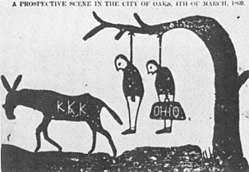
Forrest's days as the first "Grand Wizard " of the KKK were short but effective. In modern parlance, he claimed that the KKK was a "fair and balanced" alternative to the Republican "Loyal Leagues." As one Alabama newspaper put it, "The League is nothing more than a nigger Ku Klux Klan." One editorial cartoon of the period showed a KKK lynching: its victims were white, and written on one victim's carpet bag was the word, "Ohio."

Today we think of Forrest's KKK in strictly racial terms. In the 20th century, their burning crosses and white-capped members sought to intimidate Southern blacks into compliance with segregation.

But I know of no attacks that Forrest carried out against freed slaves. His target was Republicans. He hounded them out of their judgeships, targeted Northern-owned industries, and eventually returned the South to the dominance of the political, Democratic, conservative class that had ruled from the time of Andrew Jackson to the end of the Civil War. Forrest was a SOUTHERN patriot, even if he wasn't an AMERICAN one.

Eventually things got out of control. The armed "night riders" under the sheets weren't always acting for political reasons. Shortly after a federal grand jury declared the Klan a "terrorist organization"in 1870, Forrest disbanded the organization completely, claiming that it had been "perverted from its original honorable and patriotic purposes, becoming injurious instead of subservient to the public peace."

The closing years of Forrest's life wouldn't seem to reflect the actions of a notorious racist. The New York Times, in its obituary of Forrest, October 30, 1877, noted that his last public appearance was before a 4th-of-July celebration of African-Americans near Forrest's home in Memphis:
"[In] his last notable public appearance .... he appeared before the colored people at their celebration, was publicly presented with a bouquet by them as a mark of peace and reconciliation, and made a friendly speech in reply. In this he once more took occasion to defend himself and his war record, and to declare that he was a hearty friend of the colored race. "
This brings to light two ironies of Tennessee's Capitol today.

One: both legislative chambers in Tennessee's Capitol are controlled by Republicans! If Forrest were to return from the grave and learn this, there would be hell to pay. Folks would get hanged. The Capitol might even be burned.

The second irony can be found on the wall that Forrest's statue looks at. It's time for lunch, but I'll develop this more a little later.

28 February 2010

The 21st-Century Dad: A Tip

Four weeks ago, I saw something on Owen's report card I'm not used to seeing: a B.

It was math, a subject Owen has usually owned. After making sure to celebrate all of his well-earned A's with a trip to the bookstore, I asked about the B.

It was his tests. His times tables. He was getting the questions right, but he wasn't up to speed on the timed tests.

I followed his homework and noticed the same problem occurring over and over: 70s and 80s on the quizzes. Everything else had 100s.

I had to do something, so I did what any 21st-century dad would do: I downloaded a new app for my cell phone.

Last Christmas Jenny surprised me with a Motorola Droid. Wow! It had the touchscreen and the MP3 capabilities of the iPhone, but this one ran on Verizon's network! I've had so much fun with that thing in the past two months. I have apps to view the night sky, listen to Pandora, play word games.

For Owen, I downloaded an app called "Flash Cards." It spits out math problems, and he has to answer them quickly. There is a journal that keeps track of his times and the number he gets wrong. He began to play it once or twice on the way to and from school.

Last week, he brought home a math test: 100%! Yes!!

Now that's what I call high-quality 21st-century fathering.

26 February 2010

A Resurrection for Christianity: Surprised by Hope

I'm not sure where it's harder to be a Christian--in a godless land, where the Believer attracts martyrdom or in a God-full land like mine, where Belief is so easily drowned out in a cacophony of sales pitches. I'm so fortunate that I have, in N.T. Wright, a sojourner who has the intellectual muscle to break down so much of the fake noise in his book, Surprised by Hope.

If you didn't read this book last Easter (when it came out), you owe it to yourself to digest Wright's ideas before Easter rolls around again. It strikes to the heart of what Christianity has always been about, and dismisses a lot of fakery in the process.

I don't think that Wright was "rethinking Heaven, the Resurrection, and the Mission of the Church," as the subtitle implies. Instead of new thought, he is focused on re-establishing a Resurrection-centered theology and renewing the mission of the Church that naturally stems from this.

Wright sees Christianity pulled by two poles: the Liberal side is ready to dismiss the literal Resurrection and discount the miracles of Jesus, relying instead on the moral and ethical advantages of faith. On the other hand, fundamentalists have stirred up an orgy of speculation on Rapture and Second Coming--a line of theology that justifies reactionary political stances (on the environment, on justice) and subverts Resurrection. What about Death? Is it nothingness? Is it a fantasy world where Christians take time from floating on clouds to view life back on earth?

These are big questions--ones about which few Christians, even after nearly 2000 of systematic theology struggle to find agreement. Wright answers them authoritatively, using New Testament scriptures to support his case.

Wright is most concerned with Christians who adopt the Platonist view of life: a dualistic view that sees earthly things as evil and spiritual things as good. He traces this heretical line of reasoning to the Gnostics of the 3rd Century. He points out, however, that God saw Creation as "good," and that his goal in sending Christ was to sort things out here on Earth. The climax of Revelations is a New Jerusalem returning to earth. So why do so many Christians seem happy to leave Earth behind? Wright seems to agree with C.S. Lewis's idea in Mere Christianity that maybe Heaven is all around us, unseen, in a dimension or level of existence that is more real than what we experience now.

The Resurrection, properly taught, dismisses dualism. God's kingdom comes, we pray, on earth as it comes in heaven. Therefore Christians take up the promise of resurrection, sharing with everyone the taste of beauty, the sense of justice, the burden of compassion this teaching unleashes.

I found myself reading this book with a Bible close by. Wright returns again and again to 1 Corinthians 15, the chapter in which Paul discusses our resurrected bodies and the state of our spirits after death. He covers the teachings of Christ and Peter, too. Every chapter was thought-provoking. It deserves careful thought--and the earnest student of scripture will not be disappointed.

I especially loved Wright's suggestion that the Pentecost Season--the 40 days between Easter and Pentecost--be celebrated as an anti-Lent. Christians should take up one good habit during this time, even as we give up vices for Lent. He even recommends champagne on Sundays during this celebration.

Easter 2010 is coming, praise God. But a Greater Easter is the promise of every spring. Resurrection awaits all who believe and who put their hope in God.

20 January 2010

Cool Conclusions

I've been teaching writing for thirteen years now. Every year or so I come up with a new wrinkle.

This year my challenge was lazy conclusion-writers in my 11th-grade class. Somewhere along the way--probably 8th grade language arts--they learned to "bail out" on a conclusion. In other words: restate the thesis, give a pat answer, get outta Dodge.

We're practicing for the statewide TCAP writing test by writing essays for college applications. I was trying to come up with a word that summarized a good conclusion.

I came up with three:

Jedi Mind Trick.

Remember how Obi-wan Kenobi would wave his hand in front of the object's face and say something like, "These are not the droids you are looking for"?

THAT'S how to write the conclusion to a good essay. You are placing in the mind of the reader the very idea you want them to say back to you. In a college application essay, that would be something like this:

"You will enjoy having me on your campus"

"These skills and more will make OSU a livelier, funnier place"

What Jedi mind tricks do you have? If you were applying to college again, what would you want the admissions clerk to mindlessly type into their computer after reading your essay?

10 December 2009

Review: Rob Bell's Drops like Stars Tour, Nashville, TN


Jenny and I joined four of our friends from the Bethpage Church at the War Memorial Auditorium in Nashville Wednesday night to see Rob Bell, one of the few American pastors who can "tour" 1,000-seat theaters to promote a book in this day and age.

If you've seen Bell's "Nooma" videos, or you've read some of his books, you know what to expect. I've always been drawn to his intellectualism--his 'Everything is Spiritual' tour really spoke to me with its incorporation of physics and extra-dimensionality. But what has helped Bell to become one of the most widely recognized voices in Christianity is his embrace of 21st-century media.

I don't know of any channel where I can watch his sermon's every week. I do know that four or five times a year, NOOMA integrates a sermon into a compelling film which is then circulated among churches and Sunday schools of all denominational stripes--for those of you who don't know Nooma, it's basically a sermon delivered over a cool soundtrack, highlighted by a well-filmed backstory that elaborates on the sermon's themes.

Bell is media; he is message--and he integrates both sensationally.

In Drops like Stars, Bell tackles the thorniest of theological issues: suffering. It seems like a reach. It is one of the most written-about themes in Christian literature, from the book of Job to Bonhoeffer to Phillip Yancey's recent addition to this ouvre, Where is God when it Hurts. Bell's take isn't to reach for the big answers, but tries to propose a new context to suffering--to ask new questions about what suffering can accomplish in the believer's life--rather than why it occurred in the first place. Not "Why This?" as Bell puts it, but "What Now?"

I liked this approach. It testifies to Bell's creativity--his live presentation is a feast of the senses, something that evokes his fascination with music, art, film, and all manners of the creative process. It provides hope for all of us--not hope in a world free of suffering, but of hope in a community in which our own suffering, along with the shared suffering of those around us, spurs us to find more in ourselves than we ever would have expected.

While he used a host of well-chosen anecdotes about everything from Pope John to the Will Farrell movie, Old School, his message was grounded in solid biblical principles: Paul's exhortation to the Corinthians that he and his evangelizing companions had been "sorrowful, yet always rejoicing; poor, yet making many rich; having nothing, and yet possessing everything" (2 Cor 6.10); Jesus' tale of the prodigal son.

I especially appreciated his meditation on the cross--the ultimate sign of suffering in Jesus' day. When Christians wear this--when we display it in our churches--we are saying, "I embrace suffering: I adore the man who suffered here; I am an instrument to embrace those who suffer around me."

How I wished Bell had gone on. The presentation lasted a solid two hours, yet it opened up so many more areas of the Bible for me. The Beatitudes call us "blessed" when we suffer, when we are poor, when we are meek. They embraced suffering two years before the Cross, and they prescribe a fair amount of suffering for those who choose to follow Christ.

Perhaps true suffering is where real Christianity begins and all the fake forms of the religion evaporate. The Prosperity Gospel, the Medieval crusades, inquisitions, premillenial and hellfire-and-brimstone brands of Christianity go to great lengths to either ignore suffering that goes on in the present or contribute greatly to it.

I can't wrap up this review without commenting on the media. In his "Everything..." tour, Bell had used a whiteboard, which he had filled over the course of the sermon with illustrations of the theories he was describing. The "Drops..." presentation was far more media-driven.

Early in his sermon, Bell said, "Someone tweeted before we started that he had the worst seats in the house, and from the picture he posted, he was somewhere up there." He pointed to the upper balcony, high above where Jenny and I were sitting in the front. A guy waved his hands.

"Come on down," Bell said, pointing to two empty seats on the front row of the floor.

"I want a better seat, too," a female voice cried from another side of the balcony.

"Bring her with you," Bell said. I was amazed that he would have been checking his Twitter so close to the presentation.

As Bell spoke, there was a huge screen on the stage. At several points of the presentation, Bell interacted with the image on the screen--standing in the middle of a pictured hospital hallway, for example, and walking from door to door. At other times the screen showed texts, quotes and video. I thought he used the illustrations in a unique way, interacting with them, using them as powerful parts of his stories.

He also used a couple of kinesthetic tricks that appealed to the teacher in me. He gave each member of the audience a bar of soap. Then he demonstrated photos of images that sculptors had found within similar bars of soap--this is a great technique, and I plan to use it when I teach Greece and Rome. However, there wasn't anything to carve the soap with, and onlookers were merely encouraged to take the soap home...and...carve away.

The second stunt was better. When we suffer we identify with others who are suffering. Bell described how an injury to his writing hand had provided him with empathy for all who are injured. He had us write, "I know how you feel," with our non-writing hand. Then he asked everyone for whom cancer had impacted to stand. They exchanged cards. He did this with those suffering from addictions, those struggling to pay bills, several other scenarios, and the room was filled with empathy as cards were exchanged. We knew how others felt. It was a cool display.

There were a few things about the presentation that are unique to Rob Bell (I'm not sure why this is part of his style, but I noted them).

He didn't cite scripture. He used scripture, but you would need a concordance to figure out which ones. "Jesus tells a story about a man with two sons" is how he begins the story of the Prodigal Son. "A man named Paul once said" was the prelude to the text to 2 Corinthians 6.10. I'm assuming that he's used to talking to unchurched people like this, but I--a rather overchurched person--found it difficult to follow along sometimes.

Comparing notes with Jenny after the service, it was interesting how our differences had affected what we had seen. Jenny is really going through a challenging time at the clinic now, and she encounters tremendous suffering on a daily basis in the stories of her patients. She really identified with Bell's message. Admittedly I am not as emotional as Jenny, and I didn't feel as blessed, although I picked up some great ideas and some fuel for further Bible study.

In my opinion, Drops like Stars stretches the media in creative, unpredictable new ways, but it didn't feed my mind and my spirit in the ways I have seen other messages do.

09 December 2009

The Death of the Ball Turret Gunner, the Birth of What?

I'm preparing a lesson on Randall Jarrell's classic World War II poem.

As so often happens, I've found something new; something that I hadn't noticed before; something I wanted to share with you.

From my mothers' sleep I feel into the State,
And I hunched in its belly till my wet fur froze.
Six miles from earth, loosed from its dream of life,
I woke to black flak and the nightmare fighters.
When I died they washed me out of the turret with a hose.

I have always recognized the caustic reference to the State and the ultimate sacrifice it demanded.

For some reason, I have always missed the imagery. "Mother's sleep," "hunched in its belly," and "loosed from its dream of life" are all images of pregnancy and childbirth. Now that I think about it, the ball turret rests on the belly of a B17 much like that of a fetus, hovering innocently "six miles from earth."

So what happens? There is "black flak" and "nightmare fighters." The child awakens to the weapons of death.

It's an abortion that Jarrell is describing, isn't it? Read the last line again. It's an abortion.

Why didn't I understand that before?

30 November 2009

A Long Distance Merry Christmas from Grandpa

I must admit that the Christmas Season hasn't caught on with me yet. We had a great Advent service at church this week. I hear Christmas carols every time I turn on the car radio--and I don't turn them off as I did before Thanksgiving.

Today I even took my mandolin out in the hall at school, but all I could play was "God Rest Ye Merry Gentlemen." Is that even a Christmas song? It certainly didn't feel that way.

I have been busy with Christmas things--picking out gifts, preparing Christmas cards. That's all on pace (or ahead of pace). One project I took up was scanning in my Grandpa's war letters. Between December of 1941 and September of 1943, he sent my Grandma hundreds of letters and telegrams, sometimes twice a day. She saved every one.

Tonight I was scanning letters from their first Christmas apart. I found this handwritten letter, and I just want to share it. Those of you who knew Grandpa and loved him like I do, will quickly recognize him and miss him all the more (he died three years ago).

Modoc, Cal.
Christmas Eve --'41

My dearest Elinor,

This is a little note to tell you that I still love you very much and that I will be home tonight. It was impossible for me to make any arrangements to come during the daytime. I will be lucky if I get in much earlier than we did the last time. The boy that drove the car in is Liutenant Binkley, the new medical officer. He knows Dybby quite well from the Hollywood Hospital.

I hope you are having a better X-mas Eve than we are. We are having another terrific sandstorm here, with the tent practically being blown away. Since you are not with me, it makes little difference what the weather is. We did have 3 wonderful days together, and will have many more.

I was glad to get Lt. Binkley to drive the car in tonight, because of the danger of the car freezing up out here. I will have a few hours in the morning to rush up to March Field again to transact some very necessary business.

I hope you had a pleasant and grand time on X-mas Eve and day. I am sorry that world events prevented our being together this year. Better luck next year, Babe!

Well, Elinor, be nice. I will be home tonight (Christmas night). Hope you are well and happy.----

Mucho Love o -----------Al

Those of you who don't know him will recognize in his spirit a little glimmer of Christmas. I know that when I lived far away from Tennessee, how fond I was of the song, "I'll Be Home for Christmas." Perhaps we will all realize how fortunate we are, thanks to the effort--ages ago--of men like Lieutenant Albert G. Dittes.

A few notes.
1. From the tone of the letter, Grandpa will come down to Glendale (where Grandma lived) on Christmas Day. I checked on the maps. Modoc is almost 700 miles away from Glendale, up in the northeastern corner of California, near the borders of Oregon and Nevada. That must have been quite a trip in the days before interstate highways.
2. I'll check with Grandma about the details of this visit. If you want to see why Grandpa was so lovesick, just look at her!
3. I got these letters before Grandpa passed away, and I remember asking him, "Why did you tell Grandma, 'Be nice!' Did you think she every wouldn't?" Grandpa just gave me a funny grin, and I realized that he couldn't help teasing her--even from hundreds of miles away.