11 February 2012

"Tree of Life" and the Search for God

Every year, I get the chance to see one "grown-up movie."  Usually it comes around my birthday at the end of January, just after Academy Awards nominations are made.  With the help of On Demand this year, we've been able to watch both The Help and Tree of Life, and it's the latter movie that I feel is worthy of an Oscar-season review here at Point Pleasant.

I'm always amazed at the overt spirituality of the best films that are released every year.  Hollywood seems like such a bastion of secularism, but time and again I am humbled by the spiritual connections made in some of my favorite movies.  Two years, I blogged about the Easter-connected film, Slumdog Millionaire.  I didn't have time last year to discuss my favorite movie of 2010, True Grit.

First, a note about the term, "Tree of Life."  As I grew up, I understood that this was the tree that grew in the Garden of Eden, a symbol of eternal life that Adam and Eve consumed, and from which they were blocked by an angel with a flaming sword after their capital-f, Fall (Genesis 3.22-25).  

(Four years ago, I blogged about this Tree of Life after I had found the species of tree that grew in the garden.)  This tree makes a return appearance in Revelation 22.1-5, bearing twelve different fruits every season and engendering "the healing of the nations."

But there is a different Tree of Life I have studied in recent years--one that draws from Charles Darwin.  When I studied biology in school, I understood the plant and animal kingdoms, and I broke those into phyla and other, smaller groups, each kingdom was a pyramid that grew broader and broader toward its base, where I found homo sapien among the list of primate species..

The biological Tree of Life illustrates the biological principal that life is truly broader than mere plants and animals.  Ninety percent (or more) of all living things cannot be seen by the human eye, and the Tree of Life tries to incorporate bacteria, viruses, fungi, and the huge assortment of living things into one, circular family--quite a contrast to the pyramidal structure of life that I learned in my high school biology classes (a picture of this tree of life is included into the blog, a more three-dimensional representation can be found here).

This is the proper setup for the movie, Tree of Life, which is obsessed with spirituality, with prayer, with God, but not with Genesis.  Instead, the film begins with a quote from the book of Job (my favorite creation account found in the Bible): 
"Where were you when I laid the earth's foundation?
    Tell me, if you understand."  Job 38. 4
The central character in the film is a man named Jack O'Brian (yes, the initials spell, "Job"), who has come to question his faith following the death of his brother.  The plot of the film takes place inside Jack's head, in a series of recollections of childhood, of whispered prayers, and of wildly fantastical imaginings.  Because it takes place inside Jack's head, don't necessarily expect a beginning and middle--nor should the viewer expect to know for sure which of Jack's two brothers has died--I think it's pretty easy to figure out.

At his core, Jack has a God problem.  There are two forms of God who battle for Jack's affection and respect--a conundrum that most people of faith would understand.  The dilemma is stated succinctly by Mrs. O'Brian:  "There are two ways through life - the way of nature and the way of grace. You have to choose which one you'll follow.

Jack's mother represents God the Nurturer--the way of grace.  She is full of wonder.  She is loving.  She comforts Jack and his brothers.  In one of her voiceovers, she whispers, "Do good to them. Wonder. Hope."  This is the kind of God she is--and Jack adores her.

But there is a second embodiment of God, found in Jack's father:  God the Naturer, the Striver, the Responsible.  "You are not to call me, 'Dad,'" he bellows in one contentious scene, "You are to call me 'Father!'"  He tries to instruct Jack, to teach him manners, to toughen him up for the challenges that life will throw at him.  (In a particularly heartfelt scene, Mr. O'Brian teaches Jack to fight him, challenging the son to punch him in the face.)
These two forces seem to tear at Jack, who like St. Paul wrestles with the desires to do the things he doesn't want to do while failing to do that which he should do.  An illustration of this comes in one of the scenes at church.  Soon after a funeral where Mr. O'Brian's strictness and reverence has been on display, Jack can be seen in the empty sanctuary walking across the tops of the pews!
The movie never gives one form of God preference over the other.  In the scene where Jack enters transcendence, both of them are there, and both greet him warmly.
The whisper is an important part of the movie.  By my recollection, about 15% of the dialogue is whispered in voice over, sounding almost like prayers:  
  • "Are you there?"
  • "Do you know what happened?  Do you care?"
  • "Where do you live?"
  • "Are you watching me? I want to see what you see."
I'm not sure how this appears to someone who doesn't have a faith background.  It must seem terribly random, this hidden, disembodied dialogue.  To me, though, this is the "true" story of experience--the questions that linger, that bring both sadness and wonder.

I was also struck by the dynamic between the two oldest brothers featured in the movie.  While Jack is frustrated by the different natures of his parents, his younger brother, R.L, seems to embody them effortlessly.  In another transcendent scene, R.L. practices his guitar on the porch outside the room in which his father plays the piano.  The two instruments gradually fade into an impromptu duet on Pachelbel's Canon.  The look of pride on Mr. O'Brian's face is unmistakable--"This is the one who gets it."

And with mother, the relationship is also warm.  R.L. asks Mrs. O'Brian, "Tell us a story from before we can remember," and the movie launches into it's most talked-about scene: a cosmos-spanning depiction of the creation of the Universe.  This stunning, watching galaxies spin into existence, seeing the sun emerge through the dust of forming planets, peeking in on two dinosaurs that play in a riverbed.

But R.L. is an Abel to Jack's Cain.  Jack's deepest conflicts come to the fore when he is around his brother. At one point, Jack demands that R.L. stick a wire into a lamp.  When he isn't shocked, R.L. says, "I trust you."  Later, though, Jack asks R.L. to put his finger over the tip of his BB gun, and here R.L.'s faith is destroyed.  If Mr. and Mrs. O'Brian are the two sides of God, then R.L. and Jack are the two sides of humanity.

Tree of Life.  It's a prayer and a meditation more than it is a story--which is why I don't necessarily think of it as a great movie.  Still, it was an opportunity for me to seek God and see God again through Job's eyes and through those of the fictional O'Brian family, too.

26 December 2011

Book Review: Wyoming Stories by Annie Proulx

Fine Just the Way it IsFine Just the Way it Is by Annie Proulx
My rating: 3 of 5 stars

I've been to Wyoming. Once. It was late spring. I crossed the northern part of the state from the Black Hills to Yellowstone, then climbed down the spine of the Tetons to Colorado. It was the most beautiful place I've ever seen: lush and green, bursting with wildlife, hot springs, and geysers. The worst thing I can say about Wyoming is that I've never been back...

...save through the writing of Annie Proulx. She's been to Wyoming, too, and she's been there a long time. And her time in Wyoming wasn't just a verdant two weeks in spring. And her writing captures with stark realism a Wyoming that isn't just smiling hotel clerks, and dude-ranch cowboys. And yet there is real beauty hidden throughout this book--beauty that one finds in no other American place.

For example, the spectacular scenery of Catlin's hike in "Testimony of the Donkey": hidden lakes, decades-old signatures on the rocks, a splendid scene, all for one dangerous element. I loved the fairy-tale feel of "The Sagebrush Kid" and the interweaving of various histories of the West into the tales.

I completely skipped the two stories about the Devil, though. And while Proulx's prose is often praised, I tried to read "The Sagebrush Kid" out loud to my wife, and found myself tongue tied and stammering.

Still, the book is a pleasant return to a wonderfully beautiful, haunted place: Wyoming.

View all my reviews

17 December 2011

And His Name... Shall be Called... Ishmael

The Advent Season is the best time to be a Christian, and it's not just because of Christmas presents or the yummy food at Grandma's house.

The Advent Season is a season of promise.  Emmanuel is coming!  And the promise of "God with Us" is a realization that I treasure year after year after year.

It's just that every year, I find Emmanuel in a new place. It may be in the glow of candlelight or in the words of a Christmas carol.  I may find it in a gift or scrawled on the back of a Christmas card.  It's always such a surprise.  I know I will find "God with Me," and I will be blessed by that revelation.

There is one place I find Emmanuel more than any other, and that is in the Bible.  Advent is a time for scripture, and whether it is in the Psalms, the Gospels, or the lyrical prophecies of Isaiah, Emmanuel is often there waiting.

This year I found it in a Bible study I attend at Oasis Church.  We've been making our way through Genesis, and the text for study was chapter 16: the birth of Ishmael.  What I found there was the Christmas story--yes, perhaps one with Father Abraham instead of St. Nicholas, but a story with a special meaning for gentile Christians (like me) nonetheless.

The chapter begins with the matriarch of the Jewish faith, Sarai.  (Abram was a patriarch, indeed, but he fathered many different nations.  The strain of the Jewish story in the Old Testament wends back to Sarai/Sarah and the child God promised through her, not through Abram.)

Sarai gives up waiting for a child, and she gives her slave to Abram as a surrogate mother.  There is no mention of the enslaved woman's feelings about this arrangement--the prospect of a union with an 85-year-old man could not have felt too enticing.  The slave--an exiled Egyptian girl named Hagar who was part of the human bounty of Sarai's brief marriage to Pharoah--becomes pregnant, however, and soon begins to "despise her mistress" (verse 4).  The context of the verse implies an "I'm pregnant and you're not" attitude, 
but I would posit that Hagar is enslaved by Sarai, forced into a sexual union with Sarai's elderly husband, and impregnated with a child that will legally become Sarai's.  I would argue that there are very many reasons for Hagar to "despise her mistress."

What follows is abuse.  Sarai mistreats Hagar; Abram abandons her to Sarai's vengeance, "Your servant is in your hands" (verse 6).

What follows is escape.  Hagar runs away, and she doesn't stop running until she's on the road back home to Egypt.

What follows is Christmas.

The way to Egypt is perilous for a pregnant young woman to travel alone.  Hagar finds a well and waits there for help.  The Bible doesn't say it explicitly, but it's safe to say that Hagar prays for help there--begging from the merchants who passed by, and calling out to the God of her elderly protector.  (To understand the scene and her need for assistance at the well, consider the assistance her nephew, Jacob, would later give Rachael at a well in Genesis 29: 6-10).

It is at this well that Hagar meets "the angel of the Lord."

The angel encourages Hagar to return to Abram and Sarai, promising not just one child but many descendants.
The angel of the Lord also said to her:
"You are now with child
     and you will have a son.
You shall name him Ishmael,
     for the Lord has heard you" (Genesis 16.11)
Christmas suddenly seems closer.  This seems very close to the directions an angel later gave to Mary:  
"You will be with child and give birth to a son, and you are to give him the name Jesus.  For he will be great and will be called the Son of the Most High" (Luke 1.32)
The names are different, but the stories share key elements.  The message is delivered by an angel; the promise is for everyone.

Ishmael means "God listens."  In Hagar's distress, God listened.  And the woman whom God heard was no patriarch or matriarch, but an enslaved, abused, runaway, foreign girl.

I know far less of Mary's background than of Hagar's, but the words of her Magnificat echo back in time to paint the picture of Hagar's redemption at the well which she would later name, Lahai Roi, or "The Living One who Sees Me."
My Soul glorifies the Lord
    and my spirit rejoices in God my Savior
for he has been mindful
    of the humble state of his servant" (Luke 1.46-48).
The name Ishmael--"God listens"--seems very close in spirit to the name that Mary gave her child, Immanuel, "God within us."

Even as Advent is a time when I rededicate myself to "God within," the message of Ishmael's name also resounds.  God listens.  When we are trapped in the desert, God listens.  When we are enslaved, God listens.  When all hope seems lost "God listens"...Ishmael--"God listens"...Ishmael, Ishmael, Ishmael.

I'm not the only writer to connect Mary with Hagar.  Muhammad, the prophet of Islam, included in the Qur'an a description of Jesus' birth much different from the ones found in the gospels.
"So [Mary] conceived [Jesus]
And she retired with him
To a remote place.
And the pains of childbirth
Drove her to the trunk
Of a palm tree:
She cried in her anguish"
"Ah! would that I had
Died before this...!
But a voice cried to her
From beneath the palm tree:
"Grieve not! for thy Lord
Hath provided a rivulet
Beneath thee
And shake towards thyself
The trunk of the palm tree;
It will let fall
Fresh ripe dates upon thee...
At length she brought
The babe to her people,
Carrying him in her arms.  (Surah 19. 22-27)
When I read this text, I don't see Mary.  I need Joseph in my Christmas narratives, and a cave in Bethlehem is just too much for me to give up for a lonely birth at the base of a date palm.

When I read this text, though, I see Hagar.  She is alone.  The son she carries isn't hers--it's Sarai's.  A return to her mistress may not necessarily be a return to slavery, but it feels just as bad.  Yet here in the desert, Ishmael--God listens.  And a stream appears (a reference to Hagar's final escape in Genesis 21.19). And sweet, nourishing dates fall all around her as she strains against the tree in her labor.

I freely admit that I read the Qur'an just as I read the Old Testament: not as a believer, per se, but as a Christian seeking to understand the truth of my Savior, Emmanuel.  But I must also admit that I am rooting for Hagar and Ishmael as this story unfolds.

God promises, and the birth of Abram's second son, Isaac, would fulfill the promise that Sarai had sought to circumvent by giving her slave to her husband.  It was through Isaac's line that David would rise and the Christ child would be born.

But God listens, as Ishmael's name attests, and God blessed Ishmael and Abraham's other sons with another promise of source.  At the time Isaac and Ishmael were being born, I had ancestors living.  Most likely they roamed the forests of Northern Europe completely unaware of the machinations of Sarai and her slave.  The hope of their deliverance--and of mine--comes through Ishmael as well as Isaac.

God listen then (Ishmael), and God Ishmael's today

And that is the special message Advent has given me this year.

(I did not have time to add Paul's commentary from Galatians 4.21-28.  Suffice it to say, he takes a different take on the Ishmael story--demeaning him as a representative of the old law, not as a part of the promise that Isaac represented.)

11 December 2011

"One Day" takes me back to my own British Romance

Jenny and I had some time for a movie night at home last night, and after a look around, we decided to indulge our Anglophilia with a look at "One Day," an Anne Hathaway vehicle that came out last August.

The movie follows two friends whose relationship begins on July 15, 1988, the night of their college graduation, and follows them through every July 15 for the next 23years. They engage with other lovers, and they forge new careers, but their friendship remains a constant and pushes them inexorably toward romance.

This blog isn't meant to be a review of the movie, which has its flaws, but  it was easy to connect the movie with some experiences that had a huge impact on my life--and it is my own story (and that of my Bride) that the movie brought to life for me.

There are two connections:  one basic and one much, much deeper, that the movie raised for me.

I went to college in England for a year, my sophomore undergraduate year, 1990-91.  When I left at the of the year, I had built a close friendship with a woman named Jenny George (among many of the close, lifelong friendships I formed that year).  Emma and Dexter, the characters in "One Day," are thrown together on the last night of the year.  My friendship with Jenny grew over the course of the year, and involved numerous adventures which have been posted on this blog and will continue to present themselves, I'm sure, as the years go by.

One of the great challenges that our friendship faced that year--and in the years that followed--was how it would impact our relationship going forward. At one point during the year, Jenny talked to me about becoming more than friends, but I wasn't ready for a "real" relationship yet.  It was the frank honesty of our relationship that allowed me to express that to her--and let us remain friends.

By the time of my sophomore year, when I met Jenny at Newbold College, I had been through many swift romances, and I had had my share of dead-end physical relationships.  I needed friendship, I knew, and while I had many close female friends, I knew that doomed, whirlwind, physical relationships were sure ways to kill a friendship.  By the time I got to know Jenny, I had drawn a clear line between "Women I was Friends With" and "Women I Wanted to Date."  She definitely fell into the former category.

Suffice it to say, it is a challenge to manage the expectations of a close relationship with a member of the opposite sex.  A few years later, I "saw the light," as I described in this blog from Valentine's Day, 2007.

In "One Day," it takes Emma and Dexter twenty years to consummate their friendship.  And for them, it works out just as well as it did for Jenny and me, who were married four years after we became friends.  Had we followed the twenty-year timeline of the movie, we would have been married in the fall of 2010!

I can only imagine the dramatic ways in which our lives would have been different had we followed the "One Day" path--the dead ends, the bad relationships, the adventures and misadventures.  I'm so grateful for my friendship with Jenny George; that it was able to blossom into love; and that our love has endured through 17 years of marriage.  One day has become one lifetime with  person whom I respect and love immensely.

01 October 2011

The Seven-Sided Box: the Symbol of the Cube in the Bible


Awards Emblem
The Book of Revelation ends with a fascinating image:  It is a a "new heaven and a new earth," reborn after the final judgement and the expulsion of sin.
"And I heard a loud voice from the throne, saying, "Now the dwelling of God is with men, and he will live with them. They will be his people, and God himself will be with them and be their God."

One of the actors in this final set piece, one of seven angels who had held seven bowls which poured out seven plagues in the destruction of the "first earth," emerges from the scene, takes the prophet to the top of a mountain, and gives him a preview of the coming kingdom--the New Jerusalem.  And is what is striking about the New Jerusalem is this:

It's a cube.

The near wall is 1,400 miles long (the distance between my house in Tennessee and Gallup, New Mexico, going west).  It is another 1,400 miles deep (I calculated this would take me to the middle of Hudson's Bay, Canada, traveling due north).  It is also 1,400 miles high (about ten times further away than the International Space Station).

So the Bible ends with a giant, gleaming cube descending to planet Earth.

There's more to that cube that I'll cover later, but I'm fascinated by the fact that the New Jerusalem is a cube...until I consider the rest of the Bible, and realize that the whole story is cube after cube after cube--box after box after box--beginning with Genesis 1 and ending in Revelation 21.

Moreover, the cube ties in neatly with another important element of Biblical symbolism: the Number 7.

There is another cube in the Old Jerusalem, the city where Christ taught and died, and it was a copy of a cube constructed by Solomon in his temple.  2 Chronicles 3 states that Solomon laid out the Most Holy Place of that temple to be 30 feet X 30 feet X 30 feet, a perfect cube, separated from the temple's Holy Place by a curtain.  (So important was the cube to Solomon's design, that a series of steps climbed from the high-ceilinged main room of the temple to the higher, cubic Most Holy Place.

Within the Temple cube was another box, the Ark of the Covenant (this was not a cube, but a box, about 2.25' X 2.25' X 4').  Within this box was the law of God.

Solomon's design dominated the Jewish imagination all the way to the time of John the Revelator--and not just Judaism, either.  The fire-worshipping Zoroastrians incorporated the cubic room into their temples.  (Pictured, right, is the Kaba-ye Zartosht, "The Cube of Zoroaster" in Persepolis, Iran, which has origins in the time of Persian King Darius I in the 5th Century BC.)
The Arabic word for cube, "Kaaba," echoes the name of the most sacred site in the religion of Islam:  the curtained black cube in the Masjid al-Haram Mosque in Mecca toward which every Muslim directs prayers.  (This cube is larger than Solomon's holy room, roughly 40' X 40' X 40'.)

I will describe more about this second cube later as we make our way backwards to Genesis,. Needless to say, Muslims are very aware of Biblical symbolism (moreso than western Christians), and provide an insight into the deep importance that the cube plays with God.

Of course Solomon didn't invent the cube.  He based his design for the temple on that of the tabernacle revealed to Moses from Mount Sinai.  The tabernacle (also known as the Tent of Meeting) also had a cube-shaped room, 15' X 15' X 15', exactly half the scale of Solomon's room. At the center of this room was also a box, the same box as the one Solomon placed in his Holy of Holies.  Within this box were a few artifacts besides the Ten Commandments: a budding rod (a symbol of Aaron's power) and a bowl of manna were missing when the box's contents were chronicled in Solomon's day (1 Kings 8.9).

Creation, the Cube, and the number Seven
Islamic mythology traces the cube back to Adam, who built a cubic worship space in the lands westward of Eden to the specifications of God himself.  Future prophets Noah and Abraham would return to Mecca,  the site of the Kaaba, to rebuild the shrine (it is important to note here that the current Kaaba dates back to the early 10th Century).

Indeed the creation story can be seen as the building of a cube.  Creation is divided into six days--the six sides of a cube.  Imagine the creation story as the sides of a cube. There is a square of light at the bottom.  The four sides are (1) land and water, (2) sky & vegetation, (3) sun, moon, and stars, and (4) birds & fishes. The top square of this box is the creation of beasts and humans on the sixth day.

When you see the creation story in the form of this cube, I think it grows stronger as a story--and explains some of the scientific contradictions that arise in more literal readings of Genesis 1.  The foundation of the cube is light--as John 1 affirms--and its top is mankind.  The middle four days are the walls, leaving the fact that Genesis shows plants on the earth a full day before there is a sun to sustain them, as a description of space, not linear time.

One could rewrite Genesis 1 along the lines of Revelation 21 this way: In the beginning, the Cube of Creation descended into chaos  This is how the first heaven and first earth were made.

We have known about the linear week, and I know that I have practiced it all my life. But there is a cubic week in Genesis 1: a complete, six-sided box in which everything is complete.

Imagine creation as a cube.  Turn it around in your mind and look at its individual sides. See the light, the water, the sky, the fishes, all moving in concert.  It is beautiful, isn't it?  It's amazing.

It isn't yet perfect.

Genesis 2 begins with the seventh side of the box.
"By the seventh day God had finished the work he had been doing; so on the seventh day he rested from all his work. And God blessed the seventh day and made it holy because on it he rested from all the work of creating that he had done" (verses 2-3).
In terms of the box, God needed a seventh side. That seventh side was holiness, and I believe that he put it in the middle of the box--a.k.a. the seventh side.  No one waits until the seventh day of the linear week to rest; no, we sprinkle rest throughout the week--it touches all six sides. Nor was holiness intended--I believe--to be a linear idea but a spatial one.

Look back through the Biblical cubes I mentioned.  The cubes--the Holy of Holies in the tabernacle and the temple--have boxes in them.  And in these boxes is the Law of God.  These cubes are filled with holiness.

As always, the prophet Isaiah describes the Seven-Sided Cube far better than I could ever do:
"This is what God the Lord says--
he who created the heavens and stretched them out,
     who spread out the earth and all that comes out of it,
who gives breath to its people,
     and life to those who walk on it;
'I, the Lord, have called you in righteousness...." (Isaiah 42.5-6)
Here we have the sides of the box (heavens, earth) and the box's top--the "breath of its people and life to those who walk on it."  But there is also righteousness, holiness, the seventh side that touches upon all others.  It isn't just attached to the "man" side of the cube, it touches all sides of the creation.

The New Jerusalem and Me
There is another number in the Bible that has a symbolism quite opposite to the number 7.  Revelation states that "it is man's number. His number is 666" (13.18).  If the number 7 represents a created cube filled with holiness, it's pretty easy to interpret 666. It means "empty, empty, empty."

I want to close with the first cube--the massive New Jerusalem--because now that I understand the seven-sided box, I want to know this:

What's inside the big cube?

There is no temple in this New Jerusalem (I have written about this wrinkle in a previous blog).  This is
"because the Lord God Almighty and the Lamb are its temple. The city does not need the sun or the moon to shine on it, for the glory of God gives it light, and the Lamb is its lamp" (21.22b-24).
That's the inside of the box--the seventh side--and it touches on all six sides: the jewel-encrusted foundations, the four golden walls, and the crystal ceiling that glows with the light of the Creator.

There is so much to learn from this paradigm, but I want to close this blog and get your feedback.  Here are some questions I hope to answer in the future:

  • Did Jesus understand the seven-sided cube?  What are some of his teachings that can be understood spatially?
  • There are many references to empty boxes in the Bible--a desire to place God's law in the empty hearts of mankind.  Can these be better understood by the seven-sided box?
  • What are some other cubes mentioned in the Bible?  I almost added Noah's Ark to this discussion, but it wasn't a cube--although it was a box.  Another nominee might be Joseph's casket as it was carried to Caanan.

10 September 2011

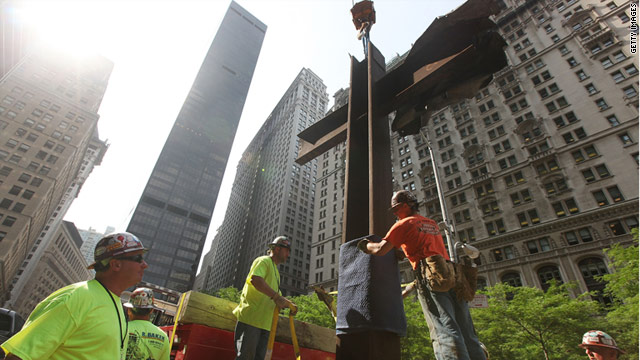
9/11 and Faith, My Journey after that Dreadful Day

CNN posted a story recently on 9/11 and its impact on Americans' faith. It really struck a chord with me, because it took me back over ten of the most decisive years of my life.

CNN's writer, John Blake, found three significant changes in Americans' faith practices since then:

  • The humiliation of the attacks had altered Americans' self-identification as a "chosen" nation
  • Interfaith forays were more acceptable, with Muslims making inroads to mainstream culture and cooperating with Christian groups more often.
  • Atheism had become a forceful, militant idea. It came out of the closet.
  • I would add a fourth: the unholy marriage between Christian fundamentalism and Zionism that lured the nation into two world wars--and nearly a third in Iran, had not cooler heads prevailed.


For me, 9/11 was a faith touchstone. It didn't seem like such a big deal at the time. I was a practicing Christian then; I am a Christian today.  But looking back, I think it raised some questions that I had no hope of finding answers to at the time.

22 August 2011

Your Education Policies: A View from the Depths

I've had a really tough time so far this year. A passel of new regulations, passed by a viciously anti-teacher legislature last spring, have tied me up in knots and wasted a lot of my time.  I wrote this essay between midnight and 1:30 a.m. just to blow off some steam.  It's not like I had time to write during my 11-hour workdays. I'm planning to share it with my legislators and with SCORE, a Trojan-horse organization founded by Republicans in Tennessee to de-fund public education and drive every last well-meaning teacher either out of the state or into private or charter school jobs.

I teach at a school that you represent, Station Camp High School in Gallatin. I’m beginning my third week of the school year, teaching German, Creative Writing and 11th-grade English.  I sponsor three clubs at our school (yours and mine and my 9th-grade daughter’s).

I’m burned out. That’s right, and it’s only the third week.

Someone needs to tell what’s going on.  Someone needs to describe all the work that has been wasted by the onerous regulations placed on public school teachers and administrators in the 2011 legislative session.  Someone needs to get you to see the effects of decisions you made six months ago.  I will do my best to try.

This is my eighth year at my high school.  During that time I have taught every grade level of English, and every strata of each class except A.P.  I have also taught--as I am teaching now--German 1 & 2 and creative writing.  After three years here--years in which I was observed regularly, and I carefully worked out lesson plans under the direction of my administrators--I earned tenure back in 2007.

While politicians, movie producers and journalists tried to disparage tenured teachers like me with allegations of ineptitude and stories of mysterious “rubber rooms,” I was proud of my tenure.  I knew how hard I had worked to earn it.  I also knew the ways it could be used to benefit both me and the students who would study in my classes in subsequent years.

Tenure gave me the freedom to turn my classroom into a learning laboratory.  I knew how to teach, plan, and manage a classroom--that’s what I understood my tenure to mean.  It meant that I had the freedom to experiment with new styles of learning, to reach out and form community partnerships that might benefit learners in my classroom, to organize learning experiences outside the classroom and collaborate with teachers across subject areas and grade levels.  I wouldn’t have gotten tenure in the first place if I hadn’t shown mastery of basic teaching methods over three years.  Tenure gave me a solid foundation from which I could reach higher.

Over the past three years, this foundation has produced amazing results both for me and for my students at SCHS. My love of experimentation and my creativity--with the support of my school administration--really began to blossom in new ways.  I formed a close bond with TPAC Education which brought teaching artists into my school to help make lessons more meaningful.  I learned Google Docs and used a donation of 32 used laptops from Volunteer State Community College to create my school’s first “paperless classroom.”  This past summer I won a fellowship from the National Endowment for the Humanities to study American history through song at the University of Pittsburgh, where I developed ways to use folk music to augment my literature classes.

I returned from Pittsburgh four days before the administrative day where we learned about the new evaluation system:  that tenure was transitory, that teachers who didn’t perform “above expectations” or “significantly above expectations” for two years in a row would return to probationary status.  When I saw the regulations--about 30 minutes of paperwork per 90-minute lesson (and I teach three different lessons a day)--I knew that my days as a tenured teacher were numbered.  But that didn’t bother me as much as knowing that the freedom I had worked so hard to gain, build, and share with my students, was also transitory.

You need to know what is going on in the schools you represent. If you’re working for teachers, parents and students, you need to understand the results of your policy actions.

This is how Tennessee Educaton Reform 2.0 has worked for me so far:

  • I have attached below the lesson-planning form that was adapted by my school’s administration. It includes all the relevant data that will go into my evaluations this year.  It took me 30 minutes to produce.  The toughest part about the planning form isn’t the questioning or the assessment--I’ve been doing that since I started teaching, it’s how I gained tenure.  It’s wasting time referencing the standards.  In German 1 there are about 20 to utilize, but in English 11, there are almost 70 state performance indicators (SPI’s). I find myself asking, “This is a logic lesson. Is it 5.2 or 5.4?”
    • This has tripled the amount of time it takes me to plan lessons.  Usually I have lesson plans posted a week in advance of the lessons I teach.  This year, I’m struggling to stay one to two days ahead.
  • My grading has increased markedly--not directly because of the state regulations, but because of an ambitious goal I had set to make my classes paperless.  With laptops at every desk, students generate about 30-35% more work for me to grade.  This is an exchange that I’m willing to make, because (1) I am investing my time to see kids learning more, and (2) I’m optimistic that eventually technology will let me cut the grading load to what it was before or less.  Before, the satisfaction of seeing successful learning and being a part of technological innovation made the extra work worthwhile. Now I feel like I’m doing a lot of work the State of Tennessee doesn’t necessarily want me to do, and instead I should spend more time acting and planning like a non-tenured teacher. You might imagine the frustration I feel there.
  • I have no time.  Last year I graded at home from 9 to 10 five nights a week; this year I am grading/planning from 8:30 to 11, and I have little to show for it.   Last year I graded on Sundays only when I had a big batch of essays to complete.  The first Sunday of this school year, I spent four hours at my school setting up for the launch of my paperless classroom.  Last Sunday, my wife and kids went to the movies without me so I could spend five hours getting my grades ready to post and plotting out lessons for my three classes.
  • I can’t perform the kinds of leadership roles I want to provide to other, less-experienced teachers.  I mentioned earlier how I arranged for teaching artists from TPAC Education to come to our school.  Last year I had three colleagues join me in an Arts in Education Unit.  This year, we’re all so busy trying to keep our heads above water, we’ve all but given up on the idea, losing precious momentum toward Arts in Education that I had labored to build over two years.  I learned some cool new teaching tricks at the NEH Summer Institute that I would love to share through a professional development, only I have no time to draw up a proposal, much less plan a three-hour training.
  • I can’t develop the technology that I brought into my school last year, and I can’t train other teachers to use these 21st-century teaching tools.  I want to train more teachers at my school about Google Docs and utilizing technology in the classroom. This summer the district brought in a “tech guru” from Atlanta as a keynote speaker.  I got to have a private meeting with her to share some of the things I was doing with Google Docs in the classroom.  While she had a broad knowledge of Google applications--and other forms of software--she hadn’t experimented with it in the classroom setting like I had, and she was very impressed.  I don’t get paid four figures a day to visit Tennessee like she did (it would be nice, but let’s face it, I’m just fighting to keep my job in this state, much less tenure).  I live here and have committed myself to my county’s education success, not just my own.  I can’t do it, though.  That’s what I’ve realized in just three weeks.


I’m just speaking for myself. I cannot speak for the administrators whose work loads have doubled with the additional evaluation responsibilities.  I cannot speak for the colleagues who were a year away from tenure and now have to wait for three.  My kids are all in school now (my youngest is eight), I can’t speak for teachers with young families or those expecting babies, who are now facing this increased workload.  You need to talk to them.  It is you who need to listen.

I share with SCORE and many others the desire to see Tennessee’s public education system become the best in the South, and I hope that I have demonstrated a willingness to do the hard work that profound change in education requires without explicit, step-by-step direction from the state department of Education.

I just fear that we’re missing out on opportunities for implementing real learning by treating teachers like numbskulls who have to fill out a planning guide and list out standards-based questions on their forms before they can teach a German class how to say “What’s up?” or lead an English 11 class through the turbid waters of Moby Dick.

Last Sunday’s New York Times featured a number of respected thinkers who finished the thought, “If I were president....”  James Dyson, the engineer who re-invented the vacuum cleaner, wanted to change education in the right way:
“Standardization and rote learning lead to sub-standard results because they don’t inspire or challenge. My solution: get rid of binary right and wrong answers. Experimentation is learning. Only through making mistakes do we find out what works, what to do differently and how to get better.  Box-ticking does not correlate with world winning. Certificates won’t beat global competition. Creativity will.” --Kornbluth, Jesse, “If I Were President,” New York Times, Sunday Review Section, 21 August 2011.

Part of me is willing to accept a lower TVAAS score because I chose to teach my students about thinking and not “box-ticking.”  I would rather see a student demonstrate a love for learning than a high score on an end-of-course exam.  As a teaching professional, of course I want to grow towards both goals, but as an overworked, maligned public school teacher, I feel hung out to dry.

In your capacity, you attend a meeting, you write a press release, you attend a luncheon or a fundraiser, and you feel like you have done something with your day, you might even feel like you did some good.  Where I’m at now, I grade sixty papers and work 90 minutes on planning, and I feel like I have only fallen an hour further behind where I need to be. I haven’t contacted parents, I haven’t arranged extra time to help a student who isn’t yet up to speed, etc.

Tennessee has gone too far towards standardization in its onerous micromanagement of teachers, both tenured and non.  Legislators and policy advocates have taken away from teachers and administrators the freedom to experiment with learning, the room to let students try--then fail--then explain and learn.  I hope that this letter may apprise you of the situation on the ground and encourage you towards more balanced, more rational policies in the future.

Sincerely,

James Dittes
Station Camp High School

16 July 2011

The Haunting at Edward Braddock's Grave

I am standing at a monument to General Braddock near Fort Necessity in Farmington, Pennsylvania. His face is etched into the panel. More than 250 years cannot erase the arrogance with which he tore a road through the wilderness from the Potomac River over the Alleghenies. I doubt that look was there when a force of French and Indians surprised his army near the banks of the Monongahela, turning them back on each other into mad confusion, just fifty miles from his goal: the forks of the Ohio River at present-day Pittsburgh.

They carried him here, 35 miles away, where Braddock died of his wounds and the only remaining officer, a 23-year-old George Washington, took over, hustled the soldiers about a mile further, and set up a fort to take on the pursuing French & Indians.

I remember the story. I wasn't even in school yet when my dad told it to me. We were walking in the woods at the time, exploring our new home near Amesville, Ohio. He told me how Indians hid in the trees, watched Braddock's army pass, and launched their attack. I pace around the monument. On my way back to the car, I pass this sign: "This is the spot where Major-General Edward Braddock was buried, July 14th 1755."

Washington had buried Braddock in the middle of the road they had built through the thick forest. Indians were known to dig up recent burials to claim scalps. Therefore, Washington's first order as commander was to bury the general and then direct every soldier and pack animal to tread the ground above him. It wasn't until sixty years later, that workers building the National Road (current US 40) unearthed the general's remains, reinterring them further up the hill, underneath the present monument.

These woods are haunted. I can tell that.

I follow the path. It ends at a creek, in woods so think and tangled, I think I can see Braddock's demise hiding in the shadows.

There is the trace of a path off to the right. I can see it. I have a sense for trails. I can see them when others can't, even in the dark of night. I have followed trails--and creeks, and sounds--since I was a boy.

I follow a trail. I see it winding through the ferns. I begin to run. I can't help it. I look down. I can't see my feet.

27 June 2011

A Musical Autobiography

Note: I'm at the University of Pittsburgh for the summer, studying at a summer institute called "Voices Across Time: American History through Music." I'm writing this as a draft of my first project, to provide a "musical autobiography" of myself, using an experience I had through music.

I have always been steeped in music. I can't remember a time in my life where music wasn't important to me. My father is an accomplished pianist and organist who today earns his living playing for churches. My mother grew up playing the violin and planned--through the end of her freshman year of college--to be a professional musician. By the time I came into my parents' lives, you could say that music was part of my destiny.

I began taking piano lessons in first grade, and I continued--summer and school year--all through elementary school. I was not an exceptional pianist, but by the time I finished eighth grade, I could play well. It was the summer after eighth grade, that I faced an important decision about my future in music.

I was bored. I practiced my exercises and the classical pieces assigned to me, but I didn't have a love for the piano. I was thinking very seriously about quitting. I was about to start high school. I felt like moving on.

I remember sitting at the piano in my living room, muttering. (I have since learned that muttering is about as natural to 14-year-olds as breathing, but it seemed really important to me at the time.) I put away my Beethoven book and pulled out a book of songs from the movie, "Snow White." It didn't take me long to learn the songs. As I was playing, "Some Day My Prince will Come," something happened.

I had a vision.

In my vision, I was playing the piano. There was a girl there, sitting on the bench next to me as I played. And she liked what I was playing!

It was a powerful vision, I must say. The girl, she sidled closer to me, so that our arms touched--from shoulder to elbow, no less. I can't remember what other fantasies might have moved my 14-year-old mind, but it probably also involved squinching my lips together at the end of the song and seeing hers--squinched up too--waiting to meet mine.

I should add that at this time in my life, there was nothing more confusing to me than teenaged girls. In reality, had one sat next to me, I probably would have been unable to play anything--not even "Chopsticks." But that shouldn't take away from the vision. I realized something about my music. I could benefit from this, I thought, this might be just the thing that will attract a girl!


13 March 2011

Real. Simple. Worship. Thoughts on Psalm 95

Psalms still have a hold on me.

I thought I have have gotten them out of my system with a furious 10,000 words at the end of 2010.

I spent my meditation time last year in Solomon's Temple. When the Psalms were read, I heard them echo through the temple courts. I watched the procession of worshipers on feast days; I joined in their songs. I delighted in this book as my guide to elemental worship.

Elemental. That's where Psalm 95 begins. It begs the question: what is worship at its most basic--at its simplest?

Think of the different elements in a modern, Christian worship service:
  • Welcome/announcements
  • Singing/Praise
  • Prayer/Testimony
  • Offering
  • Special Music/multimedia feature
  • Liturgy/Scripture
  • Sermon
Which of these were evident in the Temple? Which have been added over time? Psalm 95 answers. It is a concise, 11-verse act of worship. It is a template that is still worth following today.

(Why is today the first time in my life where the obvious connections between the words "Temple" and "template" became evident?)

Praise
"Come, let us sing for joy to the Lord," the psalm begins, "let us shout aloud to the Rock of our salvation." Worship begins with praise, with "thanksgiving...music and song" (verse 2).

The psalm reveals the reasons for praise, too. It is God's creative power that drives us, the formation of mountain peaks and the sea's deepest depths. It reminds me so much of the hymn that goes, "I sing the mighty power of God that made the mountains rise, that spread the flowing seas abroad and built the lofty skies."

So often in my own worship, I find God's creative power at the center of praise--both for those things he has done for me and through me. My kids, for example, are products of His creative power, not mine. My energies and talents have little explanation other than the Creator who engendered them in me.

Prayer
The second act of worship is prayer. "Come, let us bow down in worship" (6). The theme of the psalm's praise continues as the people "kneel before the Lord our Maker."

Yet God comes down from the mountain top at this point of worship, too, dwelling in the meadows among us, who are "the people of his pasture, the flock under his care" (7). God's creative power meets his warm embrace as worship moves to prayer from praise.

I have to admit that Prayer is the portion of worship that I have struggled with the longest. I grew up in a faith tradition where prayer was self-generated, where the best prayers spoken expressions. I found prayers in other traditions that were repeated. Nowadays, I find my best prayers to be those that are unspoken: that seek to strip away needless thoughts and listen to God's voice speak to me. Prayer is definitely the part of worship in which I feel least confident.

Scripture
Psalm 95 ends with a sermon--or more precisely, a lesson from scripture. One of the features of temple-era worship was the lack of both scriptures and literate people who could interpret them. Accounts that I have read show that the editing of the Jewish scriptures probably began under Solomon. The psalms and other wisdom literature were under centuries-long development, and about 1/3rd of the Old Testament (Isaiah through Malachi, as well as Esther-Nehemiah) had yet to be written.

The lesson comes from Meribah , the site where the "people of his pasture" grew restless with the lack of water and threatened Moses with rebellion (Exodus 17).

At first reading, this seems like an intrusion into a very lyrical meditation on worship. Why God? Haven't we praised you as Creator? Haven't we submitted our cares to you in prayer?

As I reflect upon this psalm, I find that it closes with remembrance of what worship is not. "I said, 'They are a people whose hearts go astray, and they have not known my ways.'" There is only one way to worship, and that is with God. If one's heart is elsewhere, or one does not know the way of praise and prayer, then the fullness of worship is not possible.

(This is where many people of faith get bogged down. For example, some may thing that praise "with God" requires an organ to play or the absence of drums. Others may argue that prayer "with God" invokes the Spirit through angelic utterances. I posit that "with God" implies a reverence and desire that come from putting self below God.)

The psalm ends on a somber tone. "So I declared an oath in my anger, 'They shall never enter my rest'" (11). The psalmist reminds the people that their forefathers received a 40-year sentence for their failure to worship at Meribah and Massa. (A later generation of Israelites would receive a 70-year exile for the same reasons.)

What I find fascinating by this last line is the hope that it offers. "My rest" is, after all, the be-all that God seems to have withdrawn at Meribah. "My rest" is the perfect synonym for worship. When worshipers are at praise or at prayer, they are at rest--or more specifically, at God's rest. Sabbath is, then, also a synonym for worship, and we shut ourselves out from worship, from rest, from Sabbath when we fail to put worship in its proper place.

Lessons for Today
I love the simple worship template found in Psalm 95. Praise. Prayer. Lesson. When worship is focused like this, it is easier to shut out the extraneous things. Leave announcements and offerings at the church door. Enter to worship.

And within worship, I believe that individual efforts need to be channeled through these three elements. The best worship is done collaboratively with worshipers engaged, not entertained. And remember that engagement involves not just repeating hymns or responses, but action: the movement of standing together, coming to the altar, taking part in communion, kneeling in prayer.

07 February 2011

The Artist's Journey

I'm a Google guy now.

I spend my snow days studying manuals on Google Apps in Education. I am now up to three different Google accounts--one for personal and two for teaching.

When I learned about Google Art Project, and when I got to peer close enough to a Van Gogh to see the brush strokes at what seemed to be an inch away from my nose, I was sold.

This afternoon, as snow blanketed the lawn outside my house, I took a tour of the Alte Nationalgalerie in Berlin. GAP offers two ways to tour a museum. Through "Explore the Museum" one can walk through the galleries, a la Google Streetview, and focus in on the paintings on the walls.

I prefer the more conventional "View Artwork" that allows the visitor to scroll from painting to painting. That's the way I visited the Alte Nationalgalerie today, and when I realized the depth of paintings they had on German Romanticism, I just had to start a "collection" (view the link to see the pictures I selected for yourself).

Because of the focus of my collection, I left out some Monet and Renoir as well as sculptures that I enjoyed.

One of my favorite "discoveries" was Moritz von Schwind's "The Rose, or The Artist's Journey" (above). Painted in 1847, it develops the Romantic love of both storytelling and love of the medieval. It was the clever title which drew me into the painting.

The painting is about inspiration--it beckons the viewer into the Imaginative Life. Indeed there are many artists in the painting, climbing the narrow path to the castle, hailed by trumpets and banners.

There are women--the hope for love. They peer, and they preen for the guests, gossiping and flirting. And there is one musician--a clarinet player--who hasn't caught the pleasure of the castle, but instead has looked down...where he finds...inspiration.

It's a rose, a small pink rose. It isn't the first detail of the painting that catches the eye--we actually catch the red jacket of the clarinetist and follow the reds of the players up the path toward the castle. The pink won't catch the eye until the second or third time through the story--when we've given up on the haughty woman in the pink dress.

But once the pink rose catches the viewer's eye--a second or two after the clarinetist's discovery--the setting ends and the story begins. We return to his eyes: a look of surprise, a reward for contemplation and absent-mindedness. We look above the eyes. A bouquet of pink roses rests on the edge of the balcony, next to a blonde beauty who happens to be looking down at her bait.

For once in the painting, we see her first. She's a handmaid, the only one of the attendants not busy with the pink princess. The viewer ends the story in the place where love stories should end: looking back and forth between the girl and the boy, noticing their matching blond hair, wondering how they might meet at one of the performances, wondering about...well, whether happily ever after might exist.

The painting is "The Artist's Journey," and it really is. It is the ideal journey that is every artist's fantasy, incorporating story, song and romance in away that engages the viewer and carries them along on the trip.

28 January 2011

On Turning Faustus

Birthdays are wonderful times for reflection--and none more so than the decades. I've been trying to prepare myself for "40" for weeks now. But as the days have ticked down to my 40th January 28th on planet Earth--to be followed, hopefully, by my 40th January 29 and 30--I've been thinking more about Faustus than 40.

Here's why. (Pardon my self-indulgence. I promise to keep it under wraps for another ten years.)

Faust is a German legend about a man with an unquenchable thirst for knowledge. It is original tellings, Faust was a brilliant but doomed wizard, the draw of the story was the magic and demon, Mephistophiles, Satan's right-hand man.

The Faustus story benefited from two retellings in particular. At the height of the English Renaissance, Christopher Marlowe wrote the play, "The Tragical History of Dr. Faustus." His main character was a Renaissance Man who had mastered law, medicine and logic--a man who found magic to be the only study that still interested his teeming mind.

At the dawn of European Romanticism, Johann Wolfgang von Goethe penned Germany's greatest play, "Faust." Again, knowledge was the goal, magic was the means: only this time the growth of The Enlightenment was the writer's canvas.

I find myself, therefore, entering a new age (pardon the pun), thinking more of Faustus than 40.

I can trace it back to a dream I had in 1990, just one month before I turned twenty. I was traveling Europe at the time on a Eurail pass, sleeping on trains, in youth hostels, at the homes of long-lost relatives.

I dreamed I was hitchhiking--a skill I had been taught by none other than Jenny George, a.k.a. "future bride." The person who picked me up wasn't Jenny, it was another girl--a girl I had loved in academy. As we drove, we talked, and as we talked I flirted, knowing somewhat disconsolately how badly our relationship had ended.

I realized that she had grown quiet, staring ahead at the road. I gave up flirting, and asked her the question I had asked her three or four times a day over the last month of our relationship: "What's wrong?"

"You're different," she said. "I mean, you were different before...when you were at home...but now you have been around the world. I really don't know what to think of you anymore--no one does."

I turned away and looked away out the window. I groaned. As I remember, I was groaning as I awoke a few seconds later. While I do not remember whether I awoke on a train or in a bed, I have never forgotten that dream. It informed the next twenty years of my life (so far).

When she had rejected me the first time, I was very much a creature of my culture: I was white, religious, Southern. In other words, I was a Republican--a George W. Bush voter in waiting. Fortunately my curiosity was stronger than my chauvinism, and I flew to England after one year in college.

When she rejected me the second time--in the dream--I couldn't have understood the changes that had begun in England. They wouldn't be apparent until I had returned to the bastion of small-mindedness that was my American college. The seed was there; I think that's why I had the dream.

I think of the way that seed grew throughout my twenties. I returned to the United States to find a much smaller group of friends willing to accept my socialism, my antipathy toward borders, my boundless desire for adventure, but there were enough--and there was Jenny George, the woman--the mate--who shared every dream, every adventure, every spiritual longing. Thank God that Jenny knew what to think of me.

As I neared 30, the dreams petered out. We were stranded in Albania and shut out of Pakistan, returning to Tennessee in January of 2000 to follow Jenny's call into rural medical practice in Westmoreland. When I turned 30 in 2001, I was jobless, staying home with Ellie and newborn Owen. I was hungry for knowledge, for power. I think that's when Faustus stepped in.

I know of no Mephistophiles, and I want to assure my reader that I have signed no blood oath, there is no 24-year contract for my soul that ends with me descending into hell.

I hungered for knowledge. I would walk with Ellie to the Westmoreland library and read everything I could get my hands on: religion, physics, history, engineering, war, etc. I wrote manuscripts. I went to graduate school, getting my Master's in Public Administration. I became someone who threw himself into researching any project to the hilt: whether it was a road trip, a new business venture, or an inspiring text in scripture. (Sadly, I never found a way to profit from these impulses toward expertise.)

For example, in recent years I have become literally addicted to the "webinar," an online course--usually free--that instructs educators or illustrates new technologies. Last week--during a snow break, no less--I decided to get certified in Google Apps for Education. I am any teacher's best student--I'll listen to a lecture, research the heck out of it, and return to the instructor with ideas how to implement the ideas even further!

Yet the hunger for knowledge only takes me back to that dream of twenty years ago. Learning doesn't unite people, it divides them. The questions that we ask when we reunite with friends aren't "What have you learned?" or "Have you changed?" It is quite the opposite. When people ask you a question, and you can respond with five to eight thousand words, it doesn't endear you to them. Knowledge is a threat to a relationship; ignorance is--after all--bliss.

Should I care? I confess that when I meet indifference, I'm compelled to reach further, read even more, research my way out of a problem. I'm not out to impress anyone, so I can't really feel rejected. I'm only hoping to learn more and more and--why thank you--even more.

"I don't know what to think of you anymore." I can hear the words and see the frustrated look on the girl's face even today, more than twenty years after they spoke into my dream.

The words haunt me, bittersweet like beauty that breaks the heart. I want her to care--I crave the acceptance that high school friends offered in exchange for conformity, in exchange for thinking, acting, celebrating and worshiping in a defined, conservative, Southern space. I want that protecting shell.

I'm 40. I'm Faustus. I didn't sell my soul--I sold my shell so that my spirit and my mind could break free. And that fact brings me closer--both to Heaven and to Hell--that I ever could have dreamed.

18 December 2010

A New-Old Take on the name, "Immanuel"

One of my favorite books/podcasts is "Freakonomics." The authors, Steven Leavitt and Stephen Dubner have the perfect tagline: "The hidden side of everything."

One of my favorite books to study is the Bible. Yet no matter how many times I read it, I am constantly coming across the "hidden side" to stories that I have read or referenced all my life--facts that hide in plain site right there in the text.

Read a few verses before or after a text. Check one of the cross-references listed in the study Bible. Try to do both, and you you will be taken deep inside the culture; your eyes will be opened to the "hidden side."

For example, one of Christmas's most cherished quotes was first delivered beside a water pipe. No angels sang, no shepherds watched. A king was there, but he was none too happy with the Christmas message.

The king was Ahaz, father of Hezekiah, a king who divided his loyalties between Yahweh and King Tilgath-Pilesar of Assyria. The prophet, as we all know well was Isaiah, the proto-Christian voice of pre- and post-exilic Israel.

If you read biblical encounters of prophets and kings, you figure out the prophetic modus operandi pretty quickly. Prophetic visits aren't announced or arranged. The best encounters--Moses with Pharaoh, Elijah with Ahab, Nathan with David--occur when prophets just 'show up.'

And that's what Isaiah did one day in 735 B.C., surprising Ahaz as he inspected the pools of Jerusalem. Ahaz wasn't preparing for a message from God, he was preparing for war. The kingdoms of Israel (Ephraim) and Damascus (Aram) had united against Judah. Ahaz had done two things to secure his throne (neither of which involved prayer): he had requested aid from Assyria, the superpower, and he had fortified his defenses. The aqueducts, which brought water into Jerusalem's pools and fountains, would be among the first defenses to be attacked during a siege.

Driven by divine order, Isaiah took his son, "Remnant will Return" (you have to feel for offspring of prophets in the Bible--modern-day celebrities having no corner on bizarre baby names). Isaiah met Ahaz at one of the pools.

His message was benign: "[This invasion] will not take place, it will not happen," he told King Ahaz (Isaiah 7.7). Yet Ahaz didn't respond: no praise, no thanks, no offering...no worship.

Maybe he didn't hear Isaiah and his son. "Again the Lord spoke to Ahaz," the story continues, "Ask the Lord your God for a sign, whether in the deepest depths or in the highest heights" (verses 10-11).

I imagine that Isaiah was pretty brusque at this stage. Ahaz had just been given a prophecy that would certainly seem to be "glad tidings of great joy." Peace in Judah had been confirmed by God.

Ahaz didn't want a sign. "I will not ask; I will not put the Lord to the test," I have things under control--thanks but no thanks.

This is pretty surprising, considering Ahaz's superstitions. Later his son, Hezekiah, would ask for a sign--the sun retreating down a sun dial. But Ahaz was in every way superstitious and pagan. For example he
  • carved Hezekiah's sun dial into the Temple steps, much to the dismay of God-fearers like Isaiah
  • erected two golden horses at the east-facing entrance to the temple, modeled on those harnessed by the sun god every morning
  • built a pagan altar inside the Temple, modeled on one he had seen on a royal visit to Assyria
To put it succinctly, he had most certainly put the Lord's mercy to the test.

Isaiah erupted--but his eruption ties in with the Christmas story. In the face of this vacillating, idolatrous king of Judah, Isaiah threw the Christ child.

Perhaps if this king didn't "get it" (and how many kings--or presidents--or representatives--ever really do), then a good king would come from the most unlikely of places.
"Will you try the patience of my God also? Therefore the Lord himself will give you a sign: The virgin will be with child and will give birth to a son, and will call him Immanuel" (7.14)
Before there was a Joseph or a Mary, before angels appeared to shepherds or a star lighted the way for wise men, there was a king, checking his water supply, who ignored some pretty good news from a very great prophet.

It's still pretty good news today.

10 December 2010

Getting Real about Persona

"I wish I were my persona." Billy Collins

The words really took me aback. I was in the auditorium at Nashville's Hume-Fogg Magnet School, where Collins had accepted an award from the Nashville Public Library. After about an hour reading his poems, he took questions. The first was about persona.

Collins has long been my favorite living American poet, and I have taught his poetry in my high school classes. My favorite is "We Are the Dead," a meditation on a Heaven where every religion meets its apogee, and every belief confronts its eternal application.

In all of his poems, he displays a wry persona: a person who is a viewer, not a doer.

For example, another favorite Collins poem is entitled, "Taking Off Emily Dickinson's Clothes." The title alone shows Collins's enlightened irreverence--as if any self-respecting English major would dare to entertain such a thought!
The complexity of women's undergarments
in nineteenth-century America
is not to be waved off,
and I proceeded like a polar explorer
through clips, clasps, and moorings,
catches, straps, and whalebone stays,
sailing toward the iceberg of her nakedness.

Later, I wrote in a notebook
it was like riding a swan into the night,
but, of course, I cannot tell you everything--
the way she closed her eyes to the orchard,
how her hair tumbled free of its pins,
how there were sudden dashes
whenever we spoke.

What I can tell you is
it was terribly quiet in Amherst
that Sabbath afternoon,
nothing but a carriage passing the house,
a fly buzzing in a windowpane.

So I could plainly hear her inhale
when I undid the very top
hook-and-eye fastener of her corset

and I could hear her sigh when finally it was unloosed,
the way some readers sigh when they realize
that Hope has feathers,
that Reason is a plank,
that Life is a loaded gun
that looks right at you with a yellow eye.
I loved that poem before I had met Collins. I caught the many references to different Dickinson poems. After listening to him read and talk for an hour, I was even convinced that Collins is just as funny in person as he is in his poems.

And then he had to tell me--he told the whole room actually--"I wish I were my persona." The thought just blew my mind. It really got me thinking, and it has taken a month for me to get my thoughts into place for writing it down.

As a writer, I have to admit that I've often struggled with my persona. Writing has always come easy to me, but I have to admit that--other than religious essays and sermons--the other types of writing, short stories, poetry, have been hard to come by. I struggle to master the basic forms of character and plot, yet I come out with stuff that isn't memorable--or worthy of publishing.

That's not to say that I don't know anything about persona. I have a persona named "The Lover" who lives with Jenny George here in my house in Dittessee. This persona can't stop complimenting her, he speaks in a variety of foreign accents. He spontaneously breaks into a song that begins with the line, "I'm in love with a woman..." He engages charming sons in daily battles for Jenny's affections.

"The Lover" isn't me. He is a persona that I'm able to turn on when I'm turned on by my bride. When the kids aren't around, or we're talking about something important, the "real" JD engages with Jenny George. Sometimes, Jenny gets sick of "The Lover" and tells me to knock it off.

When I look at other teachers at my school, I see many who enthusiastically embrace a teaching persona. Mike, a vice principal at my school, roams the halls like a bulldog, glaring at kids who linger. "What do you think you're doing?" he will bark, or "Where are you supposed to be?"

Yet here's the thing about Mike. He's one of the most compassionate, caring administrators I have ever worked with. He genuinely loves the kids at my school, and he makes sacrifices to help them succeed. He has the "hallway" persona down pat, but he has the real Mike, also.

I'm jealous of Mike. I've never mastered the discipline game. I teach straight--as "James Dittes," and I have to put up with a lot of disrespect and silliness that a bulldog-type persona wouldn't see.

I have come close to a teaching persona--and I may just yet adopt one. Last summer, I was encouraged by a friend to set up a Twitter account to promote my magazine sales site, Mags4Kids. On a whim, I chose the Twitter handle, "Father_Ahab." One of the highlights of the semester--for my American Literature students and for me--is the week we spend reading Moby Dick and sailing with Ahab into the jaws of doom. During that week, I get to talk like a pirate (when I read Ahab's lines), I act a little crazy, and the kids really get into it. Then I move into Thoreau and Emerson and quickly shed the persona.

For a few weeks, I had so much fun thinking about Father_Ahab. He was a dad, like me, and he was obsessed with goals--again, like me. I scanned the book, looking for quotes that I could turn into Twitter posts. For example, "Toward thee I roll...Chattanooga, Tennessee," or "Call me sleepy, too many late nights reading Moby Dick!"

While I had fun with the feed, and I added a lot of followers in the first few weeks, it made no sense to my friends. One suggested that I change it to Mags4Kids, and I did. I posted a few items about kids' magazines, then I gave up. I just couldn't think of anything to write. Without a persona, I was wordless.

The more I think about this, the more I wonder if this might be the problem behind my failure to really gain traction as a writer. I need a persona. I mean, just think about the way that Samuel Clemons was able to fill the persona of Mark Twain--the hair, the suit, the sense of wit. He never said, "I wish I were my persona." Maybe that's because Clemons eventually became his.

I think of my favorite author, John Steinbeck, how he was able to embody his outrage and channel it into great literature. Children's books are full of personae: Lemony Snicket, Dr. Seuss, Shel Silverstein, to name a few.

What I need, more than a story to tell, is a persona through whom to tell it. I have a cool pen name that I developed for a manuscript I wrote several years ago. It's Titus James. It's a cool name, a reversal of my first name and the Roman origin of my last name.

Perhaps what I've learned from Billy Collins and from the teachers around me, is that I need to invest some time to develop Titus--get to know him, write through his persona. Either that, or I need to reinvest Father Ahab the Road Warrior or some other persona that embodies and expresses all the ideas that are just ready to burst out of me!