29 November 2006

Persia and Monotheism

I posted a week and a half ago about Josiah and how the exile finally established monotheism as the dominant theology of the Jews. Since then, I've been on a mission. I've been obsessed with trying to find the historical moment in time when it all clicked for the Jewish people--where Yahweh was no longer a God superior to the gods of Judah's neighbor kingdoms, but when he became the ONLY God for them.

This is what I absolutely love about being a believing Christian, by the way. I love how the Bible has answers to more questions than we could ever imagine even asking. All we have to do is seek...and find.

So here were some questions that I asked:

What if there were one point in the Bible at which I could say--there, they get it! The Jews are finally monotheists and they aren't going back!

What is there were one person or prophet--a proto-Messiah--who could be identified as the lynchpin of monotheism? Who could he be?

In my first post on the topic, I mentioned how the history of Israel from Exodus to Exile had been one of henotheism (the belief that only one out of many gods is worthy of worship), albeit with a consistent fringe movement--my dad loves the Adventist-standard word, "remnant,"--of believers who worshipped only Yahweh and none other, according to the 1st Commandment.

Nowhere was this henotheism more evident than in the Temple itself. The reforms of Josiah, staged about 20 years before the Fall of Jerusalem, clearly point out the different gods worshipped in the Temple at this time. There was the Most Holy Place, of course, for the worship of Yahweh (the Ark of the Covenant was long gone, looted by Pharaoh Shishak just five years after the death of Solomon (1 Kings 14.25-26)). There was also an Asherah pole as well as dormitories to house male prostitutes who served Asherah there.

I searched for answers to my questions throughout the Old Testament, focusing on exilic and post-exilic prophets. Ezekiel didn't work. He prophesied during the captivity, and while he foresaw a united Judah created out of dry bones, he bewailed creeping idolatry--a polytheistic problem for sure.

The post-exilic prophets which close the Old Testament, Haggai, Zechariah and Malachi. Haggai ministers to a new people. The context of his book shows that idol worship has not crept back into the culture, but he issues warnings just in case.

Zechariah is triumphal. The Second Temple is almost complete. This temple will serve as a beacon to all nations. Consider Zechariah 1:16, "Therefore, this is what the Lord says: 'I will return to Jerusalem with mercy, and there my house will be rebuilt. And the measuring line will be stretched out over Jerusalem." This is a prophet to a culture that is redeemed. There is a concern for sinfulness, as there is in Malachi, but there is little mention of the threat of henotheism.

Did I miss something? The act of the Nation of Judah returning to God may not seem exceptional (they did it again and again), but did the fact that they stayed with Him--as they continue to do today--get overlooked in the Old Testament?

The answer is hidden within one of the greatest books of the Old Testament: the book of Isaiah, which is actually a collection of prophecies by two different prophets. Much as the books of Ezra and Nehemiah were once stuck together in the Hebrew Bible, the Second Isaiah's prophecies follow upon those of the First Isaiah, who wrote during the reign of King Hezekiah of Judah (727-698 BC).

Consider the demarcation between the First Isaiah's writings and those of the Second Isaiah in chapter 40 of the book. The last verse of Chapter 39 states,

"The word of the Lord you have spoken is good," Hezekiah replied. For he thought, "There will be peace and security in my lifetime."

Hezekiah, who has just hosted emissaries from Babylon, has been warned that later generations will pay the price for his arrogance.

Chapter 40 begins,
"Comfort, comfort my people, says your God.
Speak tenderly to Jerusalem,
and proclaim to her
that her hard service has been completed,
that her sin has been paid for,
that she has received from the Lord's hand
double for all her sins."

This isn't spoken to Hezekiah at all. The words are for a people stuck in exile, waiting for the "hard service" of their penitence in Babylon to end. I might add, they are words spoken to a people who are on the verge of total change.

So if there is another prophet who prophesied to post-exilic Judah, could he provide hints as to the kind of change that was made?

Definitively.

The exact point at which God becomes the only God for the Jews is found in Isaiah 45:18.
For this is what the Lord says--
he who created the heavens,
he is God;
he who fashioned and made the earth,
he founded it;
he did not create it to be empty,
but formed it to be inhabited---
he says: "I am the Lord,
and there is no other."

Compare this with previous statements about God/gods.

Elijah said on Mount Carmel, "How long will you waver between two opinions? If the Lord is God, follow him; but if Ball is God, follow him." Elijah's is a battle for supremacy.

The First Commandment says, "You shall have no other gods before me."

Second Isaiah shows distinct evolution from these two claims. His God is not in a battle with any other god--"there is no other." It is impossible to have another God since they don't exist. In fact,
Ignorant are those who carry about idols of wood,
who pray to gods that cannot save" Isaiah 45.21

How could this happen? Moreover, how could this happen to a people in exile--apart from their own country, subject to worshippers of Marduk and Ishtar, with no temple, no priesthood and few, isolated prophets? How could a people addicted to idolatry turn themselves into monotheists under such circumstances?

It took a messiah.

Isaiah 45 is the lynchpin of the Bible. Located near the middle of the Bible, it returns the People of God from the brink of annihilation, and sets up a culture into which Jesus will be born and grow to save His people from their sins.

Before the Messiah, however, Judah needed a messiah.

The chapter begins,
This is what the Lord says to his messiah,
to Cyrus, whose right hand I take hold of
to subdue nations before him
and to strip kings of their armor...
For the sake of Jacob my servant,
of Israel my chose,
I summon you by name
and bestow on you a title of honor,
though you do not acknowledge me. (Isaiah 45.1, 4)

It seems strange for God to provide a messiah who does not acknowledge him. Cyrus the Great (pictured right) had many good qualities that led him to conquer the empires of Persia (ruled by his grandfather Astyages), Lydia (modern Turkey) and Babylon. He did not worship Yahweh, yet he was a messiah for the Jewish people.

Why? I think it is because he was a monotheist.
The Greek traveler, Herodotus, described the beliefs of the Persians in the 5th Century (100 years after Judah's return from exile).
  • the Persians have no images of the Gods, no temples nor altars, and consider their use a sign of folly. This comes, I think, from their not believing the Gods to have the same nature as men, as imagined by the Greeks.
A clue to the source of Cyrus's belief is an understanding of the religion of Zoroaster, a prophet who wrote around the time of the Exodus. He said that there was one God, whom he called Ahura Mazda. In opposition to God was the power of capital-E Evil, known as "The Lie" or Angra Mainyu.

Scholars who have researched Cyrus have not found any records that confirm his Zoroastrianism, but we know that it was the dominant faith of his home kingdom of Persia. By all accounts he was tolerant of all gods, and he was magnanimous toward those he conquered. Consider this engraving, now in the British Museum:
  • I am Cyrus, King of the World, Great King, Legitimate King, King of Babylon... When I entered Babylon as a friend and when I established the seat of the government in the ruler's palace with jubilation and rejoicing, Marduk, the grat god, induced the magnanimous inhabitants of Babylon to love me, and I daily endeavored to worship him... I returned to the sacred cities on the other side of the Tigris, the sanctuaries which have long lain in ruins, as well as the images which used to live in them... I also gathered all their former inhabitants and returned them to their homes.
These are the words of no religious fanatic, but someone experienced in the diplomacy and the art of statesmanship.

Are they the words of a messiah? I believe they could be. The answers to Judah's abrupt turn towards monotheism during exile may lie not in Babylon but in Persia. Rather than being forged in an atmosphere of persecution, Judah's monotheism developed under an empire that itself embraced monotheism.

When Alexander would conquer Palestine 200 years later, he continued tolerance toward Judaism, as would the Ptolemies who would rule for the next 160 years. It wasn't until 168 BC, after Palestine had been conquered by the Seleucid Empire, would Judaism face an enemy in the form of the zealous paganism of Antiochus Epiphanes who erected an altar to Jupiter in the middle of the Temple. This time the Jews would stand firmly with God, as they have every since.

Of course this opens up more questions. How I wish I could learn more about Cyrus, his conquests and beliefs! Also, how does an understanding of Persia's Zoroastrianism inform us of other Biblical stories during this period such as those of Daniel and Esther? Finally, I know that Zoroaster founded a group of wise men known as Magi--does he have any connection to the Christmas story found in Matthew? It will take more blog entries to answer these questions.
(A key source for this essay was the book In Search of Zarathustra by Paul Kriwaczek (Knopf, 2003).

27 November 2006

Book Review: Malinche

Thanksgiving was supposed to be my chance to catch up on, well, about EVERYTHING: sleep, grading, lesson planning, writing, and--most importantly--reading.

I was unsuccessful on most counts, but I wanted to pass along a short review of the book Malinche by Laura Esquivel.

La Malinche is a legendary character in Mexico. Known as the native who served Hernan Cortes as a translator in his unbelievable conquest of the Aztec Empire, she has long been reviled as a traitor to her Native race. Esquivel tries to redeem her by walking many miles in her shoes. We meet the girl sold into slavery at the age of five; the young slave given over to Cortes upon his landing, where her aptitude for languages serves her well; to the concubine who shares with us her amazement at the glories of Tenochtitlan, the Aztec capital, and her despair when it is totally wracked by the conquering Spaniards.

The book focuses on the spiritual development of Malinche--known in the book as Malinalli. Initially she, like Montezuma, believes that Cortes is a reincarnation of the Aztec god, Quetzalcoatl. (Montezuma famously handed over his entire empire to Cortes without a fight because of this misconception.) Only as she is exposed to the gore of conquest and Cortes's insatiable desire for conquest--particularly when she sees the incredible floating city of Tenochtitlan reduced to nothing--does she see him as a mere, vulnerable man.

I think Esquivel has chosen the best path, considering the kind of character she is dealing with--it's like trying to explain other famous traitors like Judas or Brutus. She tries to draw us into Aztec mythology and comparisons between Quetzalcoatl and the Christ of Malinalli's new religion. But the book tends to bog down in these parts. The most gripping part of the book for me was Malinalli's journey through Tenochtitlan: the descriptions of the marketplace, the artifacts, and the other fine aspects of that incredible floating city.
Malinche is a good weekend read. Ultimately, it failed to introduce me to any redeeming characteristics of its primary character, but I would recommend it for the way it let me see through her eyes at cultures and conquests of long ago.

24 November 2006

Thanksgiving Giving

Compared to most American Thanksgivings this week, ours was a relaxed affair. We had celebrated early (see Lion King post below for the details), so we just invited my mom and dad over for a nice lunch.

Today (Friday) was a most beautiful fall day: temperatures in the high 60s and a clear blue sky. I decided to take out the new digital camera and take some pictures of the boys. Jenny and Ellie went to the clinic, leaving us to play at the park and have fun to our hearts' content.

I just love this first picture of Jo-Jo on the slide. The blue of the slide matches the blue of the sky, and the angle makes it looks like he might just slide right out of your computer screen into your lap! One thing I was worried about with my digital camera was capturing these kinds of action shots, but so far, so good, I must say.

Owen has inherited two good genes: the athletic gene from his Mama, and the piano-playing gene from me. The guy is just perfect. Here he demonstrates his prowess on the monkey bars.
The backdrop of the picture reminds me of one of the few things I don't like about Tennessee: its ugly falls and winters. No leaves are left on the trees. The blue of the sky--even the winter clouds are flat, flat, flat. There is a kind of two-dimensional quality that happens to things here between November and March, and it's just the season.
I'm reminded that there are places in the world that are beautiful this time of year--Arizona springs to mind, as does California. Oh, well.

23 November 2006

Jenny's Birthday

Jenny celebrated her 38th Year of Beauty on November 15th. Things were so busy around here, we had to arrange for a Birthday Breakfast!

Jenny has been working so much that she doesn't get home until 8:30 on weeknights (her partner had to take a medical leave, which means that Jenny has put in some six-day, 72-hour workweeks). I was gone last weekend for a Model United Nations conference with my high school students, so we wouldn't get a weekend slot.

On the morning of her birthday, I baked biscuits. The kids and I put a candle in one of the biscuits and sang "Happy Birthday." Her present was a digital camera. We've been soldiering on with 35mm cameras for all too long. Now we'll be able to upload pictures for blogs and things like that.

The picture I'm posting is of Jenny with her favorite boys. The reason that they're grinning so deviously is that I am behind the camera yelling things like, "She's my bride! I want to snuggle with her, not you two!" In Owen and Jonah, she has two handsome men who can adore her with charm equal to her beauty!

Upgrade Pains

Two upgrades in the last week haven't gone well for me.

I've been having trouble with BloggerBeta. It takes several tries to get logged in, and I'm not sure that the improvements are all that significant other than the fact that Google now apparently has another way to snoop on my life.

I downloaded Internet Explorer 7 onto my computer at work, and I really like it. It makes it possible to feature several different "tabs" on the same page. That way, instead of clicking tabs along the "START" bar at the bottom of the screen, all the tabs are on the same browser. It is also possible to hide the menu bar at the top so that it only pops up when the curser is there (kind of like it's possible to program the menu bar at the bottom of Windows to go away). This makes full-page viewing really cool.

I didn't have any trouble with the IE7 browser at work, but when I downloaded it onto my desktop at home, I was unable to get onto the Internet anymore. I eventually had to delete IE7. Once it was gone, I got on the Internet without any trouble. I think it conflicts with my DSL, and I've heard some other people complaining about this problem.

Needless to say, I need to wait for more of the kinks to be worked out before upgrading some of these programs!

18 November 2006

Babylon and Monotheism (1)

I've been studying fin de siecle events in the Kingdom of Judah over the past few weeks. This has been a part of the Bible that I usually passed over for a number of reasons: it's more interesting to skip from Solomon to Daniel than to trace Judah's descent as a nations; Israel had better prophets (Elijah, Elisha and Amos); and it's flat-out depressing.

A couple of weeks ago, I entered into a study of Josiah the Great. Ruling just a generation before the destruction of Jerusalem, Josiah was a final breath of grace before generations of suffering. Josiah was a revolutionary: one who implemented monotheistic reforms throughout the kingdom, starting in his own backyard.

I once saw monotheism as a belief that unified Israel in its history from the days of Abraham through to the time of Christ (and even on to today). I think a careful study of the Old Testament shows, however, that monotheism was an exception rather than the rule. Certainly, the writers of the Old Testament hold Yahweh-centered views of history, yet time and time again, the worship of idols comes up. How many times does the Bible say, "After the days of X the people lost their love of God and slipped into idolatry."

Considering how rare Yahweh worship was in Israel, it might be more accurate to state, "During the days of X, Israel lost their devotion to Baal/Ashtorah and slipped into Yahweh worship." The Bible clearly proves that voices for God existed throughout Israel's history--indirectly, it also states that those voices were distinct for their loneliness.

A good way to understand this is to look at the extraordionary rule of Josiah (640-609 BC). The 23rd chapter of 2 Kings describes some of the activities he took in his reforms. They included (a) tearing down the Ashterah pole inside Solomon's temple (around which orgiastic dances where held on feast days); (b) tearing down the dormitories for male prostitutes located in the courts of the temple. This doesn't sound like an idolatry hiccup--in fact it makes me wonder if Solomon's Temple had ever been used in Yahweh worship after its famous dedication.

For example, not the story of Josiah as told in 2 Chronicles 35. In the Book of the Law found in the Temple, Josiah learns of the Passover ceremony, and he orders Israel to follow it. The writer of Chronicles remarks upon how remarkable that celebration was:
The Passover had not been observed like this in Israel since the days of the
prophet Samuel; and none of the kings of Israel had ever celebrated such a
Passover as did Josiah (verse 18)

None of the kings of Israel? That means that David hadn't celebrated Passover, neither had Solomon or Asa. (This may be inaccurate, because the writer of 2 Chronicles uses Chapter 30 to celebrate Hezekiah's own renewal of Passover.) So what had these kings been doing? How had the people of Judah worshipped? It seems evident that the worship of God was very, very different prior to Josiah and immediately after his extraordinary reign.

So how did it change? How did the monotheistic worship of Yahweh move from the fringes of Judahite society into the hallmark of Judaism?

I'll need another post to fully answer that question.

06 November 2006

Lion King

What a great weekend this was. My sister, Julie, flew up from their home in Savannah, Georgia. On Sabbath we had a pre-Thanksgiving get-together with the Dittes side of the family. All my aunts and uncles were accounted for, as well as three of six cousins (I was missing Norman, Aaron, and freshman-in-academy Rachael, for the record).

On Sunday, we celebrated the other reason for Julie's trip to TN: the Lion King touring Broadway show at the Tennessee Performing Arts Center in Nashville.

I have strong opinions about the Lion King movie, and I must admit that the musical wasn't high on my list of Broadway plays--I'm waiting to see Wicked and The Producers, among others. In many ways The Lion King ruined a string of classic Disney animated movies that had stretched from The Little Mermaid, through Beauty and the Beast and Aladdin. One reason was the death of lyricist Alan Mencken. Another was that Disney invested in specatcle more than story: big-time rock star, Elton John, as composer, and gee-whiz graphics. But there wasn't a sould to the story. Once you got away from the cute songs and the Hamlet-based script, there was nothing timeless or magical like B&B. I left the theater after Lion King thinking, "that was cool." Conversely Beauty & the Beast had me thinking, "I could live in that world," just like a little kid.

The Lion King was coming, and my mom--who instilled her love of Broadway musicals into me as a kid--was determined to have the kids see it. Julie was coming, too. This production had puppets! Whew-hoo-de-doo.

So what happened? I loved it. There are about six new songs that bridge together the parts of the story that grown-up JD relates to. The character of Mustafa, something of a cypher in the movie, is brought out with the new song, "They Live in You," relating his hopes for Simba. It was the first song to really connect on a spiritual level, and it set up the incredible response that Simba sings with Raffiki, prior to the climax.

Jenny and Ellie's favorite addition came in the song, "Shadowlands," sung by adult Nala (Simba's love interest) as she leaves Pride Rock. Wonderful characterization. It really worked.

With that said, some of the parts I didn't like were holdovers from the cartoon. If you thought that "Can You Feel the Love Tonight?" was one of the cheesiest moments on film in the 1990s (like I did), you'll want to cover your eyes (and those of your kids) as Simba and Nala sing it (see picture, right) with a PG-13 backdrop of ballet dancers in suggestive poses.

I guess the kids had been a big worry before we went there. The guy on Channel 4 recommended taking kids no younger than five, and we had Jonah (3) and Julie's two sons, (ages 4 and 2). I was so worried that Jonah would get bored, throw a fit, and cause us to waste a $70+ ticket. As it turned out, however, Jo-Jo made it through. (Julie's baby fell asleep during the first song and didn't wake up again.) The costumes are wonderful, and the unique ways that the actors/puppeteers bring out the characters are truly creative. I especially enjoyed the work done by the puppeteer controlling Zazu. (Right, during the song "I Just Can't Wait to Be King" with young Nala and Simba.)

In the end, it was a great weekend with great people. We finished with a trip to the Old Spaghetti Factory--a tradition Julie and I have enjoyed since we were kids and our big summer events were Reds games in Cincinnati.

Guess Who's Blogging Now?

Ellie!

02 November 2006

First Stab at Video

I was cruising around on YouTube, and I found this video by U2 & Green Day: "The Saints Are Coming."

I hadn't really caught the gist of it when they played it in New Orleans on Monday Night Football. The video really brings out the outrage of Katrina, with its clever faux news footage that fantasizes that New Orleans (and not Iraq) would have become the primary focus of our nation's defense.

I would love to figure out how to embed YouTube videos into my blog. For now I'll just settle for the link.

28 October 2006

The Most Wonderful Time of the Year

I've been lucky enough to live in a number of places in the world, and I've seen many beautiful sites. As many places as I've been, Tennessee is the place to be in the fall. My home state is home to one of the largest stands of decidious forests in North America, and the leaves on these trees are just vivid this fall.

Last weekend, we went up to Crossville (about 600 feet higher in elevation) to meet Jenny's brothers, Johnathan and Toby, among others. We met at a place called Cumberland Mountain State Park. The park has a two-mile trail that meanders around a mountain lake. The still waters reflected and amplified the brilliant colors on the trees.

I'll let the pictures speak for themselves.

Jesus and Drama

Last week I got a "help" e-mail from a friend who is on a church school board. Plans for the school Christmas program were being stalled because parents of three of the twelve kids in the school would not let their kids participate in drama (presumably for religious reasons).

Having weathered a few of these ridiculous and wasteful controversies, I used the question as an excuse to expound on some of the research I've conducted on drama in the Gospels. I'll include it below for your enlightenment.

- - - - - - - - - - - - - - - - - - - - - - - - - - - - - - - - -
The drama issue was one of the significant things that finally pried me and my family loose from the Pit of Prejudice that I used to attend at Highland, so be careful. You're not really dealing with anything or anyone rational here, which means that there isn't anything in the Bible or Ellen G. White that will change these people's minds.

The definition of a dysfunctional church is one where decisions are based on prejudice, while a productive church makes decisions based upon the leading of the Holy Spirit.

At the time my church was cannibalizing itself, I prepared a number of salient points based solely on the Bible. Again, this doesn't change people's minds in the least, but I'll share them with you anyway.

Pardon the pun, but Jesus was well versed in drama as in other forms of literature common at the time like parable and allegory. Consider Acts 26.14, where Paul recounts his conversion before the court of King Agrippa. "Jesus told Paul, 'Saul, Saul, why do you persecute me? It is hard for you to kick against the goads.'"

What is kicking against the goads and what does it have to do with drama? It is actually a famous line from a play by the famous Greek playwright, Eurippides, called "The Bacchae." At this time, Eurippides was considered on the same level as Shakespeare might be seen today. His plays were commonly produced, and taught in schools of philosophy and rhetoric. For someone to refer to "kicking against the goads" would be like someone today saying, "To be or not to be," or "Life's but a poor player who struts and frets his hour upon the stage and is heard no more." Now of course it is possible to know these famous lines without having seen "Hamlet" or "Macbeth," but they are significant nonetheless.

It is also interesting to read "The Bacchae" that is referenced by this quote. It is given to the King Pentheus of Thebes by the god, Bacchus. The back story goes that Bacchus's mother had conceived him with the help of the god Jupiter/Zeus. He had successfully proselytized in Anatolia and had built a religious following there, but when he returned to his hometown, he was dishonored: his followers were persecuted, and he was thrown into jail. In a confrontation where Pentheus accuses him of sacriledge and threatens to destroy him, Bacchus asks him, "Why do you kick against the goads?" i.e. Why do you challenge something that will only hurt you? Pentheus ignores him and marches out to imprison the followers of Bacchus (who include Pentheus's own mother). It ends tragically. Pentheus' mother goes crazy (Bacchus was the god of wine after all) and murders Pentheus, chops him up and eats him before she can come to her senses.

This is the drama called to mind with the words the risen Jesus used there on the road to Damascus. (Not surprisingly, early pagan sceptics accused the disciples of basing false stories of Jesus on plays like "The Bacchae.") It is the same way that saying phrases like, "Party On, Dude" or "Isn't That Special" awaken in our generation specific memories of our teenhood.

Personally, I can't explain fully why Jesus used the quote. It seems obvious that anyone growing up in the culture of his day would have been exposed to Eurippides--as were all of the people listening to his sermons in Galilee and Judea. (Ellen White misquotes weren't around at the time to lead people astray, apparently.) He was probably trying to make a culture-related point to Paul--and Paul's subsequent gentile audiences--much like pastors make today.

A couple more parallels.

At the time Jesus was growing up, there were massive building projects in Sepphoris. Now the Bible NEVER mentions this town, even though it was a thriving, cosmopolitan city just four miles away from Nazareth. (It's the equivalent of having the most famous book in the world describe life in Lumberton, Mississippi, without ever mentioning Hattiesburg!) Sepphoris had been leveled in AD 10 by the Romans after the rebellion of Judas the Galilean, and Herod invested tons of money into the city. Among the public buildings he created was a state-of-the-art theater. Would a young, Nazarene carpenter/handyman like Jesus have found work in a place like Sepphoris in the years prior to his ministry? Of course. Could he have worked on the theater--it was the largest building project of its kind, it is highly likely.

The most convincing demonstration of Jesus' familiarity with the theater was the way he used theatrical terms in his teaching. The most interesting of these came in a term he used for his pharisaical opponents. He used a theater term, hypocisys, from which we get the word hypocrites. At the time, actors in the theater wore masks before their faces: hypocisys means "masked men" or "actors." By calling the Pharisees "hypocrites," Jesus was pointing out the fact that they were merely putting on an act for the world to see, even though their hearts were hollow and they could care less for people, among which were "the least of these," the children they were asked to minister to.

Here's an idea:

Encourage the "hypocrites" on your church board to humble themselves and remove their masks of prejudicial Religiousness. Tell them about the children in your church and the wonderful ways that drama enlivens their ministry (kids can't preach sermons, but drama is an early introduction to ministry). Read to them Matthew 18.10, "See that you do not look down on one of these little ones."

Then let prejudice run its course. You're doomed. I hate to say it, but it's true.

23 October 2006

I Had THE Talk with Ellie Today

Every dad has to have THE talk with his little girl. We don't look forward to it. It just sneaks up on us, and the next thing we know we're asking questions like:
"Do you really know what your getting into here?"
"What are you going to do if anyone asks you about what you're wearing?"
"I'm worried about you going there by yourself."

These questions and more came to mind when I realized that Ellie was accessing her first chat room. Groovygirl.com is apparently the rage among Ellie's friends, letting little girls create their own characters, dress them up any way they want, and even add highlights and jewelry!

They can go camping or shopping--they can even go to a dance, and all around them are other avatars of kids from Maine to California.

Yikes!!

Today I spent some time looking over Ellie's shoulder to figure the whole thing out. She had her friend, Kaitlyn, on the phone, and they were talking about where to meet online. "I'm going to Fashionista Fashion Show #2," Ellie said at one time, before she decided to move on to Campground #4 for a meet-up with Kaitlyn.

This went on more than 90 minutes before I beckoned Ellie back to reality and got her off the phone. From what I could tell, the chat was carefully regulated. The kids couldn't really type their own messages. They merely chose from among a number of provided questions and answers.

With that said, it's still bizarre to see the virtual worlds that Ellie has access to. When I was a kid, long distance charges were 18 cents a minute. When I moved away from my friends, there was NO way to communicate or keep in touch. Since Ellie's best friend, Darby, moved away 14 months ago, they have kept in daily contact via e-mail and phone (here we pay a flat rate per month for unlimited long distance).

I guess that's life in the 21st Century for a dad like me. As far as THAT OTHER talk, well, I guess I have a few more years to prepare for that one.

20 October 2006

Words on the Wind

Such is the heterodoxy of my religious life: our family attends an Adventist service on Friday nights in Portland and Methodist services on Sunday mornings in Bethpage (25 minutes' drive away).

Tonight at Oasis (the name of the Adventist church-plant group), my friend Melissa tapped me on the back about five minutes before the program ended. "Can you give the closing prayer?" she asked.

Immediately, God put a poem in my mind. I wrote it down and recited it as the prayer. We've been studying the Book of Acts and meditating on the Pentecost. Here it goes:

Outside, the wind blows
It is cold
We shiver
We know the year is
waning--it is almost at an end.

A Holy Wind blows within us
It is warm
We shake
We know that our lives begin again with you.

Amen

18 October 2006

JD Recommends

I don't have a lot of time to post, but I wanted to let you know about a new streaming radio station that I found. It's "Acoustic Praise Cafe" through Word of Truth Radio.

I enjoy it because it features some of my favorite Christian artists, Derek Webb, Andrew Peterson, and Jill Phillips. I like listening early in the morning, when I'm grading my homework papers.

Check it out!

07 October 2006

The Big Game

I haven't been able to post anything about the Cincinnati Reds game I attended two weeks ago. I'm happy to say that my friend, Eric, e-mailed me the digital pictures from the game today, and I am posting them within minutes of seeing them for the first time myself.

Our day began in Newport, KY, just across the river from Cincinnati. We met Eric and his girlfriend, Julie, at a shopping mall there, and then we walked across the river to Great American Ballpark, home of the Reds. Our first stop at the ballpark was the Cincinnati Reds Hall of Fame and Museum, just outside the park. They had a cool kids' place in the museum which had a slide and a clubhouse for the kids. Jonah had his Reds' hat on (Owen and Ellie were at a school field day).

Next to the slide was a locker room. We dressed Jonah up in a red-sripted jersey and gave him a bat and a glove. You can't tell, but the jersey had the number of Barry Larkin, an all-star shortstop from the 90s. While Jonah was posing, Eric and I took some practice pitches in a pitching cage. It's cool, you throw pitches, and a radar gun will give you your speed and tell whether it was a strike or a ball. People can also stand behind home plate and look through plexiglass to see how fast the pitches are coming. I topped out at 62 mph.

There were a number of fascinating things at the museum. The coolest thing for me was the display of 4,256 baseballs, which equals the American record for hits by Pete Rose, the player who was my favorite growing up. I had two posters of him in my room, and I modeled my game after him in every way. Well, the hits exhibit is impressive. The balls are lined up in rows about 20 feet wide, and they ascend 3 1/2 stories! It really puts into perspective what an incredible record Rose holds. (For those who aren't baseball fans, Pete Rose is a legend--the street in front of the stadium is called "Pete Rose Way"--but he is not allowed to work for the Reds or take an official part in any major league baseball game because he bet on baseball games as a manager in 1988 and 1989.)

One exhibit that Jonah recognized was the room that featured Cincinnati's 1919 World Series victory over the heavily favored Chicago White Sox. Ten months after the Reds won, word leaked out that several White Sox players had accepted payments from gamblers to "throw" games. One of the White Sox players implicated in the gambling inquiry was "Shoeless" Joe Jackson--his average for the series was .375, so it is hard to make a case that he actually played poorly. All eight players who took money from gamblers were banned from baseball for life--sort of like Pete Rose is currently banned. Jonah's nickname over the summer was "Shoeless Jo," because he refused to wear shoes of any kind!

They have a big exhibit on the Big Red Machine, teams that went to the World Series four times during the 1970s. In the middle of the exhibit are statues of eight Reds players celebrating the 1975 championship: Joe Morgan, Johnny Bench, Cesar Geronimo, Ken Griffey, Sr., George Foster, Dave Concepcion, Tony Perez, and Pete Rose. Jonah immediately tried to climb on the statues. As it turned out, the player whose leg he chose to climb was his daddy's favorite, Pete Rose!

The game gave Eric and me a chance to catch up on the last 12 years of our lives. Eric sells sports tickets and sports memorabilia on E-bay and makes a nice living for himself. His girlfriend, Julie, is pregnant with their first child, a girl due in January. We started the game with neat seats, front row in the left field bleachers. We made it through the first five innings there, after which we got up to look around the ballpark. There were plenty of porches from which to watch the game. The Chicago Cubs jumped out to a 2-1 lead, which held until the 9th inning.

By this time, we had found our way to seats on the 1st-base line. The Reds came up in the bottom of the 9th inning to fact Ryan Dempster. I was excited, because Dempster used to pitch for the Reds and he used to lose game after game for them in the late innings.

Sure enough, the Reds loaded the bases, and a wild pitch by Dempster allowed the tying run to score. With the bases loaded and one out, Royce Clayton came up to bat. (The picture at right shows the final at-bat. You can see the bases loaded. If you look at the scoreboard along the left-field wall, you can see where we were sitting at the beginning of the game.)

I was going crazy. I went to one Reds game a summer from the ages of 11 and 18. It seemed like they always lost. Yet here I was, eleven again, jumping and shouting and screaming. Unfortunately, Jonah had fallen asleep on my shoulder. Somehow he slept through all the clapping and chants of "Charge!" and "Let's Go Reds!"

Clayton came up with the score tied. He hit a sharp single to left, just beyond the reach of the diving third baseman. The Reds had won the game in exciting fashion.

It was beyond the best game I had ever attended; it was beyond an excellent chance to reconnect with my best friend; it was beyond the bizarre aspect of time travel that let me re-live being an eleven-year-old kid while supervizing my own three-year-old son. I just can't describe all the memories and emotions that I went through that day.

After the game, Eric gave me a special gift: four packs of unopened Fleer baseball cards from 1981, the year he and I had begun collecting baseball cards together. He had bought them at a card convention, and he had saved a few packs to give me for memory's sake. "They still have gum!" he exclaimed, referring to the pink sticks of gum that used to come with the cards. I gave one pack to Jonah, Ellie and Owen, and I opened one for myself. (I would not let any of the kids eat the gum, just for the record, which was 25 years old!)

The first thing I noticed was the smell: gum, cardboard, and the wax paper. Next came the feeling of the cards in my fingers. My thumb went into action, thumbing through the cards, looking for memorable players. It's like my thumb had a memory, because it just took off through those cards, just as it had done thousands of times with tens of thousands of cards when I was a kid.

It proved to be a long day. Jonah and I left at 5:15 that morning and returned around 9 that night. It was worth every minute, because it reconnected me with parts of my life I had nearly forgotten.

One baseball game. One pack of cards. One lifelong friend. My lifetime. That's what one afternoon in Cincinnati did for me.

Safety at School

I didn't have a chance to post immediately after the most recent and most horrific of the recend epidemic of school shootings here. Maybe it has just taken me this long to really come to terms with it.

On Tuesday, the day after a one-room church school was invaded in Nickel Mines, Pennsylvania, my high school staged an intruder alert. My class was in the library at the time (a terrible place, considering that was the place where most of the kids died at Columbine High School in Littleton, Colorado, in 1999. The objective during an intruder alert is to get students out of sight of the door, in hope that an intruder will take a look and move on. We went into the storeroom and waited for the all clear.

I wasn't teaching when the Columbine Massacre happened, I was in Albania. When I returned to teaching six months later, I couldn't believe how much had changed! Every classroom door was locked and closed. At the first school where I taught, students and teachers had to display ID badges. Only one entrance to the school was left open. I felt like I was teaching in an armed fort!

At the school I teach in now, there aren't quite so many security plans in place, although I feel pretty safe. There is an armed sheriff's deputy on the campus of each middle and high school. Occasionally, after a fight or something serious, he will be seen leading a student away in handcuffs. Last year, we had a lockdown while drug-sniffing dogs went through the hallways and parking lots. There are security cameras on every hallway and every entrance. It's pretty secure, I guess.

I think it's safe to say that I probably have one of the most secure workplaces in the county--yet it remains one of the most vulnerable.

Even with all those plans in place, there is very little to stop an armed madman determined to gain entry (and molest female students, as the two recent shootings have involved). Apparently, the increase in security at public schools may have had something to do with the madman in Nickel Mines, Pennsylvania, choosing an isolated, unsecure church school as a target.

What are we to do, then?

1. One legislator in Wisconsin believes that we should give firearms to teachers. This is a dumb idea, although it might have given me an extreme way to cut down on problem students in my 4th-block class (see Atypical below).
2. We could try the old method of using a five-day waiting period before the purchase of a gun. This worked throughout the Nineties, but the law has lapsed under the current national leadership.

I don't know. When a questionnaire went around Tuesday about possible security measures, I recommended that all adults on campus--if not all students--have ID. I also thought it would be a good idea to put one-way glass on the doors, along with signs declaring that an armed sheriff's officer was on the campus. I thought that might give intruders pause before entering.

05 October 2006

MIA or My Country the Crack Whore


There is an amazing story in the latest issue of Esquire magazine about the only American soldier missing in action (MIA) in Iraq.

The writer, Brian Mockenhaupt, brings out the full picture of what it means to be an American in Iraq. It is a place that is exhilerating yet terrifying, a place where patriots become mass murderers (and vice versa), a place where the only thing uglier than death is life itself.

The article recreates the April 2004 ambush during which Matt Maupin disappeared from the convoy which he was guarding. A few weeks later he showed up on Al Jazeera, surrounded by some insurgent group calling itself the Sharp Sword Against the Enemies of God and his Prophet. There has been no sign of him since.

His mother surrounds herself with angel figurines and yellow ribbons. She won't shake the belief that Matt will come home again. His dad has promised not to shave his beard until Matt returns.

Last spring, he met President Bush when Bush threw out the first pitch at a Cincinnati Reds game. "When are you gonna cut that thing?" Bush asked him.

Matt's dad answered, "When you bring home my boy."

In the hope and frustration I felt after reading the article, it occurred to me that this is how addictive war can be. War has to be the most addictive substance in the world. Compared to drugs, sex, or gambling, it is far more destructive, far more costly, far more pernicious.

Think about the new round of justifications for the Iraq War: somehow leaving would mean that the deaths of Americans there would have been in vain--so we sacrifice more of our men and women so that their deaths can someday be justified by more deaths; or there is the shrill talk of "victory" by the President and the mission "yet to be accomplished. My favorite one is the "untold" number of lives saved from terrorist attacks in the American homeland by the destruction of tens of thousands of lives in Iraq.

Compare this with addictions. I've worked with addicts in prisons and halfway houses, so I'm pretty experienced with this crowd. "I'm working on it," they will say before disappearing for another hit. Addicts can also paint wonderful pictures of what progress they will make "on the wagon" away from the gutter, and they like to pretend that they could be a lot worse off--even if it doesn't make sense to the observer.

Even now, as two wars go wrong, we hear whispers from the addicts in Washington calling for "one more war [against Iran]." All it will take is one more--that's all, then we can quit, we know we can.

Except war breeds only more war. One of the orphans created by Americans in Iraq over the last 2 1/2 years is destined to someday make orphans out of innocent American children. One of the methods used in winning the Cold War against the Soviets was the arming of mujahadin by the United States. We know how that turned out.

I think that people in other countries recognize how addictive war can be. Tell a German or Japanese about a "good war," and they will just roll their eyes. I think people in other countries now look at the United States with the same combination of fear and pity that use to view whinos and druggies.

Americans still see themselves as Lady Liberty, but to the rest of the world, our country looks like a Meth Addict, plastering its face with lipstick and stumbling around in high heels, fishnet stockings and miniskirt askew (as in the picture, right, of a meth addict).

It isn't a matter of if but when our country must recover from this addiction. I don't want to have to learn the hard way: the way the peoples of France, Germany, and Japan had to learn. I would like to do what I can to help my country kick the habit: no more blood, no more war, no more "addict answers" to problems that require cooperation and not violence.

30 September 2006

Sonneting

This past week was the week I teach sonnets to my seniors. Sonnets are cool things to teach, because they are universally unpopular things. Kids are inundated with rules--14 lines, 10 syllables, set rhyme schemes, etc.--and forced to wade through the difficult language of Spenser, Sidney and Shakespeare. The kids were groaning by the end of the classes, "Please no more sonnets!"

Until they had to write their own.

I have a funny way of teaching sonnets. I show kids how to count out the syllables by tapping my fingers on my chest (sometimes I use my face). Needless to say, once kids get the hang of banging out syllables, sonnet-writing becomes fun. I wish you could have been in my room on Friday as students were writing. There was so much finger-counting, it looked like a band of first-graders taking an arithmetic test!

One girl, Min, is an immigrant from South Korea. She had resolutely spent three hours hammering out a sonnet. She let me keep her scratch paper--it had so many crossed-out lines and edits, it was a work of art! I'm humbled that any student--even an honors student--would work that hard for me.

Of course I wrote a sonnet, too (I didn't want the kids to have all the fun). I'll include it below. Enjoy:

A Sonnet (for My Bride)

“Your eyes are stars,” I say, as hers eclipse,
Squeezed by eyelids into thin, crescent moons.
“Don’t flatter me,” she says. “My eyes and lips
Are hardly celestial residue.”

I’m stunned. “Well, they are planets then,” I say,
“Glowing with life”—just as her atmospheres
Cloud over. Hurricanes blacken as they
Grow dark—her blue skies now gloomy grey glares.

“I love you,” I add. “No telescope need
Tell me that.” And she with a twinkle says,
“Perhaps these stars would be much more agreed
When viewed up close and not light years away.”

Comets blaze, meteors stream, worlds collide:
My universe revolves around those eyes.

19 September 2006

Atypical Day (I Hope)

It's easy for teachers to make their classes look like one long version of Dead Poets' Society or some other inspiring movie. We can pretend that the bell always rings at the moment we make our best point, or we can point to the two or three projects we do each semester that really set off light bulbs over out students' heads.

I'm going to be real with you, however. I have a 9th-grade English class that is just incredible. It is simply one of the most immature group of teenagers I've ever taught (and I'm in my 10th year of teaching).

Last Friday was the worst. I was writing detentions right and left, and I had a vice principal come and remove one kid. After school was out, I sat down and unwound by writing a detailed letter to a kid's mom. I'm going to share this letter with you, my dear readers, just to let you profit a little from my 90-minutes of misery.

I don't think there is a lot of lingo. ISS stands for in-school suspension, which is a day-long time-out for disruptive kids.

-------------------

[Parent]

[Student] has been back from ISS for a few days, but his behavior has reverted to prior levels. I am extremely disappointed in his performance, especially now that I have seen the natural talent that he has as a writer. I really want to develop that—instead of constantly having to get on to him for misbehaving in class.

Let me describe his performance in class today. [Student] is often a spectator in my classroom. He isn’t learning. Instead, he is slouched sideways in his desk, looking at all the other kids in the class, waiting for someone to do something inappropriate. When no one is disruptive, he is.

For example, at one point of the class today, he lifted up one leg and excreted a loud fart that I could hear halfway across the room. I sent him out of the class at one point, because while all the other kids had books out, Chip’s desk was clear: no book, no paper, no pencil, nothing. At other times he will blow into his pen to make whistling sounds or he will loudly criticize other students who try to make points in class. At the end of class he was given an assignment to do. He took this opportunity to walk around the room and bump into another student on his way. I ordered him back to his seat, and I gave him a detention when he talked back to me.

This was all during one day’s 90-minute block.

Frankly, I feel like I am his babysitter, not his teacher.

James Dittes
Station Camp High School

16 September 2006

Abram the Unremarkable (Continued from Below)

In my prior post, I tried to establish the true location of Abram's call in Haran among the Patriarchs. The Biblical chronology indicates that Shem was alive at the time Abram lived in Haran. Even if a reader doesn't take these dates literally, the purpose of the figures was to tie Abram directly to the era of legendary men like Noah.

We often think of Abraham as a sort of Patriarch of Patriarchs. It is ironic to think of him in Haran, a minor figure among even greater patriarchs like Shem, Arphaxad, Shelah and Eber (whose children would be known as a tribe called "Hebrews").

Genesis12.4 shows that Abram left Haran at the age of 75 with a retinue which included his barren wife, Sarai, his nephew, and all of their possessions from Haran. His journey would take him down the western arm of the Fertile Crescent to the place where it ends apruptly at the edge of the Negev Desert and the Dead Sea.

What happens on this journey? Prior to his circumcision in Genesis 17, nothing much. Abram travels to Egypt to avoide famine, but he gives Sarai over to the Pharaoh as a wife, bringing plague to Pharaoh's house (Gn 12.10-20). He settles Lot near Sodom--and appears willing to live there himself if Lot chooses another place (Gn 13.8-10). He even accepts Sarai's council and takes Hagar as a concubine, betraying God's direct promise and bringing upon his house much discord (Gn 15 & 16).

His only remarkable achievement is the rescue of Lot and the kings of Sodom and Gomorrah in Chapter 14. There is no sign that God sanctions this action. In fact, God may have brought military defeat on those cities, for only a few years later He destroys them in a more direct fashion.

What does this tell us about this man? First, I find that patriarchs come from real men who blunder in the ways described above. Abram made huge mistakes--the ancestors of Isaac and Ishmael are bitter enemies to this day, for example. He placed his wife in an adulterous situation, and he became an adulterer himself after he and Sarai had given up on God's promise of a son.

Second, I am reminded of the fact that all of these mistakes happened in Caanan, not Haran. Abram blundered, yes, but he trusted God. He left his home among his own patriarchs and went to the very edge of the desert. He followed God's leading, and that was "credited to him as righteousness."

It is here that I consider the places I have left behind--the people in whom I have placed trust, and my trust in God as well. In many ways my journey as a husband, a father, a son, a believer, has itself been unremarkable. I can point to many blunders along the way and self-inflicted disasters. I can think of many more times when my trust in those close to me has been tested--times when I have felt like I was wandering in a desert of my own.

I guess that is where the great lesson of Abram shines through. Thanks be to God, we are judged not on whether we have been right or wrong, but on whether we have trusted or not. As Paul would show later, the perfect righteousness given to us by God is a covenant of trust that purposefully overlooks imperfections as galling as those of Abram.

Trust, then, is not what happens when we attempt to present a Blank Slate to God and say, "I have done everything correctly as you have directed. It is when we say to God, our spouse, our family, or our closest friends, "I have come this far because I believe in you; I have no other hope than in continuing along this path together."

15 September 2006

Abram's Call Reconsidered

It's interesting to get into the story of Abram as I did in a recent Bible study, trying to unravel the real life of the man from the legend of "Abraham: Father of All" that we get from the post-covenant man.

His story is told in Genesis 12-17 (after Genesis 17, his covenant with God transforms him into Abraham).

It is interesting to read some of the misconceptions we have about Abram. For example, in Genesis 12.1, "The Lord had said to Abram, 'Leave your country, your people and your father's household and go to the land I will show you.'"

I had always believed that God gave Abram this instruction in the city of Ur, for that is where Abram was born, raised and married. However, Genesis 11.31 tells that it was Abram's father Terah who moved the family from Ur. Abram's journey actually began in Haran, a place where rivers flow out of the Taurus/Ararat Mountain Ranges and fertilize the northernmost arc of the Fertile Crescent.

In returning to Haran, Terah wasn't going "where no man has gone before." Instead he was returning to the ancestral home of Shem and his descendants. In some way, Terah was the prodigal son returning home to Haran. In others, we might know him as a "Mama's Boy" or a "Great, great, great, great, great-grandfather's Boy."

Who was in Haran? Genesis 11 offers some tantalizing clues. Shem still lived--if you take the chronology literally, he lived until the days that Abram's grandson, Jacob was exiled there. Noah lived too. It is pretty easy to figure out from the chronologies of of the 10 generations between Noah and Abram found in Genesis 11:
  • Noah lived for 350 years after the flood (Gn 9.28)
  • Shem lived for 502 years after the flood (Gn 11.10-11)
  • Arphaxad, born two years after the flood (F + 2), lived for 403 years (Gn 11.13) [died F+405]
  • Shelah, born (F + 37) also lived 403 years (Gn 11.15) [died F+440]
  • Eber, born F+67 lived 430 years (Gn 11.17) [died F+497]
  • Peleg, born F+101, lived 209 years (Gn 11.19) [died F+310]
  • Rau, born F+131, lived 207 years (Gn 11.21) [died F+338]
  • Serug, born F+163, lived 200 years (Gn 11.23) [died F+363]
  • Nahor, born F+193, lived 119 years (Gn 11.25) [died F+322]
  • Terah, born F+222, lived 205 years (Gn 11.32) [died F+427]
  • Abram, born F+292, was given his call in Haran at the age of 75: F+367
I asked Bruce Feiler, author of the book Abraham, about these chronologies at a writer's Q&A a few years ago. He wasn't one to take the Bible so literally, so he didn't really answer my question. It is tantalizing nonetheless. By the chart there, Abram would have lived in Haran with his father and his great grandfathers, including Shem, Arphaxad, Shelah and Eber.

We have no record of when Abram actually returned to Haran with his father from Ur, but Noah himself had died just seventeen years before the Call, and one could date the arrival of Abram to this time, when he would have been 58 years old.

This is getting long, so I'll post it and continue below.

12 September 2006

Chasing Chaucer

I'm leading my seniors through The Canterbury Tales at the moment. It's a great project through which to bond with the kids. Most of the tales focus on relationships, and since relationships tend to be the primary focus of 17 and 18-year-olds, the kids are more than willing to share opinions and make judgments about the characters.

In 2 1/2 weeks we will have read the bulk of the tales (10, I expect) and the kids will have written short stories and character sketches of their own.

I always assign the Miller's Tale early in the unit. This includes some hanky-panky, a man being tricked into kissing someone's butt, and a "thunderous fart" (from a different bottom). After that tale, kids who missed it are thinking, "I've got to keep up, there's some crazy stuff in here."

This year I divided up the boys and the girls and had them write "The Rules of Relationships" after each reading. What do you do when you and your friend like the same person (Knight)? Can you really trust a woman (Clerk and Franklin)? What do women want (Wife)? These are just a few of the quesions that are answered definitively by Chaucer in this work.

Today I was reading the Franklin's Tale with the kids and I came upon a great quote about love. I'm beyond the age where my friends are marrying, but if I knew of some that were, I would recommend this quote (from the Glaser translation).
Lo, here we see a wise accord.
She gained a servant and a lord,
A servant in love, a lord in marriage--
A lord who showed a servant's carriage.
Servant? Yes, but still a lord.
He gained the lady he adored
To be his lover and his wife,
To comfort and adorn his life.

What a great quote about the way a marriage should work. I'm just not sure if we've gotten wiser since the 14th Century about these things.

04 September 2006

Labor Day at the Hogan

Today was a great holiday--one of the best I can remember. My brother-in-law Johnathan visited with his family, and we devoted the full day to the hogan.

I'm happy to report that the walls are up, the door is cut, the firepit is dug, and we are in business. For the record, we still need to top off the roof. I'm about two layers into the dome that will be, and I need to pick up some nails and a hammer to finish the job. (Johnathan wouldn't brag about this, but he bent the head off my hammer today while we were working.)

Anyway, here are some pictures for you to enjoy.

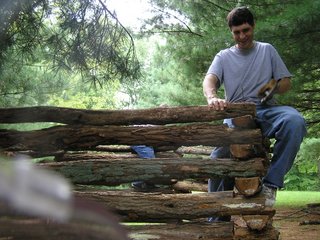
This is Johnathan, nailing in the ends of some logs. By the time he arrived, I had seven of nine levels placed. Working with him and his wife, Shadya, we had the final two layers placed in about 45 minutes. If you look through the cracks, you can see me working on another nail.
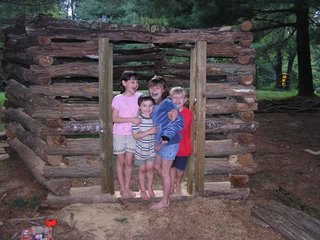
Here are the kids in the door of the hogan. From left to right, Ava, Nathan (my niece & nephew), Ellie and Owen. If you look off to the right of the hogan, you can see a yellow slide that we also set up today. In keeping with Navajo tradition, this door faces due east. If you look over Ava's right shoulder, you might be able to see all the way to Arizona: site of our great adventure this summer and source of the inspiration for this hogan. (We all spent much time thinking about the Van Eyks--from whom we took the hogan idea during our road trip last summer--and celebrating what inspiring people they are.)

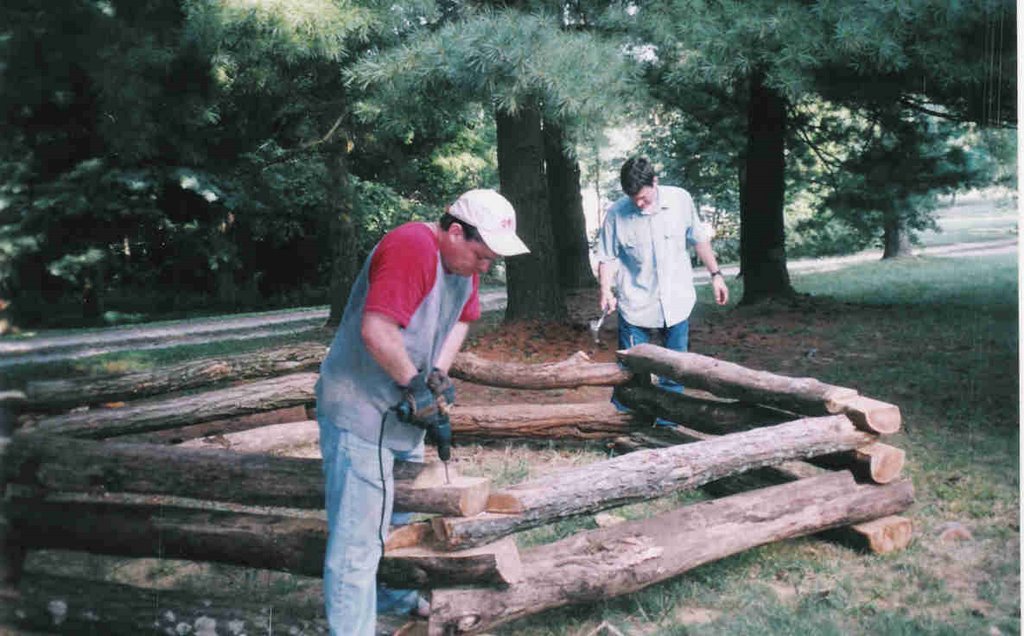
One more picture. The kids wanted to climb, so we took one last picture of them from the inside of the hogan. If you look next to Owen, you might see the beginnings of the roof: cross beams that move in from the walls of the hogan. Eventually they will create a dome, which we plan to cover with tar paper and pine needles.
28 August 2006

Hogan Update

Ellie and I added another six logs to the hogan today. It is almost up to shoulder level (4 1/2 feet or 1.5 meters). I have 36 logs placed and only 18 to go!

We'll get some pictures and post them soon. My builder-in-law (Jenny's brother, Johnathan) will be here this weekend, and I'm hoping to finish up!

25 August 2006

Mary Magdalene

I have written earlier about my affection for New Testament scholar Bruce Chilton. I found his prior books, Rabbi Paul and Rabbi Jesus, to be fascinating, compelling reads. I was thrilled when my former pastor--and ongling intellectual sparring partner, Mike Potts sent word through Jenny that he was sending me a new Chilton book: Mary Magdalene, A Biography.

In the wake of the Da Vinci Code, it seems that every two-bit scholar has a book about about Mary, Opus Dei, or one of the heresies glorified by that book. I must admit that my first inclination was that Chilton was cashing in.

As it turned out, it took Chilton only one paragraph in the middle of the book to dispatch the pseudo-history of DVC. He comes up with some fascinating stuff about Mary, though.

He describes Magdala's proximity to Tiberias, a Roman city Herod Antipas had built smack in the middle of Jewish Galilee. No self-respecting Jew would set foot there--Herod even ended up giving property away to encourage settlement--and Magdala lay just a stone's throw away from that festering sore. That is why, "the Magdalene" was also an epithet that implied a person of moral compromise as well as describing the literal place where Mary grew up (just as "the Nazarene" had other implications for Jesus).

Chilton focuses on Mary's experience with healing from demons. He argues forcefully that she was probably the source for four exorcism stories found in the book of Mark, and he points out the details provided in the work and the ways they reveal Mary's insights.

Later, he goes into Mary's annointing of Jesus, placing it in the context of religious expression in the first-century church. Annointing with oil is one of the most meaningful of Christian sacraments, yet it has been long deemphasized by the church. Chilton points out the sensual aspects of smell and touch that went along with this annointing, and he figures that later Christian leaders diminished the role of annointing (and the ministry of women) for this reason.

I am happy to report that Chilton doesn't speculate upon any physical relationship between Jesus and Mary. The act of annointing is about as sensual as he gets. I didn't really buy his version of the Resurrection, however, which--aside from contradicting my personal faith, was a retelling of his Resurrection chapter from Rabbi Jesus.

Still, I recommend this book as an intellectual feast for the faith. Most of Chilton's insights are well supported, and his description of Magdala and Mary's death there in 66 AD are fascinating.

20 August 2006

School Times

Whew! I'm tired. Let me describe the sacrifice I'm making for you, dear reader.

Tomorrow I'll get up at 4:30 a.m. to grade papers in advance of my school day. I had a bunch of summer reading sheets turned in Friday, so I'll be busy before I can even start my second week of school. It's 10:20 right now, so I won't have a long, luxurious night of sleep, no way!

My classes are different this year, and it has taken some adjusting. Our school has gone to the block schedule, which means that our classes last just one semester and last for 90 minutes instead of the 55 minutes I am used to teaching. It is good for the kids, who only have to put up with me for one semester--plus they get to take up to eight classes a year instead of the six they had previously taken.

It's tough for me, however, because I have to plan three to four activities per class. It cuts down on me jabbering on, I guess, but I rely upon teacher-made activities, and it takes awhile to get those things ready. One cool thing, though, is that I have a 90-minute planning period. Once I get around to teaching the class again, it should be really, really easy, but right now it's tough and exhausting.

I teach three classes this semester: two English honors classes for seniors, and one standard-level class for freshmen. The English honors classes are going well--I have plenty of kids there whom I don't have to work hard to motivate. We're coving vikings at the moment in advance of reading Beowulf, and we're doing creative things like making our own viking helmets and scripting movie trailers for the old Saxon poem, "The Battle of Maldon."

"Standard" refers to the basic-level English classes. I have fewer previously motivated kids in my freshman class--although I have some really good ones. I kept one boy after class last Friday because he apparently hasn't developed an inner dialogue. Any thought that passes through his mind tends to come out his mouth, no matter what I'm teaching at the moment. I gave my first detention of the year to a girl who snuck out the door one minute before the bell rang to end the period. That's the kind of stuff I have to deal with at that level.

One cool thing that I've developed this year is a web site for my classes. I'll post homework assignments, and it will be a great way to post grades and keep parents informed. I also got to write a biography of myself and describe how experienced I am in the third person.

Ellie started 4th grade last week, and Owen started kindergarten, so I have two kids at the same school for the first time. I put Jonah in a daycare near my high school, and he seems to enjoy the learning and socialization opportunities that it offers.

08 August 2006

Final Summer Project

School starts in six days. I'm working on a web site to help my students and their parents keep up with homework and grades on the Web. I'm desperately trying to get lessons ready for the first three weeks of school.

...And I have one last summer project to complete: Ellie's log hogan.

When we were on the Navajo Reservation in June, we saw hogans everywhere--so much so, that I began to believe that even a person with my limited building skills might have a shot at making one. Here is how it's gone so far.

Step 1: The Site. We chose a place among the pines on our property. I wanted a place with a good view of the East (the door must face East according to Navajo custom) and where the ground was flat. (In the picture below, Ellie and a neighbor boy, Taylor, sit in what will be the doorway of the hogan.)

Step 2: The Logs. I have plenty of wood on my property in the form of thin, strong locust trees. 3/4ths of the logs, I took from fallen trees. Later I thinned out some of the trees in our wedding site to complete the task. All told, I have sixty, seven-foot logs with which to build a hogan I expect will be seven feet high.

Step 3: Build. I invited several friends over for Navajo tacos one Sunday night. Then I drafted them into my work gang. What slowed us down were the screws we used to fasten each of the log ends together. At first, I began drilling through the top log and trying to fasten the screws into the wood of the bottom log. Unfortunately, the screws kept snapping (locust wood is tough, even after it's been rotting for years). Finally, I began drilling holes and hammering these huge, galvanized nails to fasten the logs together.

Last Sunday my cousin, Stephen, came and helped me add two log layers to the project. I'm up to 3 1/2 feet high (one meter for you modern readers), which is the halfway point. I'm now hoping to have the project completed by Labor Day weekend (one month from now). We'll organize a campout for Ellie and her friends up there when all is finished.

02 August 2006

Biblical Omissions

This morning I was studying in Mark 11 when my studies hit a little bump.

I read verse 25, "If you hold anything against anyeone, forgive him, so that your Father in heaven may forgive you your sins."

The next thing I saw was the number 27. I looked everywhere, but I could not find Mark 11:26. Where is it? What is being withheld from me!

The version of the Bible that I study is the NIV. What do you think? Tell me what I'm missing.

31 July 2006

Friends: It's a Generational Thing

Last night I got a really cool call. "Hey, Jim," said the voice on the other end of the line, "It's been a long time."

Since I have been through a bevy of names in my short life, I can often infer someone's relationship with what they call me.
  • The name, "Jim," belongs to my school days--primarily grades one through ten. I knew right away that this person and I went way back.
  • If I'm "James," then it's a professional relationship, usually.
  • "Jay" is the name from my four seminal years in Arizona.
  • I'm "Dittes" to my AZ students and a few Portlanders here.
  • And, sadly, if it's "Dits" "Dietz" or "Deits" it's usually a telemarketer. Click.
It turned out to be Eric, my best friend from my days growing up in southeastern Ohio. We hadn't talked for years--it turned out to be eight as we pieced together our last conversation eight years ago (the last chat I ever carried on over Instant Messenger).

Even though I moved from Ohio to Tennessee just before my 13th birthday, Eric and I had been able to keep in touch over the years. We attended each other's high school graduations, and he was a groomsman in my wedding. Our deep bond came from our years as close friends, but it was kept alive by meeting at Cincinnati Reds games once a summer.

When Eric and I were ten, we moved from collecting toy cars to buying packs of baseball cards. He and I both loved the Reds, and we were always pestering our parents for another 35 cents to buy a pack that included 15 cards and a stick of bubble gum.

When we were eleven, our parents drove us three hours to Cincinnati to attend a game between the Reds and the Atlanta Braves. It was one of the shining moments of my childhood, and I carry many images from that game: the Reds' starting pitcher (Bruce Berenyi), the Braves right fielder (Jerry Royster), and the time Johnny Bench came to bat with two outs and the bases loaded (he popped out).

The next year we found the entrance to the locker room, and we waited anxiously for autographs of our favorite players. That was also the year that our families started the tradition of walking to the Spaghetti Factory for a post-game meal.

After I moved to Tennessee, we met for a few more games. I was in England in 1990, the last year the Reds won the World Series, but Eric was a true friend. He made it to a game, and he even sent me a ticket stub to help me share in the glory (I have it framed, along with a picture that I clipped from the London Independent about the Reds' victory).

When he called, I thought, "This must be something big!" I prepared myself to drop everything and head up to the Magical Land for a wedding. Instead Eric told me about his business selling sports tickets on E-bay, and he invited me to attend...yes, a Reds game with him and his girlfriend in September.

Today Ellie was on the phone for a similar reason. Darby, her best friend since age three, had moved away this year, first to Chattanooga and now on to Oklahoma.

"Dad, I need to use three-way calling," she said. I had never used this feature but I dutifully--dadifully--got online and figured it out. Within minutes, we had Darby on one line and Kaitlyn on the other. They were talking girl stuff.

Next, Ellie moved online, directing her friends to some of her favorite web sites. As they looked at them together, they talked about TV stars, clothes, and many other pre-teen inanities. By the time supper had called an end to the conversation, Ellie's sadness for her missing friend had been sated.

As we sat down to eat, I tried to compare Ellie's lost friend with the one I had left behind 22 years ago. In the age before three-way calling and unlimited long distance, it had been a miracle to get the chance to meet at a Reds game once a year. Despite the miles that separated them, Ellie and Darby could confer over a joint love of Disney Channel, not baseball.

Of course this blog goes out to far-flung friends as well, keeping us informed about one another's thoughts and news, so maybe I'm not as "old school" as my daughter's high-tech reunion might have made me feel.

27 July 2006

Superman: the 2nd Coming

Today marked the official end of my summer. I attended a three-hour teachers' workshop this morning. In the afternoon I cut my hair (I had the real Surfer Dude look going, and I was constantly having to swipe the hair out of my eyes, if you can believe it).

I also watched a movie I plan to use in my British Literature classes this fall: Superman Returns. It's been eight years since I've taught senior English. I was reviewing my old notes last month, and I noticed that the first half of the class is heavy on ancient heroes like Beowulf and Gawain. I try to get students to make connections between the heroes of old and those of today. The fact is that you can tell a lot about a civilization if you can figure out two things: its hopes and its fears.

For example, when I was a teenager, my heroes were Pete Rose and Al Gore, Jr. That probably says a lot about me--more than I might want to reveal in other ways.

The upcoming unit gave me an excuse to go see Superman Returns. It was a purely literary exercise, I assure you. I may have seen snippets of the eighties Superman films, but I had never been a big fan, nor had I read the comic books. This was a movie I saw based on two reviews, one found in the New York Times and another by my favorite Christian singer, Andrew Peterson. Both reviews pointed out the religious iconography of the film, and Peterson even repeated the rumor that it could be called "The Passion of the Superman."

The movie was right up my alley--which means that it was probably doomed as a blockbuster. I'm a God-stalker, who loves scouring pop culture for inadvertent references to Jesus Christ. This movie was chock full of them. Since Jesus Christ is another hero of mine, that means that Superman is now my hero, too, right? Not quite.

The conflict of the film deals with Superman's return after a five-year absence to search for signs of his doomed planet Krypton. In his absence, Lois Lane has had a baby and moved in with a male colleague. Lex Luthor has gotten out of jail on a technicality and restored his fortune. During Superman's absence, Lois has soothed her broken heart by composing a Pulitzer-prizewinning essay entitled, "Why the World Doesn't Need a Superman."

In my mind, then, the primary conflict is between Superman and Lane. Does she still love him? Does she know how he feels about her (we understand this because of Clark Kent's clumsy efforts at romance, but she is oblivious, only her son has an inkling)?

At the end of the 2nd Act, Superman reveals himself to Lois Lane in the form of an exclusive interview (a la the Transfiguration). Soaring high above Metropolis, Lane insists, "The world doesn't even need a savior anymore."

Superman, the cries of thousands of people below echoing in his ears, replies. "From what I hear, they still do."

Indeed, by the end of the movie, Lois types a question that resounds outside of the movie: "Why Does the World Need Superman?"

Why does the world need a savior? Why did Britain of the Dark Ages need a Beowulf--or an Arthur in the Middle Ages. Why did teenage JD need Pete Rose of all heroes?

The one question the movie doesn't bother to ask is this: 'from what does the world need saving?' Lex Luthor is an anachronism, really, a relic of the 1930s and 40s when fascist madmen dreamed of world domination. His sadistic plan is to create a New Jerusalem-style island off the eastern coast of the United States. There are no terrorists, no nuclear weapons. A cool tsunami is about the only nod to recent catastrophes.

In a religious sense, then, this movie left me feeling a little empty. The line, "I will always be there for you," pops up several times in the movie, aping Christ's "I will never leave you or forsake you." There is some mention of a Son being one with the Father at the end. But in the end, the movie cannot bridge the concept of Superhero with Redeemer. Superman can save a plane from crashing into a crowded baseball stadium, and he can save the world from falling from the top of the Daily Planet building. He can mend Lois's broken heart. But he can only do these things by himself. He can save the citizens of Metropolis from disaster, but he cannot save their souls. He can leave nothing behind that gives them some measure of his power, as Christ did with us.

The limits of Superman are where Christ begins in the believer's life. Like Superman, Christ crashed into earth in a giant blaze of light, where he was raised by an adopted mother who struggled to understand his powers. He performed many whiz-bang-type deeds, yet he struggled with this alien planet, laced with deadly sin (kryptonite). Then he was resurrected, impermeable. (My favorite religious image of the movie mirrors the resurrection, as Superman rises into the heavens, bathed in golden light, until he finds himself in the direct glare of the sun, from which he gains the energy to fight Lex Luthor a final time.)

But when Jesus left us, He left something behind. For one, he left the Gospel of a life well lived and wonderfully sacrificed. For another, he left his Spirit behind, through which the superpowers that he displayed can be made evident in our own experience. He mends broken hearts with more than an embrace and a cruise above the city--he mends them with his own ever-present, boundless love.

I can't complete a commentary on the movie without mentioning a few critical things. Brandon Roush was a fair Superman. I like his performance. Kate Bosworth and Kevin Spacey left a lot to be desired. As the Mary Magdalene figure, Bosworth is completely beautiful. In the soft light, her dark hair and eyes remind me of Ingrid Bergmann in "Casablanca." But she isn't persuasive as a mother, and her size 1/2 body is emaciated to the point of ugliness. At one point, I found myself thinking, "Lois Lane has no butt!"

Kevin Spacey has played the same guy in just about every movie I've seen him in since "Se7en." Sure, he's intense, but Lex Luthor was basically the same guy as the alien in "K-Pax" or the heavy in "Se7en." I missed his Oscar-winning turn in "American Beauty," and I missed "The Usual Suspects" and "The Bobby Darin Story" (which also had Bosworth), so maybe he does have some chops I haven't seen over and over and over again. I hope you'll let me know on this one.

Superman Returns is a pleasant, if unfulfilling, way to spend a summer afternoon. The special effects are great, the iconography is thought-provoking. Does the world need to pay $6 to watch Superman? I think it does.

26 July 2006

One Man's Lake...

This summer I've tried to keep Owen outside as much as possible. If he could, he' stay on the computer/Gameboy all day and wouldn't ever leave the living room.

Often he asks, "Can I play with the hose?" In his play, he doesn't spray anyone. He just likes to let the water run and track it as it flows downhill to the creek. It's a game all boys play with water--creating dams and finding ingenious ways to divert the flow. Some boys end up using the experience to become civil engineers.

Today Owen's friend, Nicholas, visited, and they played with the hose. When Nicholas left, I noticed all these black rocks covering the driveway. I looked closer and realized that this was blacktop from a patch of the parking area (laid down 30 years ago, probably, so it was cracking).

I next looked at the end of the hose, and I realized that it was dripping into a pretty good-sized lake--a lake made by removing the blacktop from my driveway and creating, well, a humongous pothole.

I have a new saying: "one boy's lake is another man's pothole."

20 July 2006

The End is Near

I returned from Georgia today. The trip was twelve hours, including three potty stops, a McDonald's fix, and a three-hour visit with my cousin, Ken Scribner. Despite tearful goodbyes to their cousins Jacob and Joshua Gates, the kids are thrilled to breathe the same air as Jenny again.

I am left, then, to celebrate The End...of Summer. Next week, it will be nose to the grindstone, preparing lessons and ideas for the coming school year. I'm teaching Honors Senior English for the first time in eight years, so there is some rust to rid myself of. There is also a strong chance I'll be teaching German, which will take quite a bit of work to prepare, since I've never taught that class in a high school before.

Today I celebrated The End...of sub-$3 gas prices. Our President's been fiddling, Lebanon is burning, and gas has gone up by a quarter a gallon over the past week.

The situation in Lebanon really galls me. I see a defenseless country being totally destroyed over the kidnapping of two Isreali soldiers, not by the Lebanese Army, but by militants. It isn't war. It's more like a Turkey Shoot.

Why is this happening? Well, a generation has come and gone since Israel practiced genocide and war in Lebanon, leaving that country with a devastating civil war that lasted almost 20 years. (One of the war criminals who came out of that war was Ariel Sharon, who now rests in a coma.)

Of course the American President could do something, but he won't. Two years ago, he couldn't take enough credit for the Cedar Revolution, which cast of the shackles of Syria and brought democratic reforms to Lebanon. Now, that seems like a mistake. Without the protection of Syria (or the United States for that matter), Lebanon is helpless before the brutally vindictive Israeli Defense Force.

So this is what I was thinking when I paid $2.95/gallon in Calhoun, GA, today. Usually Georgia is about 5-cents cheaper than Tennessee, so I figured that it would be my last sub-$3 fill up for awhile. On the way down to Georgia last Sunday, I paid $2.65.

It isn't going to get better. Seventy percent of Americans know that now--based upon approval ratings of President Bush. Sadly, if there was a country that could have used some hope, it was Lebanon. By this time next year, Beirut and Baghdad will be parallel examples of lawlessness and hopelessness--and gas will still be over $3 a gallon.

18 July 2006

Greetings from Savannah, GA

I'm sorry these posts have gotten so far apart! I'm not sure what has happened to my summer, but it certainly isn't much. Before school starts in three weeks I want to update you on a number of things:
1. The Navajo-style log hogan I'm building for Ellie
2. Book reviews. It's been a disappointing summer for books so far--at least I've been bored by most of what I've read. I'm hoping I'll soon have something good to write about.
3. Writing progress (alas).

Sunday the kids and I drove down to visit my sister, Julie, in Savannah. We're giving Jenny another week by herself, and we're visiting cousins and having fun. Julie has two boys, ages four and two, and they are buddies with Owen and Jonah. She is also well set up for visitors. We're staying in a guest house behind her own home; she has a nice pool for the kids to play in; and they have a basement devoted to little boy things, where Owen, Jonah and Cousin Jacob build train tracks, play with animals, and run around screaming for no aparent reason whenever they want.

Ellie is modestly detached from the mayhem. She reads books, basks in the pool, and otherwise impresses her Auntie Julie (whom she admires very much). I've seen her cooking food and setting the table--all to reinforce her position as the eldest of the cousins, if not the only girl. She especially enjoys any chance she can get to stay up 30 minutes later than the boys or ride in the front seat of the car with her auntie (a new development since she's turned nine).

What have I done? Today I went to my brother-in-law's clinic to have my unibrow lasered. Julie had insisted on scheduling an appointment to have some of the hairs over my nose zapped by a cosmetic laser they have there. "I haven't really plucked my eyebrows for years," I told her this morning, "I haven't noticed my eyebrows growing together."

"I have," she responded in the curt, direct way of little sisters. "I want you to have it done."

I also got to play in the pool with the kids. Jacob and Joshua had just gotten back from SeaWorld, so Jacob insisted that I was Shamu and he was the trainer. He got me to make huge splashes and leap over outstretched floats in the water. He fed me plastic fish and diving rings. Finally he took a long "noodle" float and wrapped it around me. "That's enough," he told me. "I'm putting you in your cage. Goodbye."

Ah summer! Tomorrow we'll go to the beach at Tybee Island, and Thursday we'll return. This trip pretty much ends the summer for me. Besides the continuing writing projects, I will need to dive into planning for lessons that I'll teach in the coming school year. Fun, fun, fun.

07 July 2006

Best Songwriters

OK, so everyone has a "best" list out nowadays. When I heard that some outfit called Paste Magazine had compiled a list of the Top 100 Songwriters, I was intrigued. I have my preferences.

Before I clicked on the link, I thought of the songwriter I would recommend. I have to say Willie Nelson for two reasons: "Crazy" and "You Were Always on My Mind." I mean, this guy has written for Elvis and Patsy Cline, to name a few.

As it turned out, he didn't even crack the Top Ten! Here they are:

10. Prince
9. Joni Mitchell
8. Elvis Costello
7. Brian Wilson (The Beach Boys)
6. Leonard Cohen
5. Paul McCartney (The Beatles, Wings)
4. Tom Waits & Kathleen Brennan
3. Bruce Springsteen
2. Neil Young (Buffalo Sprinfield, Crosby, Stills, Nash & Young)
1. Bob Dylan

For the record, ole Willie was #12, right after Paul Simon.


I'm sorry, but the above list is a reach. I would keep Springsteen, Mitchell, Dylan and McCartney (who could argue with him at #1?)

Prince? Come on, "Purple Rain" had a melody that I played my 2nd week in piano lessons.

Granted, my knowledge of Neil Young came in the years after he lost his ability to actually carry a tune on a record.

Gravelly voiced Tom Waits--I hardly know him.

Leonard Cohen might belong here, I don't know. I'm usually too busy kissing my true love when his music is playing, so I'm not familiar with his use of chord structure or wordplay.

Elvis Costello is a cool singer, but I can name exactly ZERO songs that he has written.

06 July 2006

Final Thoughts on Arizona

We've been home for two weeks now. I'm frustrated I left everyone hanging on my trip. I really focused on finishing my Egypt manuscript (again). That project (a month past my personal deadline) overshadowed all of the other things I had planned to do this summer--including wrapping up my blog notes.

Well, it's done. Today I was typing my trip notes into my laptop, looking forward to some future writing assignments. I'm finally able to reflect on Arizona and all that happened.

I'll focus on favorites.

ELLIE'S FAVORITES: Ellie enjoyed White Sands National Monument as the best stop on our entire tour. We only spent about three hours there, arriving just before sunset. The kids barreled out of the van and climbed the nearest dune. They spent the next two hours sliding or rolling down the house-sized sand dunes. Meanwhile, Jenny and I got to enjoy the spectacular (and romantic) site of a White Sands sunset: pastel pinks and blues adorning the white dunes and the purple mountains. At the Navajo Reservation, Ellie picked up a taste for Sno-Cones, and we still talk about how delicious they were there and at the Acoma Reservation.

OWEN'S FAVORITE: This really doesn't have anything to do with the Southwest, but when he finished the "Alien Mothership" level on his Chicken Little Gameboy game, he screamed with joy for five minutes. Owen really enjoyed White Sands, too, and learning about the desert. We still talk about how hot it was.

JONAH'S FAVORITE: He still likes to talk about the "cactuh-eh-eh-es" he saw has we drove to Globe, Arizona--and the cacti at Al & Cinty Tomlinson's house. He loved the sand dunes, although he had the toughest time climbing back up of all the kids.

JENNY'S FAVORITE: Jenny has a special bond with Grand Canyon that dates back to a family trip she took there when she was twelve. We camped on the Rim one night, and it was a special time for us. We put the kids to bed and spent an hour looking up at the brilliant night sky. Jenny had spent the week apart in intense spiritual study, and she was bursting with ideas, hopes, dreams. As we sat close together at our picnic table that night, looking up at the Big Dipper and a million other stars, she asked me, "What is your dream?" My answer was one word: "This."

MY FAVORITE: Superior, Arizona. Our weekend in Globe/Superior was a time of intense emotion for me. We reunited with our church family there, which was totally uplifting. Leaving that place began an eight-year spiritual drought for Jenny and me that only lifted in the past ten months. My Sabbath School was taught by Preston Cox, who had been a student in my teen Sabbath School while I was there. There is nothing that makes me prouder than being taught by one of my students.

Speaking of my students, I did get a chance to meet with members of the Class of 1998 in Superior. What an experience. My four years at Superior High were there four years, and we graduated together, you could say. It was fun to learn about what they are doing eight years on--my Teacher's Pet, Aurora, is still brilliant and (alas) still making me wait to see her show her writing/teaching stuff. At least she's kept up the curiosity about Greece, and I'm looking forward to her sending me a postcard from some gorgeous Greek isle someday. (Pictured at left, beginning with me are [clockwise]: Manny, Monica, Sergio, Kelli, Aurora, Julie, and Ellie.)

The one thing they kept saying was, "You were our age (now) when you were teaching us?" (They are all 26 or 27). The one thing I enjoyed talking about was my trip to Troy in 1999. This group of kids, better than anyone else I know, including my own family, know what that meant to me--they spent hours reading The Iliad in my classroom.

04 July 2006

July 4th with the Ditteses

Today was a weird 4th of July for me. I'm a normally a very patriotic person. I've spent 4ths of July at baseball games and fireworks shows--I even dumped tea into the English Channel the year I was at Newbold College (1991). This year, it was just tough to get into the spirit.

I did my patriotic duty by supporting Germany in the World Cup semifinal this afternoon. But that was for naught, as Italy scored two goals in overtime to rout the Deutschen and move on to the World Cup Finals. I'm now rooting for France because their star player, Thierry Henry, plays for my favorite English soccer team, Arsenal.

Our budget for fireworks this year was quite modest, $10. We bought a pack of bottle rockets and another pack of sparklers. Ellie loves sparklers. She waves them back and forth and sings patriotic songs. This year Owen used his allotment of three sparklers to try to set fire to the front yard. Clearly, he's a pyromaniac like his daddy.

Jonah sat out the fireworks tonight. He enjoyed dancing among the smoke bombs this afternoon, but when I set off a pack of firecrackers, it kind of freaked him out. I burned my hand trying to light a sparking tank.

I hope your holiday was great. I'm sorry I haven't posted anything about our return trip. I've been working like crazy, trying to finish a 6th draft of my manuscript, The Sandal on the Obelisk. I'm a month late on when I was hoping to get it out to my agent.