Showing posts with label bible. Show all posts

24 March 2013

Give Me This Cup: A Meditation for Holy Week 2013

It's almost Easter.

The senses awaken: a whisper in the air, "spring is almost come," and the smell.  Dirt writhes with worms, flowers burst to life.

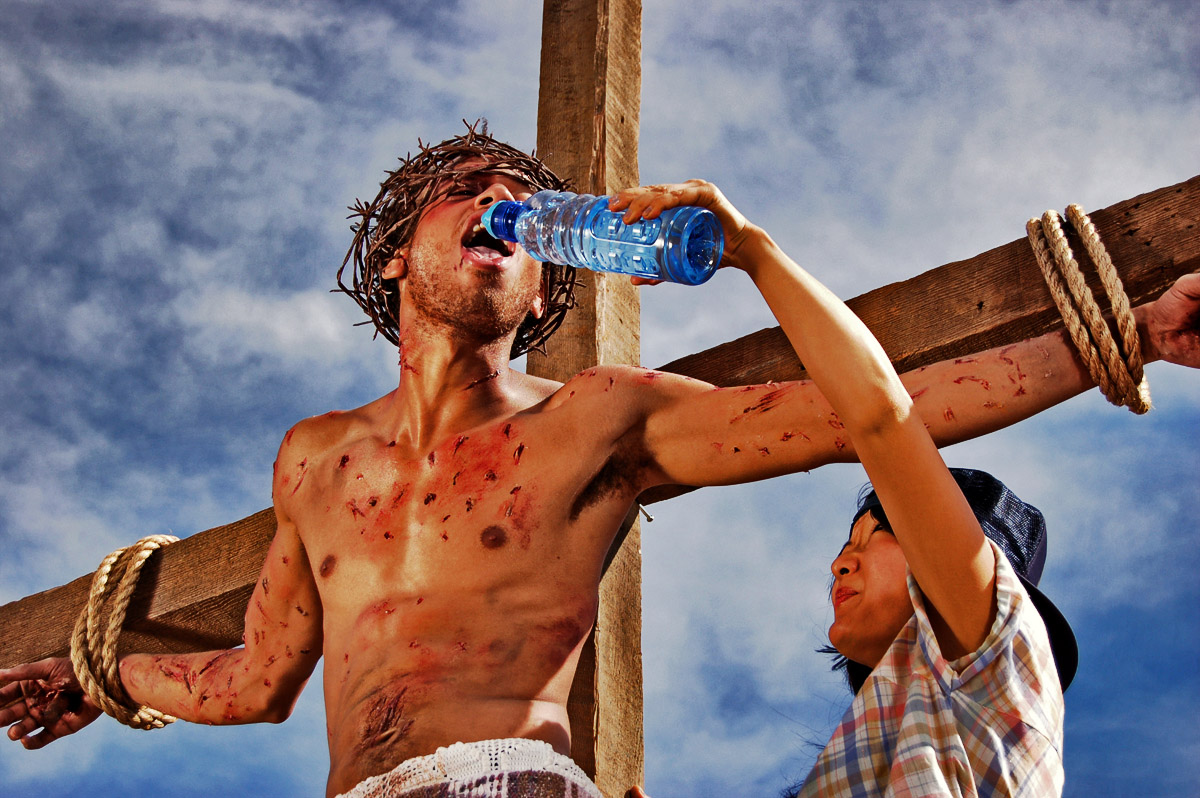
My mind goes back. I see a cross.

And hanging there, a man looks back at me.

Or maybe he's not looking directly at me. His eyes seem distant--deadened by pain and heartbreak

He says, "I thirst."

My first instinct is to help him, although soldiers guard the condemned, and his mouth would be three feet out of reach even if I did make it to the cross.  I see a soldier wrap a dirty rag around the end of a branch. Perhaps he was listening, too.

The soldier dips the rag into a wooden bucket. He twists it in there.

I wave my arm at the soldier.  He doesn't see me.

I cry out--he doesn't understand a word I say--"That's not what he meant!" I call.

"I thirst."

30 May 2008

Clues to the Tree of Life

I'm expanding my Podcast reach.

Recently I went through the offerings at New York's Metropolitan Museum of Art, and I listened to a podcast about the Assyrian collection. I want to tell the rest of what I learned in story form below:

In the halls of the Met's Near-Eastern Galleries, you can see the seeds of the Bible parading across the walls. Lovely, powerful beings march across the walls. Each one has four wings, and their power is symbolized in the enormous leg and arm muscles so carefully wrought by an artist long ago.

It's funny. When I think of an angel, usually I think of a tall, male figure. Now that I think if of it, he has blond hair and white garments. His figure isn't particularly striking--effeminate, perhaps. In my imagination, the power comes from his wings.

That's not how the writers of Genesis and Judges pictured angels when these books were written long ago.

They saw men very much like the one at right. They have long, braided beards, dark hair, and brightly painted, fringed clothes. They look like they could have stepped out of an advertisement for Gold's Gym. These men were known as Genii, from which we get the magical term of "Genie."

(The term, Genie, comes from the Arabic term, Jinn, which also refers to angelic beings, albeit beings with a different set of powers that those of our Western angels.)

I hadn't really thought about the cultural implications to what I believed an Angel to be. Yet it is clear from the relief that I'm seeing things quite differently from the way they were at the time the Bible was written.

Genesis 3 closes with an extraordinary image: an angel holding a flaming sword, guarding the entrance to the Garden of Eden and barring Adam and Eve from the Tree of Life.

Of course Revelation ends with the same image of a Tree of Life. But this is one where the angel is not barring the way, but instead it is showing John the way into heaven--quite a twist, and what I would describe as quite the happy ending.

In Revelation 22, the Tree of Life is more of a species of tree than a single tree, since apparently these trees line the River of the Water of Life (verses 1-2). What kind of tree could it be?

It "bears twelve crops of fruit, yielding its fruit every month. And the leaves of the tree are for the healing of the nations" (2). Those are some good hints. Fruit falls every month. Its leaves provide healing. When I think of fruit, I think of apples or peaches--but they fall once a year, they can't possible produce in every season (at least not during winter). Have cherry leaves been used as a medicine?

Later rabbinic traditions held that the tree of life was so tall that it took 500 years to climb to the top.

Let's review the clues: the Tree of Life is tall, it never goes out of season, it produces fruit, its leaves are for the healing of the nations.

The ultimate visual clue--if one connects the origins of the Biblical tree of life with Abraham's cultural origins in Mesopotamia--can be found on another relief. This pictures another Genii--this one with the head of a hawk rather than a prince. His wings are behind him. He has the powerful arms and legs from the original picture. Like the original, he carries a bag full of incense.

Look at his right hand. In it is the seed of the Tree of Life.

It is too long to be an apple, too narrow to be a pear, too large to be a grape or a cherry.

It is...

...a pinecone.

That's right, the people of the ancient Near East saw the pine as a tree of life. It is evergreen, almost magical. It certainly isn't what I would have expected from previous readings of Genesis or Revelation.

Is it what you expected?

After I post this blog, I'm going to walk up my driveway to get the mail. As many of you know, it is lined with pine trees that my grandpa planted over 50 years ago.

Today, as I'm walking, I think I might better imagine what John saw in Revelation 22: "Then the angel showed me the river of the water of life, clear as crystal, flowing...down the middle of the great street of the city. On each side of the river stood the tree of life."

Walking through those pines today, I'll feel closer to heaven--closer to Eternity which has been promised me.

29 April 2008

God's Favored Creatures

"God has an inordinate fondness for beetles." Biologist J.B.S. Haldane

I'm reading science again. Earlier this year I read two books on physics. This led to my sermon on Einstein--and I'm proud to say it's one of the most influential sermons I have ever preached. In the 2 1/2 months since I gave it, nearly every lay speaker at my church has referenced it somewhere in their talk. What a compliment!

Now I'm into astrobiology: The Living Cosmos by Chris Impey, where he goes into the development of life on planet Earth and speculates on the possibilities of life across the galaxy. There is plenty of evolutionary biology to be found here--something I appreciate, since my knowledge of evolutionary theory is pretty weak. Of course, there is plenty of our Creator to be found, too, if one has the spirit to seek...and find.

Impey conveys biology in a way that I had never understood it before. Instead of the two-kingdom approach of plants and animals, he presents life in a much broader array. I always saw the Animal Kingdom as a progressive chain of animals with bacteria at the bottom and humans at the top. The Plant Kingdom had a similar, somewhat hierarchical order.

Impey presents at Phylogenetic Tree of Life. This is based on genetic differences. The three branches of the PTL are Bacteria, Archaea (primitive microbes first discovered in the 1970s), and Eucarya.

In the Eucarya strain, humans seem insignificant. We are one of 5,400 species of mammals. This compares with 8,200 reptile species, 10,000 bird species, 29,000 fishes, 290,000 plants, and 1,200,000 species of invertebrates, of which 950,000 are insects.

It's a bug's world, apparently. As I noted above, you could take the total number of vertebrate species, multiply that number by five and you STILL wouldn't total the number of species of beetles.

This gives me a unique view of God. Maybe He does have a fondness for beetles. Instead of the human-centric view that I have of Him--that he created me in His image, that he set mankind above all fauna, that he sent his son to die for human beings--maybe I should consider a more beetle-centric view.

Consider this: we exist to feed beetles. The crops we plant, the dung we create, our very bodies themselves once they have left this mortal coil--all go to feed beetles. I don't know of any humans that eat beetles--or who use them to get food. No, it seems more and more that beetles are the top of the food chain.

God created man...for beetles? I need to check back with Genesis 1.

The organization of life in genetic branches also makes for some fascinating comparisons. Remember that in the new biology, humans are linked with plans, invertebrates and other complex organisms.

It is well known that humans share 99% of DNA with monkeys, but did you now that we have 85% in common with dogs and 67% in common with moths? If you could examine the DNA of the banana you had for breakfast, you would find that it holds 50% in common with you, as does yeast.

That seems crazy. I am, after all, 'fearfully and wonderfully made,' according to Psalm 8. Not as much as I thought, however, since I'm only twice as fearfully and 100% more wonderfully made than a grapefruit--in terms of my unique DNA.

Insult to injury: Impey reports that the E coli bacteria, which has 4,500 genes in its genetic code, has 1/6th the number of genes that I have. That's not a broad leap.

I don't have time to go into his astronomical observations, but they are fascinating, too. I'm not finished with the book, and I have a feeling that the refresher courses I have had in biology and chemistry are setting me up for some pretty remarkable physical conclusions.

I'll keep you posted, as always.

23 February 2008

Who Wrote the Book of John?

The theme for Lent this year has been sanctuary. I have found it just about everywhere I look in my Bible study, and I have found my Lenten readings of the Book of John to be infused with temple imagery.

In a previous post, I noted how God "tabernacled among us." As I moved into John 2, the tabernacle/temple was there again, where Jesus cleanses the temple of money lenders.

Why does the author John place this story at the beginning of Christ's ministry when the other three gospels place it in the middle of Passion Week? Is he more concerned with poetry than with accuracy--as one might be led to believe from chapter 1? What is this author really trying to say?

The Book of John was written well after the synoptic gospels were written--as many as 30 years by some estimates. The 4th-century church historian, Eusebius, states that the author had read the other three by then, and he offered his gospel to enhance and elaborate upon the themes of the synoptics.

If Eusebius is right--and I think most readers would agree that John has a more carefully developed theology and more rational development to its insights--then the author placed this story here for a purpose, not necessarily for a straight retelling of the Jesus story. Figuring out the reason the story is here, then, will help us to understand more about what the author of John really got from his time with Jesus.

The incident retold in John takes place just before the passover. Jerusalem's tourist industry is working all out, and the most lucrative place to sell to pilgrims has to be the vast temple courts. No doubt priests have been bribed for these prime spots, and now pilgrims must cope with the din of trading to make their prayers.

Into this fray, Jesus charges with righteous indignation, turning over tables, opening pigeon coops, and shouting, "Get these out of here! How dare you turn my Father's house into a market!" (v 16, NIV). The author approves of this, tying it to a text beloved by Jewish nationalists, "Zeal for your house will consume me" (Psalm 69.9).

It's almost as if he is saying, "You see? This is the one. This Jesus knows what it's all about." But it is important to note that this isn't the political blindness of disciples related by Mark and Matthew. The author has had time to think about this. That's why he adds verses 17-22.

The Jews want a sign (so far Jesus is known for a miracle that brought wine to a wedding). Jesus says he can "destroy this temple, and I will raise it again in three days."

In this chapter he has cleansed the temple; now he says he can destroy it and raise it up. The Jews react with typical blindness. They are literalists--like Nicodemus in the following chapter, they cannot imagine things they cannot see, and they are woefully unprepared to discern when the Spirit will be unleashed by Jesus following his Ascension.

The temple is Jesus' spirit, which will rest for three days before being resurrected. The temple becomes our spirit, too, as Paul relates later in the New Testament. In many ways, the destruction and rebuilding of the Temple is repeated in John 3 (in a far more memorable and understandable way) through the image of death and rebirth.

I think that's what the author of John wants us to gain from Chapter 2. It's about the Temple, but it's more than that. It's really about us--about me. Jesus cleansed the temple of a rabble of sellers and possessions--he offers cleansing to the desires and trivialities that distract my spirit when it seeks communion. He promises to tear down the temple and rebuild it--just as he offers to tear apart the house of cards in which I take pride and replace it with a life of worship, built on a solid foundation.

From the beginning of John, God is looking for a place to tabernacle. It is clear, beginning with chapters 2 and 3, that believers are the very buildings in which He hopes to dwell. The Temple in Jerusalem was a beautiful place, no doubt loved by the Jews and protected by them against a radical like Jesus, whom they mistakenly feared would tear the place down.

Jesus had different temples in mind--as different methods of destruction. His Spirit was waiting--like the pillar of fire in the Exodus--to tabernacle with the Kingdom of Heaven he had come to create.

Now to the question I pose in my title. Who wrote the Book of John? As most know, he only identifies himself as "the one Jesus loved."

The author is based in Jerusalem. Most of the book chronicles interactions Jesus had over a series of visits to the Jewish capital (the synoptics imply that Jesus only visited Jerusalem in the week prior to his death). Bethany also features in this book, with Jesus' visits to Mary, Martha and Lazarus.

The author is immersed in temple. He uses temple connections to get a front-row view of Christ's trial for himself and Peter. He fills his gospel with hidden allusions to temple, as I have demonstrated above.

Could this be a fisherman from Galilee as the son of Zebedee was? I think it is unlikely. One theologian I read, Ben Witherington III, speculated that the author was Lazarus, who may have later went to Ephesus, where he shared his story with an editor, John the Revelator.

Personally, I would vote for Barnabas, who was Jesus' disciple, a Cypriot Jew, and traditionally held to be the owner of the Upper Room, from which so much detail can be found in chapters 13-17. Furthermore, his role in Christianity's incorporation of gentiles, shows that he must have been effective at explaining Christ's mission to infant Christians.

Let me know what you think!

10 February 2008

Prepared to be a Sanctuary

In my studies during this special season, it has been amazing the number of times the Tabernacle has come up.

During the Exodus through Sinai—and for a few hundred years afterwards in Shiloh—the Tabernacle was God’s dwelling place among Israel.

It held the most sacred objects of the Exodus: the Ten Commandments and, for a time, a bowl of manna and Aaron’s flower-bedecked rod. Rising above its most holy place—at least during the Exodus—was a pillar of fire, demonstrating God’s mercy over His chosen people.

But my studies center on the New Testament these days. Aside from references to the Sanctuary in Hebrews, I hadn’t found the other 26 books to be full of the Holy of Holies…until these last few weeks.

One of the greatest resources I have found for my spiritual development has been the podcasts of Asbury Theological Seminary. For about 12 year now, I’ve been working on my “working man’s MA in theology,” reading a vast array of books on history and doing everything but learn Greek & Hebrew. Podcasts keep me up to date on the latest theological ideas, and I highly recommend these if you use iTunes.

The first place I found the sanctuary was in the beginning of the Book of John: “In the beginning was the Word, and the Word was with God…. The Word became Flesh and made his dwelling among us” (verses 1 & 14).

This chapter is full of the language of the Old Testament. If you really think about it, it could be a condensed version of the Old Testament, beginning with Genesis “In the beginning” and ending with Daniel, “You shall see the heaven open, and the angels of God ascending and descending on the Son of Man.”

To top it off, Asbury OT professor, Sandi Richter, proposed a better translation for verse 14. “The Word became flesh and tabernacled among us,” she said.

Wow. I have never heard of the verb, tabernacled, but it has quickly become one of my favorite words. I have never imagined Christ’s incarnate ministry as an act of tabernacling, but now I can’t stop praising him for it.

If “the Word tabernacles among us,” it brings to mind so many images from the Old Testament. A pillar of cloud protects and cools us by day—even as a pillar of fire lights our darkest nights. His law dwells within our hearts—just as Jeremiah had foreseen. The air smells of incense, and evidence of miracles—God’s feeding, His anointing—is all around.

Look at that last paragraph. I used the present tense, “tabernacles,” instead of the past tense “dwelt.” I guess that’s because I have read to the end of the book of John—and on into the next book, Acts, where Christ’s Spirit is unleashed so that He tabernacles among us to this very day.

The Tabernacle permeates the New Testament. That isn’t the only place it can be found. There is an even greater revelation that I don’t have space to describe here. I’m still studying, and I hope to have this most wonderful new truth ready for you to read later in the Lenten season.


07 February 2008

Ash Wednesday: How Long Until Easter?

This year will be the tenth that I celebrate Lent.

I remember my first Lenten season. I was still living in Arizona, and I was drawn to this ancient Christian tradition (dating back to 731) not only as a way to make Easter more meaningful, but also in order to get myself under control.

Ellie was a baby. And while I enjoyed taking her for walks around my Richard Avenue neighborhood, I wasn’t a very attentive daddy—especially when I was immersed in a computer game. For my first Lent, I gave up computer games. It was forty days. By the time Easter rolled around, I had a measure of control.

By the end of Lent the following year, I had kicked the habit, and computer games haven’t held sway over my life (or my attention to my kids) since. To be honest, I feel tempted to buy them, but never inclined to play them—that’s why Stronghold 2 sits in my software box, two years old, unplayed even as I write this.

This year, as I celebrated Ash Wednesday and contemplated my mortality (just 20 hours after deadly tornadoes had swept through the community where I worship), I thought about the changes that I still need in my life. The pastor had us write down our sins on a paper, then he burned them before our eyes.

It gave me pause, and a chance to implement the fasting that I had carefully considered for weeks.

I think the main thing I need to cut down on is information. I’m an omnivore—devouring everything I can get my hands on: news, science, sports, entertainment, international, local, everything.

A couple weeks ago, I read a blog that had a picture of a 700-pound man on it. The caption read, “If information were calories, what would you look like?” That really made sense to me. Information is only useful when it’s, well, useful. Therefore, I’ll spend Lent limiting myself to 30 minutes a night on the Internet. I will cut out all sports and entertainment sites/blogs, and I’ll see where that gets me.

Sports is a really strange influence. I read about three sports sites every day. Even though I rarely spend money on sports or sports merchandise, I spend about an hour a day following sports like a soap opera. Entertainment news is similar. I know more about people like Tom Cruise, Britney Spears and Heath Ledger than I could ever need to know.

More importantly, a lot of these sites are gateway sites that leave the me two clicks away from stuff I really, really don’t need to see: porn, gambling information, lurid videos, etc. Staying away from sports will hopefully keep me that much further away from other bad stuff.

A final resolution is to give up using the perjorative, “Two-time Bush Voter.” I have really been hammering my Right-wing friends with that one recently. I’m just really fed up with the direction my country is headed—more than ever—and I guess that’s my way of taking it out on them.

For example, when a friend wrote a group e-mail recently, stating that Barack Obama’s “nice words” didn’t necessarily mean that he could pull the job off, I wrote back:

“I don’t need a two-time Bush voter to tell me how disappointing politicians can be.”

See what I mean? It’s rude. It’s almost as bad as when I was referring to the Right as “The Befuddled Masses” and then calling them “BMs” for short. It’s wrong.

That’s what Lent is for, I guess: refocusing on what I can do for Christ and ridding myself of extraneous stuff. I’ll keep you posted—as always.

20 January 2008

Thoughts on Einstein and Relativity

Einstein's theory of special relativity has been around for over 100 years now. Somehow, I think that people of faith are still about 100 years from really getting it or applying it.

We can't avoid it--that's for certain. Special Relativity explains the unique characteristic of light: that its speed is constant, 670,000,000 miles per second, relative to all forms of motion.

It works like this: Let's say I set up an experiment. I have developed two spaceships, each of which travels at 500,000,000 miles per hour. One will be speeding away from me. The other will be flying toward me from another star system. After five seconds, I will shoot laser beams in each direction, asking them to measure the speed at which light passes them.

Of course, the guy with the light meter, standing stationary next to me when I flipped on the laser would measure a speed of 670,000,000 miles per second.

The bizarre finding that Einstein discovered is that the guy in the spaceship traveling away from me, would also find that the light of my laser zipped past at 670,000,000 miles per hour. Moreover the ship coming towards me would also measure the same speed. This theory has been proven mathematically and physically time and time again.

That's what relativity is all about. Speed and time are not always constant. Relative to the speed of light, they are malleable, changing, capricious. That's why Einstein showed that speed and time are not absolute values but relative values which exist on a continuum--ergo, the space-time continuum which governs physical science today.

Of course, it wasn't long before Einstein's theories were applied in a variety of ways. Prior to 1905, prior to relativity, the world embraced absolutes. There was man and woman, good and evil, right and wrong, slave and free. No one considered these to be relative terms but absolutes. Like the old cigarette advertisements said, "We've come a long way, Baby."

Now everything is relative. Absolute man and woman? Tell that to the person who claims to be "transgendered." Good and evil? Maybe for folks like Hitler and Mother Theresa, but the rest of us fall somewhere in between--somewhere on that infernal continuum that relativity unleashed.

Relative to your political beliefs, you may believe that abortion is an absolute evil--or that the child's right to life is relative to its mother's health or ability to care for it. Relative to politics, you believe that the torture and sexual abasement of prisoners of war is either absolutely wrong or appropriate, relative to acts perpetrated against Americans by terrorists.

Everything is relative. Let's admit it and move on, shall we?

Really, relativity has thrown churches for a loop for over 100 years. It has been every bit as much a challenge to established religion as the discovery, 400 years earlier by Galileo, that the sun did not orbit around the earth.

I was in church a few weeks ago, singing along with the praise band. For some reason, my thoughts turned to Einstein and relativity. Suddenly, it hit me: the whole relativity thing and the whole Christianity thing suddenly wrapped themselves together and provided me with the answer. I am sharing this with you, just as I shared it with my fellow believers later that week in a sermon.

I mean, honestly, what are Christians to do with relativity? When we really look at what Einstein was saying--and how this theory was subsequently proved over the following century--will we find it to be compatible?

Does relativity wipe absolute-dependent Christianity right off the map, or does it provide an opening for something more? I think it does.

In fact, I think that relativity opens up the gospel--the very Bible itself--to the meanings that God intended. No, I'm not kidding. I haven't blown a mental gasket. Christ wrote the rules of the universe, didn't He? One of those rules was that light is constant. He knew this, and he taught it--so did St. Paul. It just took us a little over 1800 years to figure it out.

First, consider the Bible's teachings about light. "Your word is a...light for my path," the Psalmist says (119.105). John compares the life of Christ to "the light of men. The light shines in the darkness, but the darkness has not understood it" (1.4-5). There is much imagery in the Bible comparing light to the Righteousness that God wishes to instill in us--the Righteousness that was embodied in the life of Jesus Christ.

But does this Righteousness live up to Relativity? Of course it does! One of the things that Jesus rebelled against was the insistence on absolutes by the religious leaders of his day. One could boil down his teachings in Einsteinian terms: "There is one constant in the universe--that constant is God. There is no absolute Jew and absolute Gentile." How can you explain a gospel in which a Rich Young Ruler isn't rich or a destitute widow isn't poor? RELATIVE to God, these things were so.

I mean, think about it: the greatest teaching of Christ's life is this: death and life are not absolute, they exist relative to the righteousness of God, engendered in Jesus and fed by the ongoing work of the Holy Spirit. (That last sentence is the greatest testimony to the Trinity that I have ever written.)

Should Christians, therefore, whine and moan about the loss of absolutes? Of course not! They didn't belong there in the first place--they existed only so long as people didn't completely understand Christ's teachings. Good riddance!

My second finding was this: if Righteousness, like light, is a constant, then what does that mean? It means this. Whether we are running towards God as fast as we can or running away, His righteousness meets us at a constant speed. The believing Christian who seeks God through study and prayer basks in the same glow as that which warms the back of the unbeliever who has turned away. This is the truth behind the parables of the Prodigal Son and the Vineyard Workers.

All my life I have seen people who built rocket ships to God, claiming that this truth or that practice would speed up their faith to the point that they would be ahead of other believers. Pull out the light meter and measure the righteousness. It is constant. Praise be to God!

Finally, I wondered how a Christian would act if they accepted this belief that space and time didn't matter anymore. Well, first, for the time thing: I don't see time as a normal person sees it. I live relative to eternity. This shapes my worldview and my approach to time.

And what if distance doesn't matter either? How do I treat my neighbor or my enemy when there is not distance between us? How do I treat my fellow Christian when we are one in the Spirit? It's an amazing concept--one that Christ has tried to instill in Christians since his first sermon.

The Bible is filled with this new view of light and space and time. Look it up for yourself and leave me a comment to share what you have learned. A great place to start is Ephesians 3:17-21

"I pray that you, being rooted and established in love, may have power, together with all the saints, to grasp how wide and long and high and deep is the love of Christ, and to know this love that surpasses knowledge--that you may be filled to the measure of all the fullness of God.

"Now to him who is able to do immeasurably more than all we ask or imagine, according to his power that is at work within us, to him be glory in the church and in Christ Jesus thrroughout all generations, for ever and ever!"
03 March 2007

Book Review: Abraham, The First Historical Biography

My hero of the Bible is Abraham, plain and simple.

Jenny tells the story of a conversation we had in college. She asked me what my life's goal was, and I told her it was to be a "Patriarch."

I'm not sure what got into me at the time. Perhaps it was a love of history and a fixation on greatness. Part of it must have been the admiration I have for my own grandfather, who anchored my family all of my life and gave me much to emulate in my own life (and much to improve upon, too, I should add).

When I look back on the 15 or so years since I said that to Jenny, I realize that "Patriarch" is about the only college-era goal that I have achieved. I enjoy teaching, but my goals of law school and organizational leadership bit the dust years ago. My writing hasn't taken off. The one job I have done well has been to care for three kids and support Jenny in her own, successful, professional endeavors.

I don't focus on unfulfilled dreams, really, because I sit here surrounded by the luxurious trappings of patriarchy: I live in my grandparents' home, the Dittes family seat for over 50 years; I have positions of ministry within my church and service within my community; I am a father to three kids--Jenny nixed the whole "Twelve Tribes of Dittes" idea years ago, sadly. So when I study the Bible, I study Abraham.

When I saw the title to David Rosenburg's book in my book club, I jumped at the chance to read it. It is an outsider's look at Abraham. Rosenburg brings a strong knowledge of Sumerian literature, and from this base in Sumer (the culture which Abram and his father, Terah, left for Haran). He also speculates on the authors whose versions of the Abraham story became enshrined in our Bible. Finally, he introduces a fascinating concept, the "Cosmic Theater," which encapsulates the inheritance that we draw from Abraham.

I had known little about the culture of Sumer aside from a passing knowledge of "The Epic of Gligamesh." Yet it was one of the world's first great civilizations, carried over from India, whose mountains are represented in its pyramid-like ziggurats. By the time of Abram's birth in 1750 BC, Sumer was in decline, upstaged by Babylonians northwest along the Euphrates River. Under the energetic leadership of Hammurabi, Babylonians had coopted Sumerian culture, while elevating the minor Sumerian god, Markuk, to supremacy.

This revelation highlights one of the real ironies of the Old Testament: it begins in the same way it ends: with the exile of the first Hebrew from his home in Ur--a journey from Sumer to Canaan; and with the exile of the Hebrews from Canaan back to Babylon. It makes the Old Testament a complete idea, doesn't it?

Rosenburg doesn't find the God of the Hebrews among those of Sumer. He describes the Sumerian religious festivals and traditions--their penchant for dressing up their idols and feeding them every day. Rosenburg notes that Sumerians believed in gods who interacted with man: watching us even as mankind scans the heavens trying to understand them. He describes this as the "Cosmic Theater." Abraham and his descendants invented the idea of a God who takes an interest in the individual, interacts with men, and asks people to interact in this theater that transcends dimension, time, and death itself. He believes that Yahweh was a family god in Abraham's family who was elevated by Abram's faith--and who rewarded Abram in return.

(Consider the Egyptian gods, who ruled the sky and the afterlife, yet had little to do with daily life; or the gods of Gilgamesh who try to hide from him the secret to everlasting life.)

Rosenburg has written previously on the authors of the Old Testament. This is an area of theology that I'm not sure of, but Rosenburg makes the case that one author, J, was actually a female scribe in the court of Reheboam. She comes out in the strong female characters of Sarah and Rebekah, and in the unique voice of Abram's faith experiences. She is also a well-educated author, drawing from earlier Hebrew sources for the story of Abraham as well as a library of texts from Sumer and Babylon. She is named "J" because she uses the name "Yahweh" for God (which starts with a J in German, where this theory originated).

The other major author Rosenburg identifies is "E" for "Elohim," an author writing in the northern kingdom of Israel 200 years later. E is concerned with procedure and hierarchy, and he tries to fill in the blanks with numbers (the ages of Abraham and Sarah when they conceived and died). In reading these sections, it occurred to me that we have to realize that we use two lenses to understand history and the Bible: we try to understand these stories using our own cultural parameters, the cultural parameters of the people who wrote down the stories many years after they happened, and finally the factual circumstances that are told in these stories.

Rosenburg mentions one other author of the Abraham story: Isaac. The fact that he plays such a small role in Genesis may imply that he was the one responsible for recording his father's journeys and transmitting them to the next generation. Abraham never gives up the feeling of being an immigrant in Canaan (he buys a field to bury Sarah in, stating explicitly that he has no land of his own). In a way, it was through Isaac that Sumerian culture was transmitted to the Hebrew people and down into our lives today.

As you can see, Abraham is a pretty ambitious project--trying to connect so many divergent ideas together into the story of one patriarch. At some points, it sags under the weight of its ambition. I would have been satisfied with a mere discussion of Sumerian culture and its echoes in the Old Testament or with a dissertation on J and E and the authors of the Old Testament or a reflection of the history of the "Cosmic Theater." All in all, however, this is a fascinating book, one that I'm happy to add to my collection of Abraham readings.