29 May 2006

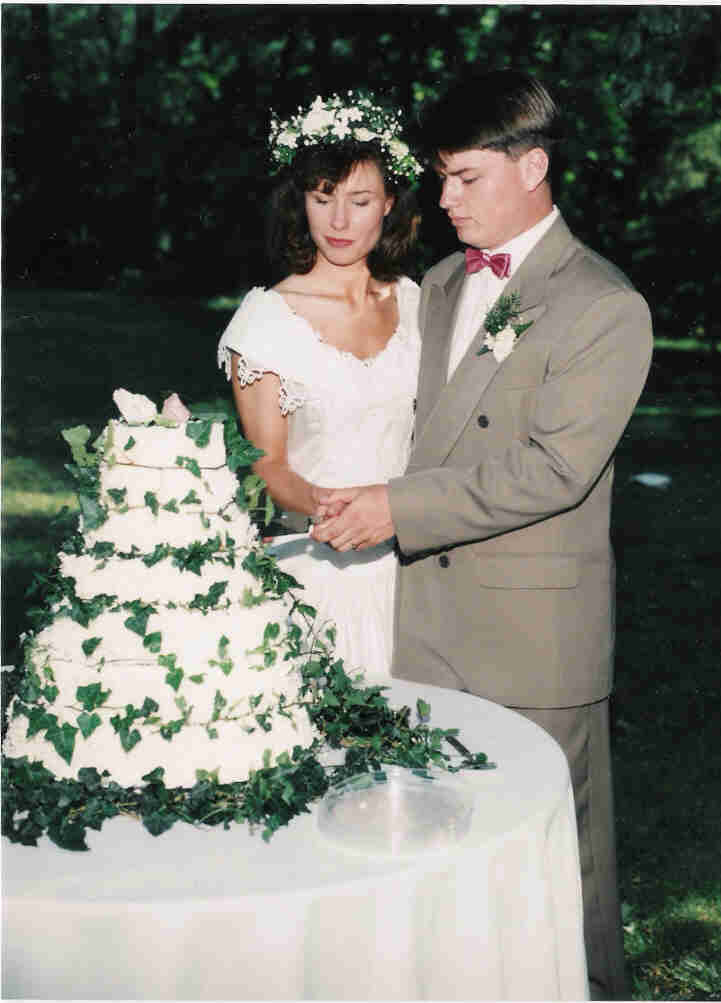
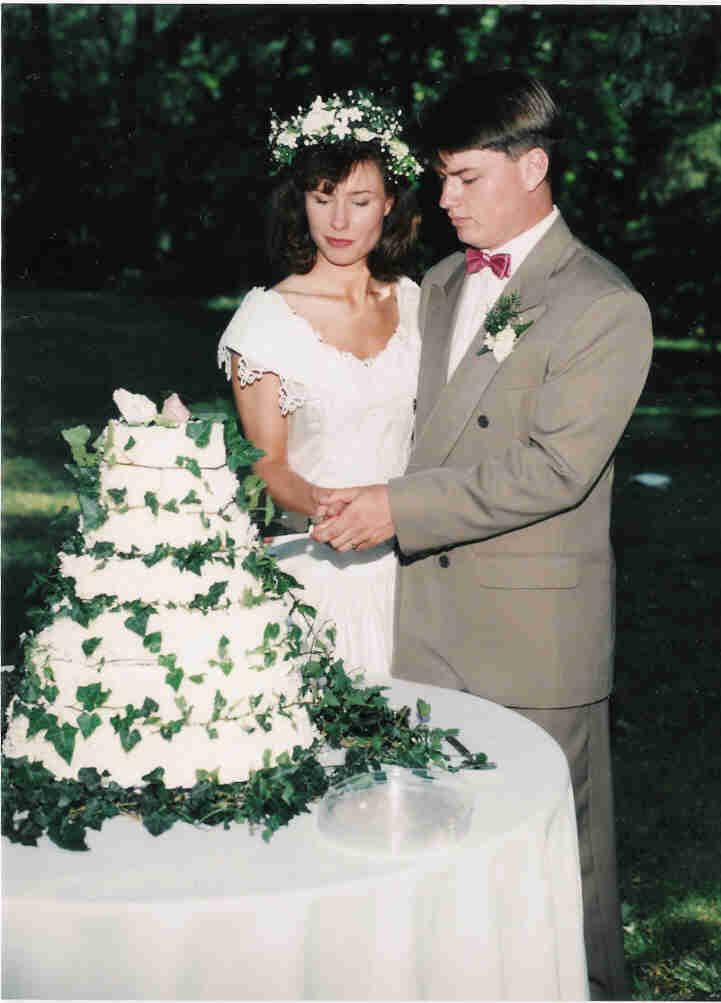
May 29: A Special Day

I love May 29. It gives me a chance to do the following things:

1) Go out on a real date with my Bride,
2) Recycle old jokes like "we've decided to stick it out another year" or "it sure feels like 23 years, are you sure it has only been twelve?" or "we've been married X bitter years" (12 to be exact).
3) Celebrate a wonderful marriage with the most perfect woman God could have possibly given me.

At lunch last Sabbath, Jenny was recounting one of the Newbold myths: about how her interest in me was unrequited. The kids all looked at me like "were you stupid or something?" (Ellie in particular gives me that look five times a day--as regularly as Muslim prayers.)

What could I do? I just took my palm and smacked it against my forehead three times.

Happy Anniversary, Jenny George!

25 May 2006

Water and Wine: Thoughts on John 2

Summer is almost here, but I must admit that Easter still has me in thrall. Bear with me, then, while I reflect a little longer....

A dark night, an upper room. The Son of Man slips into an anteroom before the meal arrives, carrying a wooden bucket and a ladle. He finds a tall, 30-gallon jar of water reserved especially for the ceremonial washing of the guests. He puts the bucket down, picks up the ladle. As his free hand touches the rim of the water jar, he pauses--thoughts invade his mind.

It was another anteroom, full of cleansing jars. It was a wedding, and he had been a guest. For weeks, he had been praying, pleading with God to lay out his mission before him. He had gained followers. He had felt the Spirit draw close to him, so close it was ready to pour out at any moment!

Yet this wedding--this party--seemed the wrong place to start such a mission. "They have no more wine," were words that didn't sound like marching orders. The words came from his mother after all--not God. He wasn't here to perform mere party tricks, couldn't she see that?

"My time has not yet come." They were his words--they are the words God hears almost every time he calls me, too.

Yet he followed, and his mother led him to an anteroom full of empty cleansing jars--jars that had been emptied in the cleansing of the hands and feet of the wedding guests. Suddenly, the Spirit struck: Jesus straightened, shook His head, opened his mouth and spoke the first words of Miracle: "Fill the jars with water."

A dark night, again, the flashback is finished. He fills the bucket with water and returns to the banquet room to wash his disciples' feet. He kneels before them, pouring water over their feet--water that washes away the dust of Jerusalem.

Next comes the miracle with the wine. He blesses it. "This is my blood," he tells his astonished audience, "Poured out for you for the remission of sins." His work has come full circle; His mission is nearly complete.

We cannot understand the Last Supper without a clear picture of the Wedding of Cana and those empty cleansing jars. They bookend the Gospel of John, perfectly explaining Christ's mission. For even as every observant Jew cleansed his hands and feet with water before eating, every observant Christian would cleanse his soul with wine after this night. Water cleanses the body; wine cleanses the soul. The wine is the miracle--Christ's first and his last.

Like the master of the banquet, I am amazed by this miracle--stunned, almost drunk. "You have saved the best till now," I whisper as I drink the cleansing blood, and I feel my spirit break free.

24 May 2006

Ellie's Birthday


I'm still recovering from Ellie's birthday party this past Sunday. She wanted a Red Carpet birthday theme, so we had our invitees dress up like starlets, and we even spent $8 at WalMart to cover four yards of the sidewalk with red.

I hosted the red carpet walk--at least my alter ego, Tres Gay Jay, hosted the event (2nd picture).

After we cut cake, we filmed a movie called Scheme for Hollywood. The girls pretended a Hollywood director was looking for talent in their town, so they all pretended to do silly things like cry, die, and perform a romantic scene with Owen's oversized Bob the Builder doll.

In the end, the part went to Shoeless Jo (Jonah). I worked the next two nights editing the movie--and a bonus music video--which we gave to the invitees. Now I'm ready for bed!

15 May 2006

Family Crest Update


I've gotten a little more done on our Dittes family crest. I'd like to hear some feedback on this one, so let me know what you think.


I added two points that have real significance for Jenny and me. In the background on the right is Pennard Castle, a ruin on Wales's Gower Peninsula that Jenny and I discovered on the Most Awesome Hitchhiking Trip of our Lives in April 1991. We were camping along the beach there, and we hiked up to the top of some bluffs, where we found this beautiful castle overlooking the Bristol Channel. It's ours now.

On the top left is Picket Post Mountain, which watched over our first home in Superior, Arizona. We climbed it a number of times (Ellie climbed it once in utero), and it brings back some fond memories of our early married years.

In the foreground is a pine tree from our house in Tennessee. A trail connects the foreground to the background (my obsession is finding and building trails).

All that's left is some color. I also plan to add some dogwood branches to the lower right corner--again from our home here in Tennessee. I wasn't originally planning to have a 3-D effect in the crest, but I think it's really cool. It's as if we're looking through the trees at our home, back on the great events and places that brought us together as a family.

Let me know what you think!

12 May 2006

Book Review: A New Way to Look at Someone You've Always Known

I don't remember exactly what my pastor and I were discussing that Sabbath four weeks ago in his office. I do remember looking over at his bookshelf and jumping up with a start: "You have Chilton's Rabbi Jesus!" I blurted. "Can I read it?"

I'm a big fan of Bruce Chilton, an Anglican priest and college professor. A few years ago I bought his book, Rabbi Paul, and that book has been real food (both intellectual and spiritual)--I've read it twice, and now I'm going back through it, cross-referencing the texts that he cited. It let me into Paul's writings in a number of dramatic ways: (1) providing a convincing narrative that connected his travels and his writings; (2) providing a well-researched context for the communitites in which he worked (pharisees, school of Gamaliel, Tarsus, etc.); and (3) giving unique analysis to Paul's writings.

I come from a literalistic theological background which has traditionally focused solely on scripture without getting bogged down on scholarly criticism or the social/philosophical context of the writings of the Bible. For the most part, this is a good thing. I haven't spent time wondering if the Resurrection was physical or metaphorical; I haven't tried to disprove the clear message of the Bible based on some scholar's hypotheses.

But my fascination for scholarly, Bible-related works has grown over the years. Much of what is out there, thanks to people like Crossan, Pagels, and Ehrman, is recycled 2nd-century heresies, repackaged to show "oppressed, alternate strains" of Christianity and supposedly trump the testimony of the New Testament (written within 70 years of Christ's death--and the single-most vetted book in the history of literature).

Chilton could easily be lumped together with the afore-mentioned writers. I would not call him orthodox by any means, yet his arguments are usually well-supported and enlightening. His books are worth the read, particularly if you're up to a challenge. I'll review the book based on the three points I mentioned above.

The Teaching/Travel Narrative. Traditional readings of the gospels have the birth story, the temple scene and then a big gap between Jesus at age 12 and the beginning of his ministry around his 30th year (John mentions four trips to Jerusalem, while the other three gospels mention only the final, climactic visit). Chilton gets rid of most of the gaps, starting in Jesus' adolescence, theorizing that Jesus (a mamzer rejected by the community because of his questionable parentage) went to Jerusalem around age 14, along with his devout, legitimate brother, James. He dropped away from his family in the busy streets of Jerusalem and spent the next six to eight years as a disciple of John the Baptist. Chilton shows Jesus leaving John's side just a few months prior to John's arrest and picking up disciples of his own in Galilee--per the Gospel of John.

He also stretches the traditional three years of Christ's ministry out to ten or more, including a number of years spent back at home, working as a handyman in Nazareth, and more years in Capernaum. He then sends Jesus wandering as Herod Antipas grows wary of this "new John" and pursues him throughout Galilee/Syria. The fear of arrest, the need to differentiate his mission from that of John, the great desire to see fulfilled the prophecies of Ezekiel and Zechariach--these are used to explain Jesus' motives for his travels as well as his teachings.

I find some of it persuasive--the close connection with John, the fear of Herod, the final mission to Jerusalem--but some leaps are too far for my orthodoxy. For example, he mentions the temptations of Christ as coinciding with the aftermath of the Feeding of the 5,000, rather than earlier in Christ's ministry. Also, Chilton as a secular-oriented scholar explains things like Christ's walking on water, the Transfiguration, the Resurrection, as "shared visionary experiences" rather than literal ones. I'm not bound by book sales or scholarly criticism to affirm my faith in each of these.

One fascinating divergence Chilton takes is incorporating the story of Barnabas. Using tradition and some mid 2nd-century sources, he writes that Barnabus (whose family was from Cyprus) had a home in Jerusalem where Jesus might have stayed--and he may have even been the host for the Last Supper. The Bible does show that Barnabus was one of the first apostles, and that he later sold his lands and donated the proceeds to the Jesus Movement.

Context for 1st-Century Communities. Chilton's description of the temple as it appeared in Jesus' day is vivid and breathtaking in its scope. I also appreciated his explanation of Ezekiel's fiery chariot visions and how they informed both the worldview of John and Jesus. Most interesting was the dichotomy between John's practice of watery baptism and Jesus' meal-oriented sacraments--although Jesus directed his disciples to baptize, I had never before wondered why he, himself, never baptized anyone until I read this book.

Chilton is an astute observer of the political dynamics of 1st-century Galilee and Judeah, tracing Pilate's vacillations back to a Roman political scandal involving his mentor, Sejanus, and explaining how the forces of Pilate, Caiaphas, and Herod united against Christ after his cleansing of the temple. He spends six pages reflecting on the duties of a 1st-century handyman. My orthodox sensibilities were offended, however, by his repeated use of the term "illiterate peasant" to describe my Savior. Personally, I see it as a derogatory term--I think there are ample mentions of Christ reading or quoting scripture in the gospels--but he may have intended it more to reflect historical/class details than prejudice.

Finally, Chilton is able to give unique analysis to Christ's teachings. The most fascinating was in the dichotomy with John's message. Jesus believed that the Spirit of God was available to everyone at any time--not necessarily through baptism but through remembrance and thanks, best typified by the way Christ remembered his heavenly Father at meal times. (Chilton focuses a lot on Christ and food--even speculating that at the end of his stay in Capernaum, just before Herod's pursuit, Jesus had developed a paunch.) To me, this was the revolutionary idea of Christ's work. The Kingdom of God was a community of believers--one very effectively set up by Christ.

I also appreciated the discussion of the Ezekiel and Zechariah texts--two books that I haven't studied sufficiently before. Ezekiel speaks of envisioning a flaming chariot (the throne of God), and Chilton writes that this vision was ever before Jesus, fueling his mission. Jesus' gift to his disciples, then, was the incorporation of this vision within them--along with others, as I have mentioned above.

Finally, the Zechariah prophecies that showed a cleansed temple at which the world would worship helped to explain the impetus for Jesus' final trip to Jerusalem, his dramatic demonstration in the temple, and his combative demeanor with the pharisees he debated there.

There are really two kinds of narratives for the life of Jesus: those where he walks among men, and those where his feet barely touch the ground because of his godliness. Rabbi Jesus belongs among the former type: every idea may not please the orthodox among us, but the view will give us a compelling portrait of the man we know as the Son of God.
06 May 2006

Da Vinci Code: Ignore the Hype and Enjoy

I'm trying to get a book published. Last week, I got a very constructive "no thanks" letter back from an editor at Penguin Books, and I've decided to rewrite key sections of The Sandal on the Obelisk to ramp up the action and make the conflict clearer.

Of course, if I wanted to be published that badly, I would put Da Vinci or Opus Dei in the title. Then it would get plenty of attention! It's amazing to me how easily our country's polarized Culture of Outrage can be perverted to sell books and movie tickets. There is much money to be made--hey folks, how about cutting this aspiring author in on the racket?

I read The Da Vinci Code about a year ago. I loved it. It was a thriller that I just couldn't put down from Chapter Two onward. It begins with a spectacular murder in the Louvre. Three sets of people focus on the crime: the granddaughter of the murdered man, who, with the help of an American scholar, races through France and Britain to unravel the secrets of her lineage; the French police, who believe the aforementioned pair are responsible for the murder; and a reclusive English baron who is on his own search for the Holy Grail.

There are so many clues, so many excellent plot twists, your head is spinning and spinning until the end. I must say that I thought the end was disappointing. Brown fumbles the romantic element of the story and the discovery of the Holy Grail...well, it can't live up to the hype.

Speaking of hype, the Culture of Outrage" has really bought into the hype, driving sales of the book to 30 million (most of any novel, ever). Why the hype? Well, one of the plot elements is that Sophie (the granddaughter) is a descendant of Jesus and Mary Magdalene (whose womb, according to Brown, is the real Holy Grail--can you understand the letdown, now?).

To me, these are plot twists, just like other thrillers I've read revealed the location of Hitler's secret child, the passcode to the secret Enigma machine, or evidence of a conspiracy by the FBI to assassinate JFK.

I am a devout Christian, but I don't believe in the holiness of a Grail or in the survival of any clay cup used at the Last Supper. I am mildly offended by allusions to a sexual relationship between Jesus and Mary, but Christ's virginity isn't exactly a cornerstone of my theology. What is the big deal? If a thriller about the Holy Grail is enough to make a Christian lose their faith in Christ's holiness, then by the same logic, a ghost story would be enough to make them lose belief in the Resurrection.

No, it's the usual suspects at work again in our Culture of Outrage. Just like Mel Gibson tweaked the usual suspects (Jews and secularists) to drive movie sales of The Passion of the Christ to over $300 million; Brown and movie director Ron Howard are tweaking the usual suspects (Christian fundamentalists) to drive controversy and sell books & movie tickets.

Will I see the film? Probably not. As a rule, I ignore overhyped movies. The only movies I see nowadays are kid flicks anyway. I've read the book--and I enjoyed it--and that's why I shared this with you.

Luke 5

Bible study this morning: Jesus get into Peter's boat and teaches crowds from around Capernaum. When he is finished speaking, he turns to Peter and says, "Put out into deep water and let down the nets for a catch."

Peter answers, "Master, we've woirked hard all night and haven't caught anything. But because you say so, I will let down the nets" (Luke 5.4-5). Peter goes out to deep water, and the catch is so great that it almost sinks his boat. He calls for help and James & John come to help.

It's a wonderful story--and a wonderful allegory for this season between Easter and Pentecost. Jesus' message had been proclaimed and sealed with His blood. It was at Pentecost that Peter finally overcame his fears and went out into the "deep water," far outside his comfort zone in Galilee. It was at Pentecost that Peter became a "fisher of men."

And the catch! Thousands upon thousands upon thousands! It took help from the SS John, the SS James, the SS Paul, and it continues to pour in through the efforts of believers today.

03 May 2006

Modern War or Ancient?

This is a short post. I spent the morning grading papers. One of the questions about Kipling's ballad, "Danny Deever," asked about the time period in which the title character lived.

One answer: "The Evolutionary War."

01 May 2006

I-65 Live with Owen Mike


The older my kids get the more I see them passing developmental milestones that I remember passing. Ellie’s first day on crutches last month took me back to the two weeks I flailed around on crutches after a particularly nasty bike wreck.

Owen’s reading has caught up with some of my memories, too. Of course, the first book I remember reading was a book about Jairus’ daughter, while Owen’s choice of books tends more towards encyclopedias. He’s got me there, definitely.

Recently, Owen has taken to reading street signs whenever we drive somewhere. “Speed Limit 45, Dad,” he chirps from his place in the middle section of the minivan. “Are you going 45?” Now he has figured out how to read the speedometer, so it often sounds more like this: “Dad, you’re going too fast. The speed limit is 35. Slow down!”

The first weekend in March our family shook off some winter weariness by taking a road trip. The road trip is an essential and unique aspect of American culture—a time when the family gathers together, shares experiences, and has some bonding time. In other countries families do this at meal times, but here in the States, we strap on the seat belts and burn a few gallons of Saudi Arabia’s finest.

The whole togetherness thing didn’t happen right away. Ellie buried her nose in a book in the back seat, and Jonah perched the portable DVD player on his lap and watched “Jay-Jay the Jet Plane.” Owen began a play-by-play, sign-by-sign routine that would last the whole two-hour trip.

As we approached the on-ramp, Owen noted, “Interstate 65 that-a-way.” He paused. “Yield,” he intoned deeply.

Our minivan bounced through the hills of southern Kentucky. “Road construction 1500 feet,” he announced as we passed an orange sign. He took a quick breath and added, “Road construction 1000 feet, [another quick breath] Road construction 500 feet.”

Exit signs showed what a good reader Owen has become. “Mumfordville,” “Bonnieville,” and “Lietchfield” rolled out of his mouth without a hitch. Mile markers became chances to practice his knowledge of numbers. Owen, who can read his numbers up to 99, got the chance to practice the higher numbers. “Mile one-one-seven,” he said.

“One hundred seventeen,” I corrected him. Owen refused to take the bait. He looked at me for a second. “That’s right,” he grinned. Quickly he turned his face away and announced, “Mile one-one-eight!”

He even found ways to read signs that didn’t say anything. Again and again he would say, “Bumble-bee sign!” I couldn’t tell what he was talking about until we passed a bridge. At the sight of the diagonal yellow-and-black striped sign, he said it again: “Large Bumblebee Sign!”

“Narrow road,” I instructed. “It means the road narrows.”

Owen didn’t think much of my reading ability. “It’s a Bumblebee Sign, Dad,” he said with a tone of disparagement in his voice.

We were driving through a construction zone just north of Bowling Green, Kentucky, when the whole speed limit thing came up again. “Speed limit 55,” he proclaimed. I admit I wasn’t paying much attention—I was trying to listen to a book Jenny was reading to me.

A few minutes later, he said it a little louder, “Speed limit 55!” I looked in the rearview mirror. I could see him looking past my shoulder at the speedometer. “Dad!” he said, “You’re going too fast!”

“It’s OK,” I tried to reassure him. “You can drive a little faster than the speed limit here.”

“You’re going 65 and the speed limit says 55!”

“OK, fine.” I let my foot off the gas pedal as we reached the crest of a hill. I looked back at Owen. He was still scrutinizing the speedometer, but he was silent. As the van careened down the other side of the hill at exactly 55 miles per hour, I spotted the front end of a police car peering around a corner. I was safe, and I had a five-year-old to thank for it.

28 April 2006

The Bible's Least Romantic Verse

"Enjoy life with your wife whom you love, all the days of this meaningless life that God has given you under the sun--for all your meaningless days." --Eclesiastes 9.9

23 April 2006

Ecclesiastes Made Easy

I had this message in my Inbox yesterday:

"Could you and would you have time to do an introduction to Ecclesiastes? This is an unusual and fascinating book and you could do it justice. Please confirm that you receive. I hate to call you on Sat... Johnny"

I'm a teacher through and through, but there are some times when I don't mind being the student. That tends to happen when the lesson is on something that I don't understand very well--such as the book of Ecclesiastes. All week I'd been studying my Sunday School lesson, thinking, "I'm sure glad I don't have to teach this." Of course, all week, Johnny had been down in Nashville working as a lobbyist in the state legislature, too busy to prepare a full lesson. (Watching Tennessee's legislature takes as much energy and fortitude as watching teenagers, I believe.)

Even Johnny's flattery, "You could do it justice," couldn't break through the hopelessness of my goal. Then again, hopelessness is the theme of the book. I thought I'd share some of the insights with you.

First some context for the study. Prior to Easter, our class was studying the book of Job--man suffers injustice, keeps his faith in God, gets rewarded in the end. It closed with Christ's suffering, first in Gethsemane and then on the cross, and we made parallels between Job and Christ.

This week we began Ecclesiastes, and closed with a study of some of the Resurrection appearances of Jesus. The book of Ecclesiastes reads like an "inside-out" version of the Book of Job. Rather than being a testament of suffering, it is a chronicle of excess--reflections of a man who gained the whole world, only to find the meaninglessness of a life without God's leading.

At the end of Job, the main character has been vindicated by God. By the 2nd chapter of Ecclesiastes, the writer has almost eviscerated all the hope, all the love, all the grace that a believer might expect from God.

Most people believe that Ecclesiastes come from Solomon--and it is fascinating to consider them in light of Solomon's own life story. His kingdom had an auspicious beginning: God appeared to him in a dream and promise to grant any one wish he could make. Solomon asked for wisdom--a wish granted by God, along with wealth, splendor and empire (1 Kings 3.1-15; 4.29-34). Only a few stories of Solomon's wisdom survive in the Bible: his judicious judgment of two women arguing over a surviving child, and his epic encounter with the Queen of Sheba.

The high point of Solomon's career was the dedication of the temple. His prayer of dedication is one of the greatest speeches found in the Bible (1 Kings 8), yet a critical study of the speech shows the seeds of the fall that will soon come. By 1 Kings 11, we learn that Solomon's excesses--his enslavement of his own people, his 700 wives, his 300 concubines have attracted God's wrath. "The Lord became angry with Solomon because his heart had turned away from the Lord," (1 Kings 11.9).

God raises two opponents to harass Solomon in his final years. The mysterious King Hadad of Edom (a survivor of the genocide through which Joab wiped out the nation of Edom in 2nd Samuel 8) gains the sponsorship of Shishak, Pharaoh of Egypt, and tries to invade.

Closer to home, the prophet Ahijah promises Jeroboam ten of the twelve tribes of Israel. When Solomon learns of Jeroboam's goals, he tries to murder him, but Jeroboam escapes to Egypt to await Solomon's demise and the rule of his inferior, vain, and incompetent son, Rehoboam.

This, then, is the context for the book Ecclesiastes. Solomon is hedged in by enemies, and Egypt is on the rise, ready to seize any opportunity to invade and take away everything Solomon has built. Such excess would seem meaningless in this context, wouldn't it?

Wise as he was, Solomon knew the game was up--that his glorious building projects and his wide-ranging empire were "a chasing after the wind." Hindsight shows that within five years of his death, ten tribes would split away under the rule of Jeroboam, leaving the rump nation of Judah to stumble forward another 250 years. Within 15 years, Pharaoh Shishak would sack Jerusalem and carry away many of the treasures so lovingly stored in the temple (including the Ark of the Covenant so celebrated by Solomon's father, David).

Eight chapters in the first book of Kings tells the story of Solomon--only eleven chapters. He appears to me to be a man whose life was squandered with excess and shallowness. Ecclesiastes bears this theme out, leaving us with wisdom, yes, but also a health share of regret for all that Solomon wasted.

17 April 2006

Easter Thoughts


There is a reason why I worship from church pews rather than from the pulpit: my ideas tend to come a little late, usually while my mind and my spirit are interacting with the message of the sermon. Although these Easter thoughts are technically a day late, they were inspired yesterday, and I hope they will inspire you, too.

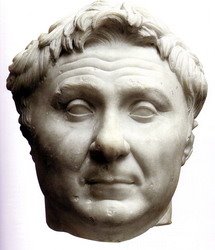
In the year 63 BC, Jerusalem welcomed the greatest general to ever set foot in that ancient city. For all the warcraft of Nebuchadnezzar or David or Sheshak (the pharaoh who looted the Ark of the Covenant from Reheboam), Pompey the Great was a general at the height of his glory, welcoming comparisons to Alexander the Great (who had bypassed Jerusalem in his conquests).

In full glory--his armor was coated with gold for his triumphs--Pompey strode through the city, advancing to the steps of the Temple, the very temple rebuilt by Nehemiah about 400 years earlier. Pompey, the Roman governor responsible for the eastern provinces, had joined the Hasmonians in a bitter civil war that had divided the ancestors of Judas Maccabees, who had gained independence from the Hellenistic Seleucid Empire. As power broker, he would usher in Roman suzerainty that would dominate the region for another 400 years.

His bodyguard shoved aside a group of Jewish protesters and held wide the temple doors for Pompey to enter. The general climbed the steps and entered as a Hasmonian guide described the significance of the altar and the Holy Place. At the far end of the hall hung a great curtain. Much to the horror of his hosts, Pompey advanced, reached out, and slipped through the curtain into the Holy of Holies, a room entered only by the High Priest once every year on the Day of Atonement.

He looked up into the square chamber, gazing at its four walls and smooth cobblestones. He looked back at his aides and grinned quizzically. "It is empty," he observed.

He turned, strode hurriedly through the temple to the exit, and left Jerusalem for more conquests and an eventual showdown (13 years later) with the only man in the world who could surpass his military genius: Julius Caesar.

No doubt the Most Holy Place became a punchline in the stories that Pompey told thereafter: such reverance and adoration given to a room that was completely empty!

The same observation was made by two women, who had hurried to a room carved out from the base of Golgotha, "Skull Hill," early on a Sunday morning nearly 100 years later. They had gone to adorn the body of a fallen Teacher, yet they had found that room empty: an empty cave that would become every bit as holy to believing Christians as the Most Holy Place had been to the Jews.

What would Pompey have thought? What's the big deal about an empty room?

After all, is religion just the worship of empty chambers? The ancient Minoans worshipped caves, I read, viewing them as portals, dwelling places of the gods. I don't know enough about Islam or Buddhism, but I would expect that there are empty rooms there, too. Perhaps empty rooms are the most obvious sign that faith is empty, the objects of believers' adoration are simply nonexistent.

Another question came this weekend at men's Bible study: what does it mean to be "poor in spirit" (Matthew 5:3)? My Bible commentary showed that this was "in contrast to the spiritually proud and self-sufficient."

One who is "poor in spirit," then, is someone with an empty room deep within themselves. Spiritual hunger, spiritual thirst, the longing for reunion with Christ--all come from the Empty Room of the heart. And Christ promised to bless these rooms with the "kingdom of heaven."

We worship empty rooms because there is a spiritual longing within each person that the God of Empty Rooms can only fill. Had the Holy of Holies been packed to the ceiling like a pharaoh's tomb, it could not have honored God before Pompey any more than it did. (As it was, the Holy of Holies became the first holy place Pompey couldn't loot.)

On Easter Sunday this year, I peered into the tomb with Mary and with Peter and with John. It was empty. Christ was risen. I broke bread and drank juice. On my knees in the silence thereafter, I hear echoes in the Empty Room within me. I begged to be filled.

15 April 2006

A Funny Story Set in Sweden

My favorite Christian music singer, Andrew Peterson, just got back from a trip to Sweden. We've been discussing Sweden on a message board on his web site (he actually responded to one of my posts), and I just had to post the story on my own blog.

I hope you enjoy this.
I understood AP's story about the Swedish meatballs, but I would love to
hear any other examples of culture shock that he went through. Do Swedes still
drive on the left-hand side of the road? Did he find anything over there he
wished that we had here in the States? Were the churches and methods of worship
similar to ours here? That's what I would love to hear about.

I'll tell one more story, which will hopefully be funnier than the lame
joke I posted above. I spent a week near Gothenburg, Sweden, celebrating
Midsummer's Day in 1991. (Two close friends are Danish, hence the joke above. My
grandmother was actually full-blooded Norwegian.)

Anyway, Midsummer's Day is a big celebration there, especially considering
the length of the year's longest day in those high lattitudes. I remember that
the sun went down at 11 p.m. and rose again around 2:30 a.m., and the
"nighttime" was more of a dull, gray dusk.

My hosts held a bonfire and set off fireworks to celebrate the holiday.
Then they took me to a Swedish sauna that was set right next to a beautiful
lake. "You're going to love the sauna," they told me.

Well, since I had been hitchhiking, I didn't exactly have a bathing suit,
so I borrowed one from a Swede. The Swedes translate the American word, "bathing
suit," as "embarassingly tiny, near-immodest, loin purse" or, more familiarly,
"Speedo."

We went to the sauna, talked, laughed, and roasted until somebody said,
"Let's jump in the lake!" Before I knew what had happened, I had leaped from the
120-degree sauna into 60-degree lakewater. We returned to the sauna, and
repeated this every 20 minutes for about two hours.

I remember two things about the experience. First, it felt really good.
When I went to bed that night, my skin felt really soft and healthy. I'll always
remember that first great sauna, even if I haven't sauna-ed since.

Secondly, I'll never forget the embarassment I felt when I got out of the
lake the second time and looked down at my, er, bathing suit. I won't go into
gory details describing the effects of cold on the male anatomy, but ...

Those are the kinds of stories I love about Sweden--a most excellent
country, I must say. Let's hear more!

12 April 2006

Beautiful Creatures


I developed my first rolls (yes, I'm still doing the old 35mm thing) of film this week in about six months! I wanted to share some with you. We spent a Sabbath in March visiting Jenny's patients and adventuring at Barren River Dam, which led to the picture you see above.

Here's a test: stare at the above left photo for ten seconds, and just try to keep from grinning back. Come on! It's not working!

Jenny and Ellie attended a "tea party" fundraiser for the American Cancer Society. Ellie won a prize for best-dressed doll. I think she should have also won the prize for Most Gorgeous Mama.

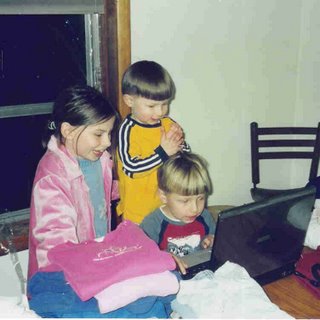
I bought a laptop computer last month. Rather than finally getting a computer of my own, it was quickly seized by the kids. The picture above is almost a Norman-Rockwell-style portrait of a 21st-Century American family. Big Sister was playing a game, but she got to a rough part and had to get help from 5-year-old Brother. Meanwhile, Baby Brother uses the distraction to pull people's hair!
09 April 2006

No School Tomorrow

I'll be home tomorrow, and the weather will be perfect.

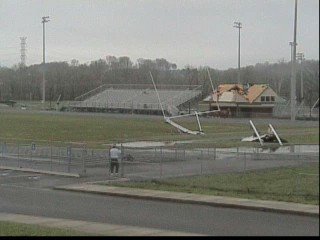
Sadly, most people and businesses in my school's district will spend their day recovering from the single most devastating weather attack I have witnessed in my area in my lifetime.

Last Friday, around 2:15 p.m. Two tornadoes ripped through southern Sumner County. One passed within about 200 yards of my high school, while another ripped through the administration building at Volunteer State Community College and made the car dealerships on the other side of highway 31E look like my sons' bedroom floor.

I was away from school when it struck, supervising students at a Youth in Government conference in Nashville. I did get to visit my school on Saturday morning, and I captured some photos from the video I took.


This is one of the electrical poles behind the school. Along with this light pole, one of the light towers on the baseball field also was knocked down.

The storm also tore down the goalposts in the end zone of our football field. Of course, our team was 1-8 this year, so it would take a tornado for that to happen! To the front right of the goalpost, you will see the scoreboard. The building behind the field was the baseball/softball scorehouse, concession stand.

Apparently the roof was ripped off the top of the gym. Some windows were also broken. Hopefully we'll be back in school on Tuesday.

02 April 2006

Family Goals, Family Crest


Jenny and I are going through a lot of changes right now, developing some new relationships and refocusing our attention on the relationships that matter most: our time with our kids.

One of the things we have developed is a set of goals for our family. We have chosen two German words, "Abenteuer, Dienst," as our family motto. They mean "Adventure, Service."

Now we're working on a new family coat of arms. It is a fun project that involves choosing colors, flags, and symbols that represent our goals for our family. It is clearly a work in progress. Here it is to date:

We need to add a number of family symbols. I will put a river through the middle. It's a symbol that comes from the ancient Dittes family coat of arms (from Germany). The creek that flows through our familienstadt of Diedelsheim, Germany, is called the Saarbruecke. Beyond the Saarbruecke, there are other rivers that Jenny and I love: the Wye in Wales, is a place where Jenny hiked to find her ancestors. I tell people, "The Ohio is my mother, and the Danube is my father."

Otherwise, we're considering other symbols: something to do with Christianity, the pines along our driveway, Penard Castle (another special place in Wales), a glove with an extended thumb (for hitchhiking). Those are just some of the ideas.

If you can think of any, I would welcome your comment.

23 March 2006

New Internet Fun

According to my students, I'm one of the last to pick up on this, but I've had fun experimenting with Pandora over the past two days.

If you're not familiar with it, Pandora is an online music cache that will stream a unique radio station through your computer. You simply fill in a number of artists you like, and it selects music for you based on those tastes. Furthermore, you can set up separate accounts. I have three accounts. Girls Rock Radio was set up by Ellie to sample teenybopper songs from Hilary Duff and Aly & A.J. and others. I listen to JD Pop during the day and evenings. It features BritPop along with some Bruce Hornsby, U2, and Five for Fighting for a pretty crazy mix. In the morning I listen to an Inspirational/Bluegrass mix to get my day started right.

The cool thing is I don't have to choose the music. Pandora acts as my brain!

19 March 2006

I Want 'Owen" Things--a 2-year-old's guide to Covetousness

I never had a little brother. A little sister, yes, but I never had the "Clone Wars" experience that happens between younger and elder brothers.

My sister and I spent most of our growing up years abhorring the "girl ways" and "boy ways" of each other. It wasn't until high school that she began stealing from me regularly--my green polo shirts were an obsession for her.

On the other hand, I watch Jonah mimic every move of his elder brother, Owen. Goslings cannot imprint any stronger on their mother than Jonah has fixated on his elder brother. Toys, baths, even books: where one is, I'm sure to find the other. And Owen's influence on Jonah is so complete, that if I so much as see Jonah doing something illicit--blowing bubbles in his juice or spitting water around the kitchen--I know that the only way to end the behavior is to stop Owen's example first. (I should add that these brothers share EVERYTHING with each other, so Jonah's mimicry seldom instigates sibling battles.)

Last month, Jonah began using his brother's name in a context that had never occurred to me before. We were at supper. Jonah pointed across the table and said, "I want Owen corn."

I thought he was pointing to his brother's plate. "You can't have that," I said. "Owen is going to eat it."

Jonah fussed a bit. Then he pointed again and said, "I want Owen corn!"

I looked at his plate and noticed that it was clean, so I spooned another serving of corn out of the bowl and gave it to him. He smiled broadly and said, "Thankooo."

'Owen corn' hadn't referred to Owen's corn. It had been used in a context that could mean "more" or "another." Jonah had wanted what Owen had on his place--he always wants the things he sees around his brother.

Since then, I have heard Jonah ask for "owen candy" or an "owen piece of bread," even when his brother isn't even around. His passion to have everything like his brother's has added a new adjective to the growing Dittes Family Vocabulary.

Instead of 'keeping up with the Joneses,' we say, "I want owen this and that."

I spend many of my own energies trying to imitate others around me, failing to be satisfied with the incredible blessings I have been given. So long as these desires are in the abstract, they are palatable--even honorable. I want a laptop computer, a Mini Cooper, new windows in my home, money for travel and leisure.

There's nothing wrong with that, is there? Well...there is.

I smile about a two-year-old who imitates every jot and tittle of his big brother's life. Does God smile at me in the same way?

I spend my energies wanting a Lee computer, a Jon car, some Smith windows, and a Meggan trip. I don't put it this way, because I've been tricked into believing that I'm "thinking for myself" in these areas.

In the end, the person I am called to imitate isn't Lee or Jon or Meggan but Jesus. My life must be devoted to the One who acts as my perfect "Big Brother" and beckons me to follow Him.

Could I ask for a Jesus laptop, a Christ car, some Messiah windows or a Savior trip? I could, but it sure would seem funny, since He never had any of those. No, once I have given up the ones I emulate in favor of the One who calls me, I will lose the desire for those worldly things as well.

24 February 2006

Book Review: Gilead

The Presidents' Day weekend gave me an opportunity to finish a good book. Usually I have to read piecemeal: 10 to 20 pages a night before I go to sleep. That's the way I'm working through the unabridged Count of Monte Cristo, all 1,500 pages of it. This weekend, though, I found time for Marilynne Robinson's Gilead, and I'm glad I did.

Set in Iowa, it is a story told by a dying Congregationalist preacher, John Ames, to his seven-year-old son. It begins as a diary, strays into family history, and ends with a focus on Ames's namesake, Jack Boughton, a prodigal son who has returned home burdened by an unspoken past.

The diary style of the book is fascinating as it examines Ames's grandfather, a zealous abolitionist who had moved to Kansas in the 1850s and had justified the use of violence to eradicate slavery. Robinson has a sly way of enlightening the reader about Ames as well as the grandfather at this time.

Where the diary style completely fails is in the frank discussion of contemporary events. It's fascinating nonetheless, but hard to justify telling a son about.

What I liked about Gilead was Robinson's treatment of faith. Ames is a solid, grounded Believer who has been tempted and tried. His brother had become an athiest at university in Germany, and his father (also a minister) had even encouraged him to get out of Iowa. Ames had stayed, and I really enjoyed his voice--his faith.

I want to reflect upon a few quotes from the book that really were powerful.

"I feel sometimes as if I were a child who opens its eyes on the world once and
sees amazing things it will never know any names for and then has to close its
eyes again. I know this is all mere apparition compared to what awaits us,
but it is only lovelier for that, when we have all been changed and put on
incorruptibility, we will forget our fantastic condition of mortality and
impermanence, the great bright dream of procreating and perishing that meant the
whole world to us. In eternity this world will by Troy, I believe, and all
that has passed here will be the epic of the universe, the ballad they sing in
the streets. Because I don't imagine any reality putting this one in the
shade entirely, and I think piety forbids me to try." (57)


Now I'm a serious Homer-phile, but I like the treatment of earth's history as Troy--the most celebrated battle of all time.

Robinson also makes a sublime connection between the 10 Commandments and Creation.
"[The 10 Commandments] to me seem almost a retelling of Creation--First there is
the Lord, then the Word, then the Day, then the Man and Woman--and after that
Cain and Abel--Thou shalt not kill--and all the sins recorded in those
prohibitions, just as crimes are recorded in the laws against them. So
perhaps the tablets differ as addressing the eternal and the temporal." (139)

I just know I'm going to use the following quote many times in the future:
"How do you tell a scribe from a prophet...? The prophets love the people
they chastise, a thing this [scribe] does not appear to me to do" (142).

On the issue of doubt, there is more sage wisdom:
"Don't look for proofs. Don't bother with them at all. They are
never sufficient to the question, and they're always a little impertinent, I
think, because they claim for God a place within our conceptual grasp. And
they will likely sound wrong to you even if you convince someone else with
them. That is very unsettling over the long term. "Let your woks so
shine before men," etc. It was Coleridge who said Christianity is a life,
not a doctrine, words to that effect. I'm not saying never doubt or
question. The Lord gave you a mind so that you would make honest use of
it. I'm saying you must be sure that the doubts and questions are your
own, not, so to speak, the mustache and walking stick that happen to be the
fashion of any particular moment" (179).

Finally, I'll include Ames's ruminations on the issue of memory. They are beautiful, touching and heartbreaking:
"I wish I could give you the memory I have of your mother that day. I
wish I could leave you certain of the images in my mind, because they are so
beautiful that I hate to think they will be extinguished when I am. Well,
but again, this life has its own mortal loveliness. And memory is not
strictly mortal in its nature, either. It is a strange thing, after all,
to be able to return to a moment, when it can hardly be said to have any reality
at all, even in its passing. A moment is such a slight thing, I mean, that
its abiding is a most gracious reprieve" (162).

18 February 2006

Mardi Gras and More

We can expect much coverage this week of the Mardi Gras carnival in New Orleans. This city, devastated by Hurricane Katrina last August, has long been a target of media attention and Mardi Gras on February 28th will be a chance for many to reflect--as well as party.

Mardi Gras or Carnival has been celebrated since the Dark Ages. It's English name is Fat Tuesday, the day before Lent, the day people emptied the larders and consumed the last of the sweets before an extended period of fasting.

As much as I have always loved the city of New Orleans, I have never been there for Mardi Gras, and I doubt I ever will. My idea of reveling is, I'm sure, quite different from the spirit of Mardi Gras. It tends to be alcohol-free, for one.

One element that I have practiced for the last seven years has been Lent. Mine has been a learned practice, since I didn't grow up in a church that practiced 40 days of fasting prior to Easter. Back in 1998, as I was preparing to go to the mission field, I felt that Easter deserved to be a religious focal point--it was far more deserving than Christmas for that title. I also felt a great need to practice Lent. I didn't eat meat (which is what most Catholics fast from), so I determined to find something else to forego--a spiritual and physical challenge that could lead to development. I determined to focus on one personal "vice" or another as well as spiritual renewal.

What Worked. The first year, when I was still living in Arizona, I gave up TV during Lent (Sabbath is the day I take off from fasting). When the experience was over, I felt better. I had had more time for God, my Bride, and my baby daughter. Later I focused on my addiction to computer games. It was a time when my love for "Age of Empires" was really frustrating Jenny. I would start playing and be unable to stop unti 2 a.m. sometimes. Giving up the games for 40 days, gave me perspective, new habits, less addiction. Since my 2nd 40-day "fast" from computer games, I haven't been tempted by them since.

What Hasn't. There have been Lenten blunders, too. I have tried to fast by enforcing a certain behavior: worship and exercise have been two. I tried daily exercise the past two years, and each time it failed. I think it was a little too me-focused. Sorry, but I still can't bring myself to imagine that I'm glorifying God by exercising.

This Year. I'm planning to focus on diet. My appetite has gotten away from me since mid-January. I need to bring it under control and dedicate all of myself to God. I'll abstain from sugar or sugar substitutes over the month (except Sabbaths). Furthermore, I'll devote the six Fridays to fasting and prayer for choices Jenny and I are making about where and how we worship.

Why am I revealing this on a blog? I need to be help accountable, for one. I do this for myself by talking about my beliefs. Just seeing this written down gives me hope that Lent, this year, will begin a lifelong change--and continue a lifelong adoration of Jesus Christ.