28 April 2006
The Bible's Least Romantic Verse
"Enjoy life with your wife whom you love, all the days of this meaningless life that God has given you under the sun--for all your meaningless days." --Eclesiastes 9.9


23 April 2006
Ecclesiastes Made Easy
I had this message in my Inbox yesterday:
"Could you and would you have time to do an introduction to Ecclesiastes? This is an unusual and fascinating book and you could do it justice. Please confirm that you receive. I hate to call you on Sat... Johnny"
I'm a teacher through and through, but there are some times when I don't mind being the student. That tends to happen when the lesson is on something that I don't understand very well--such as the book of Ecclesiastes. All week I'd been studying my Sunday School lesson, thinking, "I'm sure glad I don't have to teach this." Of course, all week, Johnny had been down in Nashville working as a lobbyist in the state legislature, too busy to prepare a full lesson. (Watching Tennessee's legislature takes as much energy and fortitude as watching teenagers, I believe.)
Even Johnny's flattery, "You could do it justice," couldn't break through the hopelessness of my goal. Then again, hopelessness is the theme of the book. I thought I'd share some of the insights with you.
First some context for the study. Prior to Easter, our class was studying the book of Job--man suffers injustice, keeps his faith in God, gets rewarded in the end. It closed with Christ's suffering, first in Gethsemane and then on the cross, and we made parallels between Job and Christ.
This week we began Ecclesiastes, and closed with a study of some of the Resurrection appearances of Jesus. The book of Ecclesiastes reads like an "inside-out" version of the Book of Job. Rather than being a testament of suffering, it is a chronicle of excess--reflections of a man who gained the whole world, only to find the meaninglessness of a life without God's leading.
At the end of Job, the main character has been vindicated by God. By the 2nd chapter of Ecclesiastes, the writer has almost eviscerated all the hope, all the love, all the grace that a believer might expect from God.
Most people believe that Ecclesiastes come from Solomon--and it is fascinating to consider them in light of Solomon's own life story. His kingdom had an auspicious beginning: God appeared to him in a dream and promise to grant any one wish he could make. Solomon asked for wisdom--a wish granted by God, along with wealth, splendor and empire (1 Kings 3.1-15; 4.29-34). Only a few stories of Solomon's wisdom survive in the Bible: his judicious judgment of two women arguing over a surviving child, and his epic encounter with the Queen of Sheba.
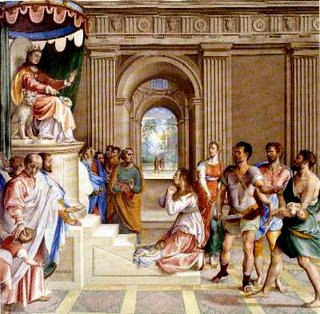 The high point of Solomon's career was the dedication of the temple. His prayer of dedication is one of the greatest speeches found in the Bible (1 Kings 8), yet a critical study of the speech shows the seeds of the fall that will soon come. By 1 Kings 11, we learn that Solomon's excesses--his enslavement of his own people, his 700 wives, his 300 concubines have attracted God's wrath. "The Lord became angry with Solomon because his heart had turned away from the Lord," (1 Kings 11.9).
God raises two opponents to harass Solomon in his final years. The mysterious King Hadad of Edom (a survivor of the genocide through which Joab wiped out the nation of Edom in 2nd Samuel 8) gains the sponsorship of Shishak, Pharaoh of Egypt, and tries to invade.
Closer to home, the prophet Ahijah promises Jeroboam ten of the twelve tribes of Israel. When Solomon learns of Jeroboam's goals, he tries to murder him, but Jeroboam escapes to Egypt to await Solomon's demise and the rule of his inferior, vain, and incompetent son, Rehoboam.
This, then, is the context for the book Ecclesiastes. Solomon is hedged in by enemies, and Egypt is on the rise, ready to seize any opportunity to invade and take away everything Solomon has built. Such excess would seem meaningless in this context, wouldn't it?
Wise as he was, Solomon knew the game was up--that his glorious building projects and his wide-ranging empire were "a chasing after the wind." Hindsight shows that within five years of his death, ten tribes would split away under the rule of Jeroboam, leaving the rump nation of Judah to stumble forward another 250 years. Within 15 years, Pharaoh Shishak would sack Jerusalem and carry away many of the treasures so lovingly stored in the temple (including the Ark of the Covenant so celebrated by Solomon's father, David).
Eight chapters in the first book of Kings tells the story of Solomon--only eleven chapters. He appears to me to be a man whose life was squandered with excess and shallowness. Ecclesiastes bears this theme out, leaving us with wisdom, yes, but also a health share of regret for all that Solomon wasted.
"Could you and would you have time to do an introduction to Ecclesiastes? This is an unusual and fascinating book and you could do it justice. Please confirm that you receive. I hate to call you on Sat... Johnny"
I'm a teacher through and through, but there are some times when I don't mind being the student. That tends to happen when the lesson is on something that I don't understand very well--such as the book of Ecclesiastes. All week I'd been studying my Sunday School lesson, thinking, "I'm sure glad I don't have to teach this." Of course, all week, Johnny had been down in Nashville working as a lobbyist in the state legislature, too busy to prepare a full lesson. (Watching Tennessee's legislature takes as much energy and fortitude as watching teenagers, I believe.)
Even Johnny's flattery, "You could do it justice," couldn't break through the hopelessness of my goal. Then again, hopelessness is the theme of the book. I thought I'd share some of the insights with you.
First some context for the study. Prior to Easter, our class was studying the book of Job--man suffers injustice, keeps his faith in God, gets rewarded in the end. It closed with Christ's suffering, first in Gethsemane and then on the cross, and we made parallels between Job and Christ.
This week we began Ecclesiastes, and closed with a study of some of the Resurrection appearances of Jesus. The book of Ecclesiastes reads like an "inside-out" version of the Book of Job. Rather than being a testament of suffering, it is a chronicle of excess--reflections of a man who gained the whole world, only to find the meaninglessness of a life without God's leading.
At the end of Job, the main character has been vindicated by God. By the 2nd chapter of Ecclesiastes, the writer has almost eviscerated all the hope, all the love, all the grace that a believer might expect from God.
Most people believe that Ecclesiastes come from Solomon--and it is fascinating to consider them in light of Solomon's own life story. His kingdom had an auspicious beginning: God appeared to him in a dream and promise to grant any one wish he could make. Solomon asked for wisdom--a wish granted by God, along with wealth, splendor and empire (1 Kings 3.1-15; 4.29-34). Only a few stories of Solomon's wisdom survive in the Bible: his judicious judgment of two women arguing over a surviving child, and his epic encounter with the Queen of Sheba.
 The high point of Solomon's career was the dedication of the temple. His prayer of dedication is one of the greatest speeches found in the Bible (1 Kings 8), yet a critical study of the speech shows the seeds of the fall that will soon come. By 1 Kings 11, we learn that Solomon's excesses--his enslavement of his own people, his 700 wives, his 300 concubines have attracted God's wrath. "The Lord became angry with Solomon because his heart had turned away from the Lord," (1 Kings 11.9).
God raises two opponents to harass Solomon in his final years. The mysterious King Hadad of Edom (a survivor of the genocide through which Joab wiped out the nation of Edom in 2nd Samuel 8) gains the sponsorship of Shishak, Pharaoh of Egypt, and tries to invade.
Closer to home, the prophet Ahijah promises Jeroboam ten of the twelve tribes of Israel. When Solomon learns of Jeroboam's goals, he tries to murder him, but Jeroboam escapes to Egypt to await Solomon's demise and the rule of his inferior, vain, and incompetent son, Rehoboam.
This, then, is the context for the book Ecclesiastes. Solomon is hedged in by enemies, and Egypt is on the rise, ready to seize any opportunity to invade and take away everything Solomon has built. Such excess would seem meaningless in this context, wouldn't it?
Wise as he was, Solomon knew the game was up--that his glorious building projects and his wide-ranging empire were "a chasing after the wind." Hindsight shows that within five years of his death, ten tribes would split away under the rule of Jeroboam, leaving the rump nation of Judah to stumble forward another 250 years. Within 15 years, Pharaoh Shishak would sack Jerusalem and carry away many of the treasures so lovingly stored in the temple (including the Ark of the Covenant so celebrated by Solomon's father, David).
Eight chapters in the first book of Kings tells the story of Solomon--only eleven chapters. He appears to me to be a man whose life was squandered with excess and shallowness. Ecclesiastes bears this theme out, leaving us with wisdom, yes, but also a health share of regret for all that Solomon wasted.
17 April 2006
Easter Thoughts
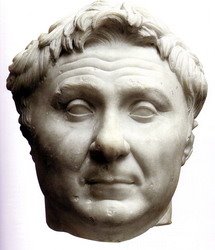
There is a reason why I worship from church pews rather than from the pulpit: my ideas tend to come a little late, usually while my mind and my spirit are interacting with the message of the sermon. Although these Easter thoughts are technically a day late, they were inspired yesterday, and I hope they will inspire you, too.
In the year 63 BC, Jerusalem welcomed the greatest general to ever set foot in that ancient city. For all the warcraft of Nebuchadnezzar or David or Sheshak (the pharaoh who looted the Ark of the Covenant from Reheboam), Pompey the Great was a general at the height of his glory, welcoming comparisons to Alexander the Great (who had bypassed Jerusalem in his conquests).
In full glory--his armor was coated with gold for his triumphs--Pompey strode through the city, advancing to the steps of the Temple, the very temple rebuilt by Nehemiah about 400 years earlier. Pompey, the Roman governor responsible for the eastern provinces, had joined the Hasmonians in a bitter civil war that had divided the ancestors of Judas Maccabees, who had gained independence from the Hellenistic Seleucid Empire. As power broker, he would usher in Roman suzerainty that would dominate the region for another 400 years.
His bodyguard shoved aside a group of Jewish protesters and held wide the temple doors for Pompey to enter. The general climbed the steps and entered as a Hasmonian guide described the significance of the altar and the Holy Place. At the far end of the hall hung a great curtain. Much to the horror of his hosts, Pompey advanced, reached out, and slipped through the curtain into the Holy of Holies, a room entered only by the High Priest once every year on the Day of Atonement.
He looked up into the square chamber, gazing at its four walls and smooth cobblestones. He looked back at his aides and grinned quizzically. "It is empty," he observed.
He turned, strode hurriedly through the temple to the exit, and left Jerusalem for more conquests and an eventual showdown (13 years later) with the only man in the world who could surpass his military genius: Julius Caesar.
No doubt the Most Holy Place became a punchline in the stories that Pompey told thereafter: such reverance and adoration given to a room that was completely empty!
The same observation was made by two women, who had hurried to a room carved out from the base of Golgotha, "Skull Hill," early on a Sunday morning nearly 100 years later. They had gone to adorn the body of a fallen Teacher, yet they had found that room empty: an empty cave that would become every bit as holy to believing Christians as the Most Holy Place had been to the Jews.
What would Pompey have thought? What's the big deal about an empty room?
After all, is religion just the worship of empty chambers? The ancient Minoans worshipped caves, I read, viewing them as portals, dwelling places of the gods. I don't know enough about Islam or Buddhism, but I would expect that there are empty rooms there, too. Perhaps empty rooms are the most obvious sign that faith is empty, the objects of believers' adoration are simply nonexistent.
Another question came this weekend at men's Bible study: what does it mean to be "poor in spirit" (Matthew 5:3)? My Bible commentary showed that this was "in contrast to the spiritually proud and self-sufficient."
One who is "poor in spirit," then, is someone with an empty room deep within themselves. Spiritual hunger, spiritual thirst, the longing for reunion with Christ--all come from the Empty Room of the heart. And Christ promised to bless these rooms with the "kingdom of heaven."
We worship empty rooms because there is a spiritual longing within each person that the God of Empty Rooms can only fill. Had the Holy of Holies been packed to the ceiling like a pharaoh's tomb, it could not have honored God before Pompey any more than it did. (As it was, the Holy of Holies became the first holy place Pompey couldn't loot.)
On Easter Sunday this year, I peered into the tomb with Mary and with Peter and with John. It was empty. Christ was risen. I broke bread and drank juice. On my knees in the silence thereafter, I hear echoes in the Empty Room within me. I begged to be filled.
15 April 2006
A Funny Story Set in Sweden
My favorite Christian music singer, Andrew Peterson, just got back from a trip to Sweden. We've been discussing Sweden on a message board on his web site (he actually responded to one of my posts), and I just had to post the story on my own blog.
I hope you enjoy this.
I hope you enjoy this.
I understood AP's story about the Swedish meatballs, but I would love to
hear any other examples of culture shock that he went through. Do Swedes still
drive on the left-hand side of the road? Did he find anything over there he
wished that we had here in the States? Were the churches and methods of worship
similar to ours here? That's what I would love to hear about.
I'll tell one more story, which will hopefully be funnier than the lame
joke I posted above. I spent a week near Gothenburg, Sweden, celebrating
Midsummer's Day in 1991. (Two close friends are Danish, hence the joke above. My
grandmother was actually full-blooded Norwegian.)
Anyway, Midsummer's Day is a big celebration there, especially considering
the length of the year's longest day in those high lattitudes. I remember that
the sun went down at 11 p.m. and rose again around 2:30 a.m., and the
"nighttime" was more of a dull, gray dusk.
My hosts held a bonfire and set off fireworks to celebrate the holiday.
Then they took me to a Swedish sauna that was set right next to a beautiful
lake. "You're going to love the sauna," they told me.
Well, since I had been hitchhiking, I didn't exactly have a bathing suit,
so I borrowed one from a Swede. The Swedes translate the American word, "bathing
suit," as "embarassingly tiny, near-immodest, loin purse" or, more familiarly,
"Speedo."
We went to the sauna, talked, laughed, and roasted until somebody said,
"Let's jump in the lake!" Before I knew what had happened, I had leaped from the
120-degree sauna into 60-degree lakewater. We returned to the sauna, and
repeated this every 20 minutes for about two hours.
I remember two things about the experience. First, it felt really good.
When I went to bed that night, my skin felt really soft and healthy. I'll always
remember that first great sauna, even if I haven't sauna-ed since.
Secondly, I'll never forget the embarassment I felt when I got out of the
lake the second time and looked down at my, er, bathing suit. I won't go into
gory details describing the effects of cold on the male anatomy, but ...
Those are the kinds of stories I love about Sweden--a most excellent
country, I must say. Let's hear more!
12 April 2006
Beautiful Creatures

I developed my first rolls (yes, I'm still doing the old 35mm thing) of film this week in about six months! I wanted to share some with you. We spent a Sabbath in March visiting Jenny's patients and adventuring at Barren River Dam, which led to the picture you see above.
Here's a test: stare at the above left photo for ten seconds, and just try to keep from grinning back. Come on! It's not working!

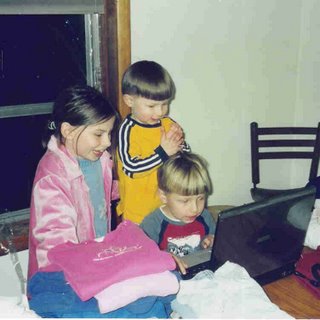 I bought a laptop computer last month. Rather than finally getting a computer of my own, it was quickly seized by the kids. The picture above is almost a Norman-Rockwell-style portrait of a 21st-Century American family. Big Sister was playing a game, but she got to a rough part and had to get help from 5-year-old Brother. Meanwhile, Baby Brother uses the distraction to pull people's hair!
09 April 2006
No School Tomorrow
 I'll be home tomorrow, and the weather will be perfect.
Sadly, most people and businesses in my school's district will spend their day recovering from the single most devastating weather attack I have witnessed in my area in my lifetime.
Last Friday, around 2:15 p.m. Two tornadoes ripped through southern Sumner County. One passed within about 200 yards of my high school, while another ripped through the administration building at Volunteer State Community College and made the car dealerships on the other side of highway 31E look like my sons' bedroom floor.
I was away from school when it struck, supervising students at a Youth in Government conference in Nashville. I did get to visit my school on Saturday morning, and I captured some photos from the video I took.

This is one of the electrical poles behind the school. Along with this light pole, one of the light towers on the baseball field also was knocked down.
The storm also tore down the goalposts in the end zone of our football field. Of course, our team was 1-8 this year, so it would take a tornado for that to happen! To the front right of the goalpost, you will see the scoreboard. The building behind the field was the baseball/softball scorehouse, concession stand.
Apparently the roof was ripped off the top of the gym. Some windows were also broken. Hopefully we'll be back in school on Tuesday.
02 April 2006
Family Goals, Family Crest

Jenny and I are going through a lot of changes right now, developing some new relationships and refocusing our attention on the relationships that matter most: our time with our kids.

One of the things we have developed is a set of goals for our family. We have chosen two German words, "Abenteuer, Dienst," as our family motto. They mean "Adventure, Service."
Now we're working on a new family coat of arms. It is a fun project that involves choosing colors, flags, and symbols that represent our goals for our family. It is clearly a work in progress. Here it is to date:

We need to add a number of family symbols. I will put a river through the middle. It's a symbol that comes from the ancient Dittes family coat of arms (from Germany). The creek that flows through our familienstadt of Diedelsheim, Germany, is called the Saarbruecke. Beyond the Saarbruecke, there are other rivers that Jenny and I love: the Wye in Wales, is a place where Jenny hiked to find her ancestors. I tell people, "The Ohio is my mother, and the Danube is my father."
Otherwise, we're considering other symbols: something to do with Christianity, the pines along our driveway, Penard Castle (another special place in Wales), a glove with an extended thumb (for hitchhiking). Those are just some of the ideas.
If you can think of any, I would welcome your comment.
23 March 2006
New Internet Fun
According to my students, I'm one of the last to pick up on this, but I've had fun experimenting with Pandora over the past two days.
If you're not familiar with it, Pandora is an online music cache that will stream a unique radio station through your computer. You simply fill in a number of artists you like, and it selects music for you based on those tastes. Furthermore, you can set up separate accounts. I have three accounts. Girls Rock Radio was set up by Ellie to sample teenybopper songs from Hilary Duff and Aly & A.J. and others. I listen to JD Pop during the day and evenings. It features BritPop along with some Bruce Hornsby, U2, and Five for Fighting for a pretty crazy mix. In the morning I listen to an Inspirational/Bluegrass mix to get my day started right.
The cool thing is I don't have to choose the music. Pandora acts as my brain!
If you're not familiar with it, Pandora is an online music cache that will stream a unique radio station through your computer. You simply fill in a number of artists you like, and it selects music for you based on those tastes. Furthermore, you can set up separate accounts. I have three accounts. Girls Rock Radio was set up by Ellie to sample teenybopper songs from Hilary Duff and Aly & A.J. and others. I listen to JD Pop during the day and evenings. It features BritPop along with some Bruce Hornsby, U2, and Five for Fighting for a pretty crazy mix. In the morning I listen to an Inspirational/Bluegrass mix to get my day started right.
The cool thing is I don't have to choose the music. Pandora acts as my brain!
19 March 2006
I Want 'Owen" Things--a 2-year-old's guide to Covetousness
I never had a little brother. A little sister, yes, but I never had the "Clone Wars" experience that happens between younger and elder brothers.
My sister and I spent most of our growing up years abhorring the "girl ways" and "boy ways" of each other. It wasn't until high school that she began stealing from me regularly--my green polo shirts were an obsession for her.
On the other hand, I watch Jonah mimic every move of his elder brother, Owen. Goslings cannot imprint any stronger on their mother than Jonah has fixated on his elder brother. Toys, baths, even books: where one is, I'm sure to find the other. And Owen's influence on Jonah is so complete, that if I so much as see Jonah doing something illicit--blowing bubbles in his juice or spitting water around the kitchen--I know that the only way to end the behavior is to stop Owen's example first. (I should add that these brothers share EVERYTHING with each other, so Jonah's mimicry seldom instigates sibling battles.)
Last month, Jonah began using his brother's name in a context that had never occurred to me before. We were at supper. Jonah pointed across the table and said, "I want Owen corn."
I thought he was pointing to his brother's plate. "You can't have that," I said. "Owen is going to eat it."
Jonah fussed a bit. Then he pointed again and said, "I want Owen corn!"
I looked at his plate and noticed that it was clean, so I spooned another serving of corn out of the bowl and gave it to him. He smiled broadly and said, "Thankooo."
'Owen corn' hadn't referred to Owen's corn. It had been used in a context that could mean "more" or "another." Jonah had wanted what Owen had on his place--he always wants the things he sees around his brother.
Since then, I have heard Jonah ask for "owen candy" or an "owen piece of bread," even when his brother isn't even around. His passion to have everything like his brother's has added a new adjective to the growing Dittes Family Vocabulary.
Instead of 'keeping up with the Joneses,' we say, "I want owen this and that."
I spend many of my own energies trying to imitate others around me, failing to be satisfied with the incredible blessings I have been given. So long as these desires are in the abstract, they are palatable--even honorable. I want a laptop computer, a Mini Cooper, new windows in my home, money for travel and leisure.
There's nothing wrong with that, is there? Well...there is.
I smile about a two-year-old who imitates every jot and tittle of his big brother's life. Does God smile at me in the same way?
I spend my energies wanting a Lee computer, a Jon car, some Smith windows, and a Meggan trip. I don't put it this way, because I've been tricked into believing that I'm "thinking for myself" in these areas.
In the end, the person I am called to imitate isn't Lee or Jon or Meggan but Jesus. My life must be devoted to the One who acts as my perfect "Big Brother" and beckons me to follow Him.
Could I ask for a Jesus laptop, a Christ car, some Messiah windows or a Savior trip? I could, but it sure would seem funny, since He never had any of those. No, once I have given up the ones I emulate in favor of the One who calls me, I will lose the desire for those worldly things as well.
My sister and I spent most of our growing up years abhorring the "girl ways" and "boy ways" of each other. It wasn't until high school that she began stealing from me regularly--my green polo shirts were an obsession for her.
On the other hand, I watch Jonah mimic every move of his elder brother, Owen. Goslings cannot imprint any stronger on their mother than Jonah has fixated on his elder brother. Toys, baths, even books: where one is, I'm sure to find the other. And Owen's influence on Jonah is so complete, that if I so much as see Jonah doing something illicit--blowing bubbles in his juice or spitting water around the kitchen--I know that the only way to end the behavior is to stop Owen's example first. (I should add that these brothers share EVERYTHING with each other, so Jonah's mimicry seldom instigates sibling battles.)
Last month, Jonah began using his brother's name in a context that had never occurred to me before. We were at supper. Jonah pointed across the table and said, "I want Owen corn."
I thought he was pointing to his brother's plate. "You can't have that," I said. "Owen is going to eat it."
Jonah fussed a bit. Then he pointed again and said, "I want Owen corn!"
I looked at his plate and noticed that it was clean, so I spooned another serving of corn out of the bowl and gave it to him. He smiled broadly and said, "Thankooo."
'Owen corn' hadn't referred to Owen's corn. It had been used in a context that could mean "more" or "another." Jonah had wanted what Owen had on his place--he always wants the things he sees around his brother.
Since then, I have heard Jonah ask for "owen candy" or an "owen piece of bread," even when his brother isn't even around. His passion to have everything like his brother's has added a new adjective to the growing Dittes Family Vocabulary.
Instead of 'keeping up with the Joneses,' we say, "I want owen this and that."
I spend many of my own energies trying to imitate others around me, failing to be satisfied with the incredible blessings I have been given. So long as these desires are in the abstract, they are palatable--even honorable. I want a laptop computer, a Mini Cooper, new windows in my home, money for travel and leisure.
There's nothing wrong with that, is there? Well...there is.
I smile about a two-year-old who imitates every jot and tittle of his big brother's life. Does God smile at me in the same way?
I spend my energies wanting a Lee computer, a Jon car, some Smith windows, and a Meggan trip. I don't put it this way, because I've been tricked into believing that I'm "thinking for myself" in these areas.
In the end, the person I am called to imitate isn't Lee or Jon or Meggan but Jesus. My life must be devoted to the One who acts as my perfect "Big Brother" and beckons me to follow Him.
Could I ask for a Jesus laptop, a Christ car, some Messiah windows or a Savior trip? I could, but it sure would seem funny, since He never had any of those. No, once I have given up the ones I emulate in favor of the One who calls me, I will lose the desire for those worldly things as well.
24 February 2006
Book Review: Gilead
The Presidents' Day weekend gave me an opportunity to finish a good book. Usually I have to read piecemeal: 10 to 20 pages a night before I go to sleep. That's the way I'm working through the unabridged Count of Monte Cristo, all 1,500 pages of it. This weekend, though, I found time for Marilynne Robinson's Gilead, and I'm glad I did.
Set in Iowa, it is a story told by a dying Congregationalist preacher, John Ames, to his seven-year-old son. It begins as a diary, strays into family history, and ends with a focus on Ames's namesake, Jack Boughton, a prodigal son who has returned home burdened by an unspoken past.
The diary style of the book is fascinating as it examines Ames's grandfather, a zealous abolitionist who had moved to Kansas in the 1850s and had justified the use of violence to eradicate slavery. Robinson has a sly way of enlightening the reader about Ames as well as the grandfather at this time.
Where the diary style completely fails is in the frank discussion of contemporary events. It's fascinating nonetheless, but hard to justify telling a son about.
What I liked about Gilead was Robinson's treatment of faith. Ames is a solid, grounded Believer who has been tempted and tried. His brother had become an athiest at university in Germany, and his father (also a minister) had even encouraged him to get out of Iowa. Ames had stayed, and I really enjoyed his voice--his faith.
I want to reflect upon a few quotes from the book that really were powerful.
Now I'm a serious Homer-phile, but I like the treatment of earth's history as Troy--the most celebrated battle of all time.
Robinson also makes a sublime connection between the 10 Commandments and Creation.
I just know I'm going to use the following quote many times in the future:
On the issue of doubt, there is more sage wisdom:
Finally, I'll include Ames's ruminations on the issue of memory. They are beautiful, touching and heartbreaking:
Set in Iowa, it is a story told by a dying Congregationalist preacher, John Ames, to his seven-year-old son. It begins as a diary, strays into family history, and ends with a focus on Ames's namesake, Jack Boughton, a prodigal son who has returned home burdened by an unspoken past.
The diary style of the book is fascinating as it examines Ames's grandfather, a zealous abolitionist who had moved to Kansas in the 1850s and had justified the use of violence to eradicate slavery. Robinson has a sly way of enlightening the reader about Ames as well as the grandfather at this time.
Where the diary style completely fails is in the frank discussion of contemporary events. It's fascinating nonetheless, but hard to justify telling a son about.
What I liked about Gilead was Robinson's treatment of faith. Ames is a solid, grounded Believer who has been tempted and tried. His brother had become an athiest at university in Germany, and his father (also a minister) had even encouraged him to get out of Iowa. Ames had stayed, and I really enjoyed his voice--his faith.
I want to reflect upon a few quotes from the book that really were powerful.
"I feel sometimes as if I were a child who opens its eyes on the world once and
sees amazing things it will never know any names for and then has to close its
eyes again. I know this is all mere apparition compared to what awaits us,
but it is only lovelier for that, when we have all been changed and put on
incorruptibility, we will forget our fantastic condition of mortality and
impermanence, the great bright dream of procreating and perishing that meant the
whole world to us. In eternity this world will by Troy, I believe, and all
that has passed here will be the epic of the universe, the ballad they sing in
the streets. Because I don't imagine any reality putting this one in the
shade entirely, and I think piety forbids me to try." (57)
Now I'm a serious Homer-phile, but I like the treatment of earth's history as Troy--the most celebrated battle of all time.
Robinson also makes a sublime connection between the 10 Commandments and Creation.
"[The 10 Commandments] to me seem almost a retelling of Creation--First there is
the Lord, then the Word, then the Day, then the Man and Woman--and after that
Cain and Abel--Thou shalt not kill--and all the sins recorded in those
prohibitions, just as crimes are recorded in the laws against them. So
perhaps the tablets differ as addressing the eternal and the temporal." (139)
I just know I'm going to use the following quote many times in the future:
"How do you tell a scribe from a prophet...? The prophets love the people
they chastise, a thing this [scribe] does not appear to me to do" (142).
On the issue of doubt, there is more sage wisdom:
"Don't look for proofs. Don't bother with them at all. They are
never sufficient to the question, and they're always a little impertinent, I
think, because they claim for God a place within our conceptual grasp. And
they will likely sound wrong to you even if you convince someone else with
them. That is very unsettling over the long term. "Let your woks so
shine before men," etc. It was Coleridge who said Christianity is a life,
not a doctrine, words to that effect. I'm not saying never doubt or
question. The Lord gave you a mind so that you would make honest use of
it. I'm saying you must be sure that the doubts and questions are your
own, not, so to speak, the mustache and walking stick that happen to be the
fashion of any particular moment" (179).
Finally, I'll include Ames's ruminations on the issue of memory. They are beautiful, touching and heartbreaking:
"I wish I could give you the memory I have of your mother that day. I
wish I could leave you certain of the images in my mind, because they are so
beautiful that I hate to think they will be extinguished when I am. Well,
but again, this life has its own mortal loveliness. And memory is not
strictly mortal in its nature, either. It is a strange thing, after all,
to be able to return to a moment, when it can hardly be said to have any reality
at all, even in its passing. A moment is such a slight thing, I mean, that
its abiding is a most gracious reprieve" (162).
18 February 2006
Mardi Gras and More
We can expect much coverage this week of the Mardi Gras carnival in New Orleans. This city, devastated by Hurricane Katrina last August, has long been a target of media attention and Mardi Gras on February 28th will be a chance for many to reflect--as well as party.
Mardi Gras or Carnival has been celebrated since the Dark Ages. It's English name is Fat Tuesday, the day before Lent, the day people emptied the larders and consumed the last of the sweets before an extended period of fasting.
As much as I have always loved the city of New Orleans, I have never been there for Mardi Gras, and I doubt I ever will. My idea of reveling is, I'm sure, quite different from the spirit of Mardi Gras. It tends to be alcohol-free, for one.
One element that I have practiced for the last seven years has been Lent. Mine has been a learned practice, since I didn't grow up in a church that practiced 40 days of fasting prior to Easter. Back in 1998, as I was preparing to go to the mission field, I felt that Easter deserved to be a religious focal point--it was far more deserving than Christmas for that title. I also felt a great need to practice Lent. I didn't eat meat (which is what most Catholics fast from), so I determined to find something else to forego--a spiritual and physical challenge that could lead to development. I determined to focus on one personal "vice" or another as well as spiritual renewal.
What Worked. The first year, when I was still living in Arizona, I gave up TV during Lent (Sabbath is the day I take off from fasting). When the experience was over, I felt better. I had had more time for God, my Bride, and my baby daughter. Later I focused on my addiction to computer games. It was a time when my love for "Age of Empires" was really frustrating Jenny. I would start playing and be unable to stop unti 2 a.m. sometimes. Giving up the games for 40 days, gave me perspective, new habits, less addiction. Since my 2nd 40-day "fast" from computer games, I haven't been tempted by them since.
What Hasn't. There have been Lenten blunders, too. I have tried to fast by enforcing a certain behavior: worship and exercise have been two. I tried daily exercise the past two years, and each time it failed. I think it was a little too me-focused. Sorry, but I still can't bring myself to imagine that I'm glorifying God by exercising.
This Year. I'm planning to focus on diet. My appetite has gotten away from me since mid-January. I need to bring it under control and dedicate all of myself to God. I'll abstain from sugar or sugar substitutes over the month (except Sabbaths). Furthermore, I'll devote the six Fridays to fasting and prayer for choices Jenny and I are making about where and how we worship.
Why am I revealing this on a blog? I need to be help accountable, for one. I do this for myself by talking about my beliefs. Just seeing this written down gives me hope that Lent, this year, will begin a lifelong change--and continue a lifelong adoration of Jesus Christ.
Mardi Gras or Carnival has been celebrated since the Dark Ages. It's English name is Fat Tuesday, the day before Lent, the day people emptied the larders and consumed the last of the sweets before an extended period of fasting.
As much as I have always loved the city of New Orleans, I have never been there for Mardi Gras, and I doubt I ever will. My idea of reveling is, I'm sure, quite different from the spirit of Mardi Gras. It tends to be alcohol-free, for one.
One element that I have practiced for the last seven years has been Lent. Mine has been a learned practice, since I didn't grow up in a church that practiced 40 days of fasting prior to Easter. Back in 1998, as I was preparing to go to the mission field, I felt that Easter deserved to be a religious focal point--it was far more deserving than Christmas for that title. I also felt a great need to practice Lent. I didn't eat meat (which is what most Catholics fast from), so I determined to find something else to forego--a spiritual and physical challenge that could lead to development. I determined to focus on one personal "vice" or another as well as spiritual renewal.
What Worked. The first year, when I was still living in Arizona, I gave up TV during Lent (Sabbath is the day I take off from fasting). When the experience was over, I felt better. I had had more time for God, my Bride, and my baby daughter. Later I focused on my addiction to computer games. It was a time when my love for "Age of Empires" was really frustrating Jenny. I would start playing and be unable to stop unti 2 a.m. sometimes. Giving up the games for 40 days, gave me perspective, new habits, less addiction. Since my 2nd 40-day "fast" from computer games, I haven't been tempted by them since.
What Hasn't. There have been Lenten blunders, too. I have tried to fast by enforcing a certain behavior: worship and exercise have been two. I tried daily exercise the past two years, and each time it failed. I think it was a little too me-focused. Sorry, but I still can't bring myself to imagine that I'm glorifying God by exercising.
This Year. I'm planning to focus on diet. My appetite has gotten away from me since mid-January. I need to bring it under control and dedicate all of myself to God. I'll abstain from sugar or sugar substitutes over the month (except Sabbaths). Furthermore, I'll devote the six Fridays to fasting and prayer for choices Jenny and I are making about where and how we worship.
Why am I revealing this on a blog? I need to be help accountable, for one. I do this for myself by talking about my beliefs. Just seeing this written down gives me hope that Lent, this year, will begin a lifelong change--and continue a lifelong adoration of Jesus Christ.
14 February 2006
Poem: Empty Me of Me
I'm in the middle of teaching poetry at the moment: my freshmen are writing song lyrics for their latest writing project. It gave me an excuse to finish up a lyric I've had on the brain for a few years now.
"Empty Me of Me" deals with the Communion Service, a service which means more and more to me as my faith grows. I have taken to repeating the chorus while I am praying after taking the bread & the wine. Enjoy.
CHORUS
Empty me of me, Lord, fill me with You
Cover all that I've done with what You can do
Instead of all that I know, teach me the truth
Empty me of me, Lord, fill me with You
This morsel in my hand, this bread,
I take, I eat, I'm filled.
As deep within my soul it wakes
Like winter daffodils.
The bread--green shoots; my life--the snow,
The barren, frozen ground.
This morsel blooms within, a living
Body all its own.
CHORUS
And now a sip of wine, I drink
Though thirsty I remain.
The sweetness of the vien bemasks
A twinge of bitter pain.
The pain of sacrifice, a Man
So just and kind and good,
A Man whose death fills up this cup
With His redeeming blood.
CHORUS
BRIDGE
A bite of bread, a sip of wine, a moment on my knees.
You said, "Take these things as a rememberance of me."
CHORUSE
"Empty Me of Me" deals with the Communion Service, a service which means more and more to me as my faith grows. I have taken to repeating the chorus while I am praying after taking the bread & the wine. Enjoy.
CHORUS
Empty me of me, Lord, fill me with You
Cover all that I've done with what You can do
Instead of all that I know, teach me the truth
Empty me of me, Lord, fill me with You
This morsel in my hand, this bread,
I take, I eat, I'm filled.
As deep within my soul it wakes
Like winter daffodils.
The bread--green shoots; my life--the snow,
The barren, frozen ground.
This morsel blooms within, a living
Body all its own.
CHORUS
And now a sip of wine, I drink
Though thirsty I remain.
The sweetness of the vien bemasks
A twinge of bitter pain.
The pain of sacrifice, a Man
So just and kind and good,
A Man whose death fills up this cup
With His redeeming blood.
CHORUS
BRIDGE
A bite of bread, a sip of wine, a moment on my knees.
You said, "Take these things as a rememberance of me."
CHORUSE
30 January 2006
World Famous Video Clip
I'm probably one of the last to discover this guy, but I'm still cracking up over Crying Pro Wrestling Fan. If you haven't seen this video clip, you just have to.
It's a testament to the well of emotion springing up inside your typical Southern White Male--particularly when it comes to Professional Wrestling.
It's a testament to the well of emotion springing up inside your typical Southern White Male--particularly when it comes to Professional Wrestling.
Living Water
Tonight Owen, Jonah and I reviewed Owen's Bible lesson for the week: the Woman at the Well. I tried to focus on making friends with people who are racially, religiously, or socially different from us.
The lesson progressed in a typical disjointed fashion (sadly) for our worship. When I mentioned that Jesus had asked for a cup of water, Owen jumped up and raced to the kitchen. "I'm going to get a drink," he chirped.
"Sit back down," I told him. "You won't get up until worship is over."
"Awww!" he protested. "I haven't had a drink in minutes!" (Owen has little guile. Even when he's trying to manipulate me, he usually tells the truth in a precise, scientific manner.)
We finished the story, and I went to Plan B. What is living water? I asked. We talked about Jesus and how His friendship can make us happier than Sprite can.
We prayed, and I went into the kitchen and got a cup. "Who wants water?" I asked.
Jonah started toddling around the living room in his stagger-like jog. "I want living water!" he yelled, "I want living water!"
In one sentence he had taught a better worship lesson than I had in a whole story.
The lesson progressed in a typical disjointed fashion (sadly) for our worship. When I mentioned that Jesus had asked for a cup of water, Owen jumped up and raced to the kitchen. "I'm going to get a drink," he chirped.
"Sit back down," I told him. "You won't get up until worship is over."
"Awww!" he protested. "I haven't had a drink in minutes!" (Owen has little guile. Even when he's trying to manipulate me, he usually tells the truth in a precise, scientific manner.)
We finished the story, and I went to Plan B. What is living water? I asked. We talked about Jesus and how His friendship can make us happier than Sprite can.
We prayed, and I went into the kitchen and got a cup. "Who wants water?" I asked.
Jonah started toddling around the living room in his stagger-like jog. "I want living water!" he yelled, "I want living water!"
In one sentence he had taught a better worship lesson than I had in a whole story.
The Moral Majority
I haven't seen much opinion on this (I admit that I don't view too many blogs or opinion sites), but I think it's interesting to point out that--as of the Senate vote tomorrow--the Supreme Court of the United States will have a majority of Catholics on the bench: Roberts, Thomas, Scalia, Alito, and Kennedy.
This bugs me on a number of levels--so many so that I won't even dwell on typical Adventist end-time interpretations. First, it is interesting to note that a perverse religio-political movement of befuddled evangelical protestants made this development so. I don't know how many Catholic congregations joined in the "Justice Sundays" that were broadcast nationwide, but I have a hard time believing there were that many, considering the liberal bent of Catholic leadership in America. Even more offensive is that some of the most blinded right-wing evangelicals I know are Adventists--close friends of mine, even.
Secondly, I value diversity in every place. Sandra Day O'Connor, whom Alito will replace, was the second great "diversity nominee" after Thurgood Marshall. Her presence on the Court dramatically shifted the Court to relevance and full representation of the American polity. On the other hand, Alito merely becomes the second Italian-American, the eigth male, and, yes, the fifth Catholic to climb. Was it a brave pick? No. It was the choice of a weak president in thrall to the Religious Right.
Finally, with this kind of ideological goose-stepping on the Supreme Court, is it safe to say that a woman's right to an abortion isn't the only right that will be lost on a court with only TWO Democratic nominees as opposed to seven Republicans. Thanks to President Bush, our country's Constitution will soon be devastated on a par with New Orleans, the World Trade Center and the Islamic Republic of Iraq.
So far, I've been good at avoiding political posts on this blog. I'll get back to faith and family on a subsequent post, but this was important.
This bugs me on a number of levels--so many so that I won't even dwell on typical Adventist end-time interpretations. First, it is interesting to note that a perverse religio-political movement of befuddled evangelical protestants made this development so. I don't know how many Catholic congregations joined in the "Justice Sundays" that were broadcast nationwide, but I have a hard time believing there were that many, considering the liberal bent of Catholic leadership in America. Even more offensive is that some of the most blinded right-wing evangelicals I know are Adventists--close friends of mine, even.
Secondly, I value diversity in every place. Sandra Day O'Connor, whom Alito will replace, was the second great "diversity nominee" after Thurgood Marshall. Her presence on the Court dramatically shifted the Court to relevance and full representation of the American polity. On the other hand, Alito merely becomes the second Italian-American, the eigth male, and, yes, the fifth Catholic to climb. Was it a brave pick? No. It was the choice of a weak president in thrall to the Religious Right.
Finally, with this kind of ideological goose-stepping on the Supreme Court, is it safe to say that a woman's right to an abortion isn't the only right that will be lost on a court with only TWO Democratic nominees as opposed to seven Republicans. Thanks to President Bush, our country's Constitution will soon be devastated on a par with New Orleans, the World Trade Center and the Islamic Republic of Iraq.
So far, I've been good at avoiding political posts on this blog. I'll get back to faith and family on a subsequent post, but this was important.
23 January 2006
Picture

I'm going to post this picture just to prove what an awesome family I have. (And because I can't figure out how to send it to my friend, Robyn, in Kenya!)
The picture was taken at Cheekwood Gardens in Nashville, Tennessee last September. The statue in the background depicts St. George--also the maiden name of my beautiful bride, Jenny.
20 January 2006
Book List
My cousin Norman had a great blog idea about identifying all the books we're reading at the moment. I think I'll chime in--as my bedside table is full of books!
1. Romeo & Juliet, by William Shakespeare. Sorry, but January is Shakespeare month for my classes. My advanced honors students are working their way through R&J, and they are watching different productions of the play and analyzing the differences. Every time I read it, I get something new like Romeo's line: "He jests at scars that never felt a wound." Everyone has a friend like Mercutio who can't help but make fun of us when our hearts are impassioned. If only we could dismiss them so eloquently.
2. 1 Timothy. I'm studying the qualities of a leader--and I find myself wanting in many respects. God has seen fit to give me some unique positions of church leadership at the moment, and I am struggling to find myself worthy.
3. Wicked, by Gregory Maguire. Righteousness in the morning; wicked at night! It's about the Wicked Witch of the West from the Wizard of Oz. Maguiare has created a fantastical world and really fleshed out this character. Is she "wicked" or just a misunderstood Animal rights activist? I'll have to let you know how it turns out, but it is a yellow brick road of adventurous fun and great characterization.
4. Homeric Moments, by Eva Brann. One letter removed from Hitler's mistress, Brann--a classics professor--has wonderful insights into The Odyssey and The Iliad, two of my favorite books. She exposes wrinkles in the Greek versions and insights into the characters I had never thought of--and that's something to say, considering I've read The Odyssey six times and The Iliad three! I am a Homerphile.
5. Six Questions of Socrates, by Christopher Phillips. I found this book at school. His chapters follow the six basic questions of the great Greek philosopher: What is virtue? What is courage? What is justice? What is piety? What is moderation? and What is good? Personally, I would rather focus on what is good than what is Wicked.
6. The Life All Around Me by Ellen Foster, by Kaye Gibbons. I have an exceptional student who has grown up in Tennessee's foster care system with whom I'm working on a book project. Gibbons's Ellen Foster is a wonderful character who takes you into her tragic life and somehow makes you feel whole. It's a story about survival and much, much more--a miracle considering the child's upbringing in an abusive home and, then, foster care.
That's it. I'm aching to get my hands on more books. I have yet to start Thomas Friedman's The World is Flat, but as you can see, I have much to finish first.
1. Romeo & Juliet, by William Shakespeare. Sorry, but January is Shakespeare month for my classes. My advanced honors students are working their way through R&J, and they are watching different productions of the play and analyzing the differences. Every time I read it, I get something new like Romeo's line: "He jests at scars that never felt a wound." Everyone has a friend like Mercutio who can't help but make fun of us when our hearts are impassioned. If only we could dismiss them so eloquently.
2. 1 Timothy. I'm studying the qualities of a leader--and I find myself wanting in many respects. God has seen fit to give me some unique positions of church leadership at the moment, and I am struggling to find myself worthy.
3. Wicked, by Gregory Maguire. Righteousness in the morning; wicked at night! It's about the Wicked Witch of the West from the Wizard of Oz. Maguiare has created a fantastical world and really fleshed out this character. Is she "wicked" or just a misunderstood Animal rights activist? I'll have to let you know how it turns out, but it is a yellow brick road of adventurous fun and great characterization.
4. Homeric Moments, by Eva Brann. One letter removed from Hitler's mistress, Brann--a classics professor--has wonderful insights into The Odyssey and The Iliad, two of my favorite books. She exposes wrinkles in the Greek versions and insights into the characters I had never thought of--and that's something to say, considering I've read The Odyssey six times and The Iliad three! I am a Homerphile.
5. Six Questions of Socrates, by Christopher Phillips. I found this book at school. His chapters follow the six basic questions of the great Greek philosopher: What is virtue? What is courage? What is justice? What is piety? What is moderation? and What is good? Personally, I would rather focus on what is good than what is Wicked.
6. The Life All Around Me by Ellen Foster, by Kaye Gibbons. I have an exceptional student who has grown up in Tennessee's foster care system with whom I'm working on a book project. Gibbons's Ellen Foster is a wonderful character who takes you into her tragic life and somehow makes you feel whole. It's a story about survival and much, much more--a miracle considering the child's upbringing in an abusive home and, then, foster care.
That's it. I'm aching to get my hands on more books. I have yet to start Thomas Friedman's The World is Flat, but as you can see, I have much to finish first.
17 January 2006
Word of the Day
My trips with the kids to the Portland library are always an event. Owen races to the collection of Magic School Bus videos to pick out two that he hasn't seen recently (he's checked out all of them four times, and the same can be said of most of the nature books).
Jo-Jo toddles everywhere after him, hoping to hold one of the videos--and giving the librarians dirty looks when they take them for check out.
Ellie searches for unread Nancy Drew mysteries. Today she checked out four. Between 5 p.m. and 10 she had read the first one. (Why is Ellie awake at 10 p.m? Snow day!)
When Jonah showed me his latest MSB find--a science video about volcanoes, I told him, "Jonah, I think you are a Magic School Bus expert!"
He grinned at this idea, twisted his lips together, and tried to copy me (with his adorable lisp, no less).
"Eppthert!" he said.
"Expert?" I asked. "Eppthert!" came the reply.
Jo-Jo toddles everywhere after him, hoping to hold one of the videos--and giving the librarians dirty looks when they take them for check out.
Ellie searches for unread Nancy Drew mysteries. Today she checked out four. Between 5 p.m. and 10 she had read the first one. (Why is Ellie awake at 10 p.m? Snow day!)
When Jonah showed me his latest MSB find--a science video about volcanoes, I told him, "Jonah, I think you are a Magic School Bus expert!"
He grinned at this idea, twisted his lips together, and tried to copy me (with his adorable lisp, no less).
"Eppthert!" he said.
"Expert?" I asked. "Eppthert!" came the reply.
16 January 2006
Music Review: Derek Webb "Mockingbird"


There are a lot of words that come to mind when one considers "Contemporary Christian Music." I can say that it has brought about a revolution in worship music--akin to the other great eras currently enshrined in church hymnals. Much of this is forgetful, but some of these choruses will be sung for generations--and criticized by my great grandchildren for being "for old fogies."
Can you imagine? Just like people a century ago might have said, "There are churches that might sing 'Softly and Tenderly,' but ours isn't one of them!" People a century from now will say, "'We Fall Down?' what kind of a boring song is that?"
One word that is seldom used in connection with contemporary christian music is the word, "progressive." These artists are cris-crossing the country, singing in megachurches, signing albums at the Family Life Store for a white, Republican, SUV-driving public. The songs are upbeat, encouraging--in other words totally devoid of the social responsibility that got thrown out with the bathwater of Christ's gospel as evangelical churches guzzled the snake oil peddled by Right-Wing politicos.
Thankfully there is Derek Webb. I have to say that his last album, "I See Things Upside Down," gave me one of the most mind-blowing moments of 25 years of listening to music. His lyric, "I repent, I repent of America's dream," in the song was so abrasive--so revolutionary--I had to sit down before I could listen to the rest of the song (I Repent).
Now comes "Mockingbird," his latest release on Epic records. Clearly, Webb hasn't let up. Indeed, I saw him in concert last December, when he performed "Rich Young Ruler," a song that berates Christians for trying to ignore poverty while justifying our own excesses. The song begins: "Poverty is so hard to see when it's only on your TV 20 miles across town/ we're all living so good, we've all moved out of Jesus' neighborhood."
In "A King and a Kingdom" he pokes fun at people who try to imagine Jesus as "a white middle-class Republican" before they can begin to imitate Him. It is a pretty funny thought, isn't it?
The CD isn't all heavy-handed preaching. I have to hand it to Derek for writing a song glorifying his wife's kisses, "Please, Before I Go." His wife, Sandra McCracken, is also an acclaimed Christian singer-songwriter.
To be contrary, I could point out that the production on the album is sometimes unpolished, which detracts from some songs, but Webb is on target and on message. While not as mind-blowing and revolutionary as "I See Things Upside Down," "Mockingbird" is a solid and much-anticipated follow-up that I will have in my CD player for weeks.
09 January 2006
When I Was Young...
I'm old--halfway to my "threescore and ten" as of the 28th of this month, my 35th birthday.
I could wail about the usual signs: I can't play a game of softball without pain. I go to bed before 10:00 (so I can get up to grade papers at 4:30 a.m.). I talk about walking to school through the snow in bare feet, etc.
When we were returning from our Christmas vacation to Florida, I had a big episode of age shock. It took place at Taco Bell, where I ordered two bean burritos, only to be charged $2.25. What????? I went into a coma of sheer nostalgia.
It was my freshman year in college when the Taco Bell Value Menu first came out. Burritos that had cost $0.85 were slashed to $0.59 each and stayed that way for the next five or six years. They were so cheap, my friends and I could eat two meals at Taco Bell for the price of one meal at the cafeteria. For $2.85 I could get three bean burritos, a drink, and a chance to talk with my favorite Taco Bell employee, Johnathan George, whose sister, Jenny, I had the hots for.
"Have you heard from Jenny?" I asked him every time I was there. He usually smiled and stammered and said something about not having her address (she was serving in Africa as a volunteer my junior year). Of course I always recited her address from memory.
I remember how my roommate Calvin claimed he was "saving money for his wedding" by ordering water with his Taco Bell orders and then sneaking over to fill the cup with soda--a 75-cent savings every visit. Classic times, those.
So when I paid $1.05 per burrito two weeks ago in South Atlanta, I knew an era had come to an end.
Alas, there is no free lunch; and there are no 59-cent burritos. Life is a bitter, bitter thing, man.
I could wail about the usual signs: I can't play a game of softball without pain. I go to bed before 10:00 (so I can get up to grade papers at 4:30 a.m.). I talk about walking to school through the snow in bare feet, etc.
When we were returning from our Christmas vacation to Florida, I had a big episode of age shock. It took place at Taco Bell, where I ordered two bean burritos, only to be charged $2.25. What????? I went into a coma of sheer nostalgia.
It was my freshman year in college when the Taco Bell Value Menu first came out. Burritos that had cost $0.85 were slashed to $0.59 each and stayed that way for the next five or six years. They were so cheap, my friends and I could eat two meals at Taco Bell for the price of one meal at the cafeteria. For $2.85 I could get three bean burritos, a drink, and a chance to talk with my favorite Taco Bell employee, Johnathan George, whose sister, Jenny, I had the hots for.
"Have you heard from Jenny?" I asked him every time I was there. He usually smiled and stammered and said something about not having her address (she was serving in Africa as a volunteer my junior year). Of course I always recited her address from memory.
I remember how my roommate Calvin claimed he was "saving money for his wedding" by ordering water with his Taco Bell orders and then sneaking over to fill the cup with soda--a 75-cent savings every visit. Classic times, those.
So when I paid $1.05 per burrito two weeks ago in South Atlanta, I knew an era had come to an end.
Alas, there is no free lunch; and there are no 59-cent burritos. Life is a bitter, bitter thing, man.
Subscribe to:
Posts (Atom)